
悟空理财

Search documents
最高院判玖富仅提供中介服务非借款方 出借人回款应法催借款人
Cai Fu Zai Xian· 2026-02-05 08:58
Core Viewpoint - The article discusses a recent civil ruling by the Supreme Court regarding a case involving the P2P lending platform "Jiufu" and highlights the challenges faced by lenders in recovering their funds from such platforms [1][2]. Group 1: Case Details - The plaintiff invested through the "Wukong Finance" app and lent multiple amounts via the Jiufu platform from September 2016 to September 2020 [1]. - The plaintiff's account showed outstanding loans that could not be repaid as of November 30, 2020, leading to a lawsuit against Jiufu for repayment of principal and interest [1]. - The plaintiff argued that Jiufu lacked a financial license, failed to provide risk warnings, and did not disclose borrower information, claiming a private lending agreement existed [1]. Group 2: Court Ruling - The court ruled in favor of Jiufu, stating that the relationship was one of intermediary service rather than a private lending agreement, thus rejecting the plaintiff's claims for repayment [2][4]. - The ruling emphasized that the plaintiff's claims lacked factual and legal basis, reinforcing the notion that lenders must pursue actual borrowers for fund recovery [4]. Group 3: Recovery Options for Lenders - Lenders are advised to determine if the P2P platform they used is compliant and not involved in risky practices like fund pooling or self-financing [2]. - The article suggests that lenders should consider legal action against actual borrowers as the primary means of recovering funds, despite potential challenges in enforcement [4]. - There is a growing trend of platforms initiating "localized collection lawsuits," which could provide lenders with better opportunities to recover their investments [5].

玖富旗下融担被列入经营异常,为知名助贷平台“万卡”运营方
Zhong Guo Neng Yuan Wang· 2026-01-23 01:16
Core Viewpoint - Xiamen Fucheng Financing Guarantee Co., Ltd. has been listed as operating abnormally by the Xiamen Market Supervision Administration due to inability to contact through its registered address or business location, which raises concerns about the operational stability of the company and its parent, Jiufu [1] Group 1: Company Overview - Jiufu, established in 2006, is a veteran player in the fintech industry and went public on NASDAQ in August 2019 [1] - Fucheng Financing Guarantee Co., Ltd. was founded in December 2019 and is a wholly-owned subsidiary of Jiufu, operating the lending platform "Wanka" [1] Group 2: Financial Performance - Jiufu reported a net profit of 50.2 million yuan for the full year of 2024, marking its first profitable year after several years of losses [1] - In the first half of 2025, Jiufu achieved total revenue of 152 million yuan, a 6.3% increase from 143 million yuan in the same period last year, and a net profit of 219 million yuan, representing a staggering increase of over 1600% year-on-year [1] - Sales revenue for the first half of 2025 reached 75.86 million yuan, up 69.5% year-on-year [2] Group 3: Revenue Composition - Jiufu's revenue is composed of sales revenue, technical service revenue, and wealth management revenue, with sales and technical service revenues holding a significant share [1] - Technical service revenue for the first half of 2025 was 60.98 million yuan, down 22.3% year-on-year, attributed to reduced demand for technical services [3] - Wealth management revenue for the first half of 2025 was 15.27 million yuan, a decline of 21.7% year-on-year [4]

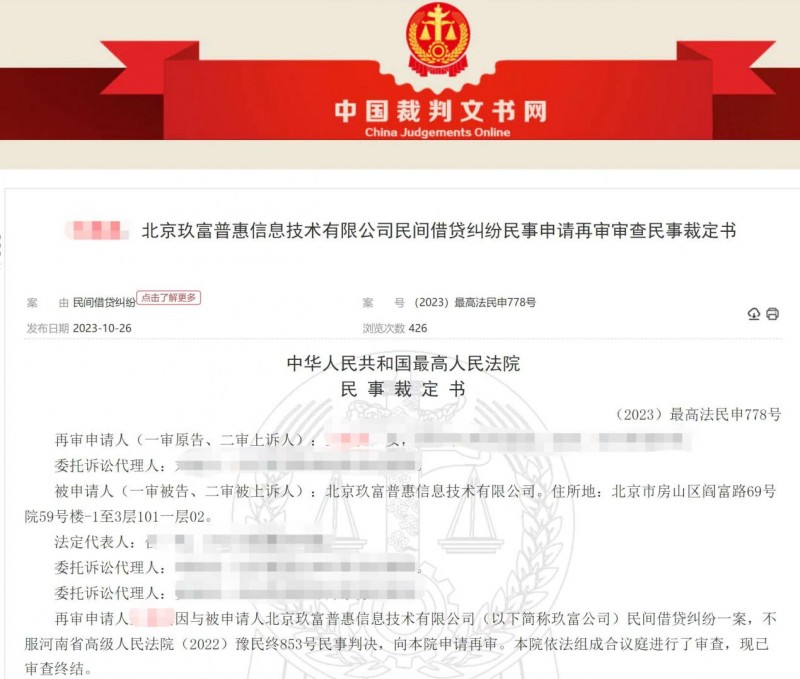
最高院明确玖富与出借人为中介合同关系 驳回出借人再审申请
Cai Fu Zai Xian· 2025-11-14 03:33
Core Viewpoint - The recent court ruling highlights that P2P lending platforms, such as Jiufu Puhui, are classified as information intermediaries and are not liable for repayment to lenders, as they do not engage in direct lending relationships [1][3]. Group 1: Legal Context - According to Chinese laws and regulations regarding private lending and online lending management, P2P platforms are not considered actual borrowers [1]. - In a case involving a lender named Wang, the court ruled that there was no established private lending contract between Wang and Jiufu Puhui, affirming the platform's role as an intermediary [1]. Group 2: Court Ruling Details - The Supreme Court determined that Wang did not actually lend money to Jiufu Puhui, nor did Jiufu Puhui lend money to borrowers, thus establishing a contractual relationship based on intermediary services [1]. - The court rejected Wang's claim for repayment, stating that Jiufu Puhui is not legally obligated to repay the loan amount [1]. Group 3: Industry Practices - P2P lending platforms utilize big data and artificial intelligence to effectively match funding supply and demand, addressing the challenges faced by small enterprises and individual borrowers [3]. - Some platforms are now implementing localized collection lawsuits to enhance recovery efforts from overdue borrowers, which is seen as a positive development for lenders [3].