
《卢克明的偷偷一笑》

Search documents
2026,文学大师开始在评论区“营业”
3 6 Ke· 2026-01-27 03:11
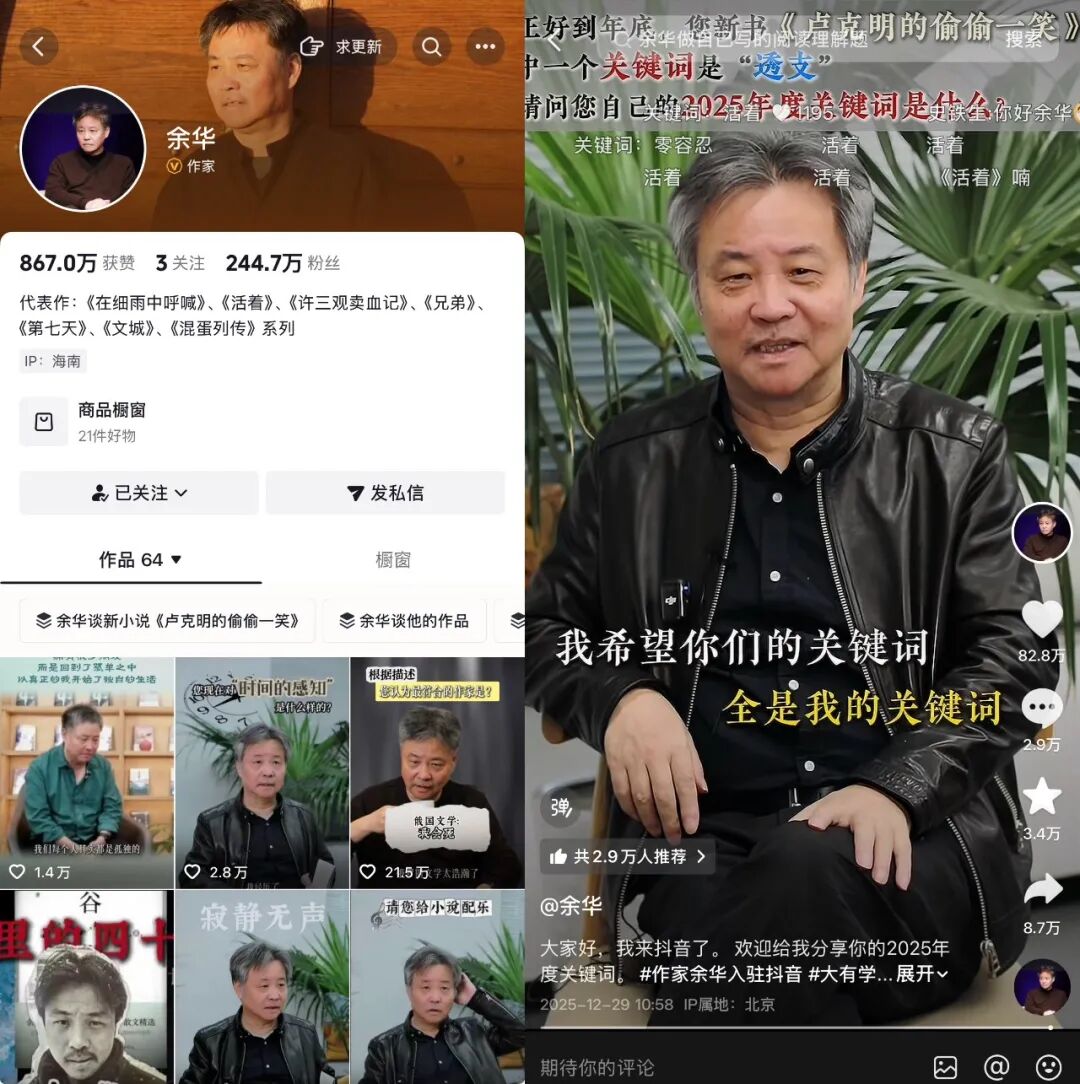
Core Viewpoint - The collective entry of literary masters like Yu Hua and Mo Yan into social media platforms signifies a strategic adaptation to modern communication methods, aiming to engage younger audiences and promote new works effectively [6][12][20] Group 1: Social Media Engagement - Yu Hua's entry into Douyin has garnered significant attention, with one video receiving over 800,000 likes and trending hashtags reflecting the humorous interactions in the comments [3][8] - The informal and relatable interaction style of Yu Hua has resonated with younger audiences, making him appear more approachable and less distant than traditional literary figures [10][16] - Other literary figures, such as Mo Yan and Liu Zhenyun, are also utilizing social media to connect with audiences, indicating a broader trend among cultural icons to embrace digital platforms for engagement [10][12] Group 2: Promotion of New Works - The entry of these authors into social media is often linked to the promotion of new publications, with Yu Hua's latest book being launched on Douyin, highlighting the need for modern marketing strategies [12][16] - Sales data indicates that Yu Hua's works have sold over 4 million copies on Douyin's e-commerce platform in 2024 and 2025, showcasing the effectiveness of social media in driving book sales [14] - The shift in reading habits from traditional bookstores to digital platforms is evident, as social media provides a more efficient means of reaching potential readers [16][19] Group 3: Cultural Impact and Platform Evolution - The presence of literary masters on social media is transforming these platforms into hubs for professional content, enhancing their cultural ecosystem and attracting user engagement [17][19] - Social media is not merely a space for entertainment but is evolving into a significant channel for cultural dissemination, allowing classic literature to be presented in a more relatable manner [17][20] - The collaboration between literary figures and social media platforms is mutually beneficial, enhancing content quality while providing readers with easier access to classic works [19][20]

新民艺评|王宏就像看了部爽剧
Xin Lang Cai Jing· 2026-01-11 06:53
Core Viewpoint - Yu Hua's new work "The Secret Smile of Luke Ming" is perceived as a departure from his previous literary achievements, receiving mixed reviews and a low rating of 4.8 on Douban, leading some critics to view it as a setback in his career [3][5]. Summary by Sections Narrative and Characterization - The protagonist, Luke Ming, is depicted as a thoroughly unscrupulous character, lacking any moral integrity, and is characterized as a "little devil" in the business world [5][10]. - His wife, Lan Ying, initially a shy bank manager, is manipulated into marrying him, only to later discover his infidelities and deceitful nature [5][8]. Economic Context - Luke Ming's rise to wealth coincides with China's rapid economic growth in the early 2000s, where he amassed significant wealth in a short period [6][10]. - As the economy begins to decline, Luke's true nature starts to emerge, revealing his ruthless business tactics and lack of empathy [8][10]. Plot Development - The narrative includes a significant plot where Luke Ming uses cunning strategies to avoid financial repercussions, such as orchestrating the arrest of his employees to justify their dismissal [8][12]. - The book's humor is highlighted, with moments of dark comedy that evoke both laughter and reflection on the character's moral failings [10][12]. Literary Style and Themes - Yu Hua employs a straightforward and impactful writing style, focusing on storytelling rather than intricate psychological exploration, reminiscent of classic literature featuring morally ambiguous characters [12][14]. - The ending suggests a critique of traditional moral narratives, as Luke Ming faces no consequences for his actions, prompting readers to question the nature of justice in literature [14][15].

制造余华,反对余华
3 6 Ke· 2025-12-29 09:20
Core Viewpoint - Yu Hua's new book "A Secret Smile of Luke Ming" has received a low rating of 5.3 on Douban, indicating a disconnect between the author's previous acclaim and current reception [1][4]. Group 1: Reader Reception - The rapid criticism from fans reflects a shift in literary consumption, where readers expect immediate engagement with new works rather than a delayed critical analysis [4][17]. - The backlash against Yu Hua's new work highlights the cultural consumption's fast-food nature, leading to a scenario where even established authors face harsh scrutiny for their new releases [5][20]. Group 2: Themes and Content - The novel centers on a middle-aged man, Luke Ming, who engages in multiple extramarital affairs while simultaneously amassing significant wealth, illustrating a morally ambiguous character [5][21]. - The narrative includes themes of sexual addiction and manipulation, with Luke Ming's actions reflecting a critique of contemporary societal values [5][9]. Group 3: Cultural Commentary - The book's failure to resonate with readers may stem from its inability to maintain Yu Hua's cultural icon status, as it diverges from the expectations set by his previous works [20][22]. - The criticism of the book also points to a broader issue in contemporary Chinese literature, where authors struggle to authentically depict urban life and middle-class anxieties [22][23].

又双叒叕上热搜!余华“同款”潦草小狗,来头居然这么大!
Nan Fang Nong Cun Bao· 2025-12-24 12:33
Core Viewpoint - The article discusses the recent surge in popularity of Yu Hua's new work "A Secret Smile from Luke Ming," which has led to the emergence of a "scruffy dog" meme associated with him, capturing the attention of netizens and sparking curiosity about the dog’s breed and background [6][12][15]. Group 1: Yu Hua and the Scruffy Dog - Yu Hua's new book has generated significant online discussion and interest [6]. - The "scruffy dog" meme has become widely shared, with netizens associating it with Yu Hua's laid-back and casual public persona [10][12]. - The dog, which has become a symbol of Yu Hua's image, is a Shih Tzu mix, a breed with a rich history and cultural significance [21][23]. Group 2: History and Popularity of Shih Tzu - The Shih Tzu breed originated in Tibet and was bred from Lhasa and Pekingese dogs, historically serving as temple guard dogs [24][25]. - The breed gained royal favor in China during the Ming and Qing dynasties, often kept as pets by emperors and nobility [33][35]. - The Shih Tzu became popular in Europe and America after being introduced in the 1930s, leading to its status as a beloved pet worldwide [39][40]. Group 3: Recent Achievements of Shih Tzu - Recently, a Shih Tzu named "Fubao" won prestigious awards at the Brussels International Dog Show, showcasing the breed's elegance and charm [48][50]. - The event highlighted the bond between pets and their owners, emphasizing the cultural significance of the breed [55][56]. Group 4: Upcoming Pet Industry Event - The first Greater Bay Area Pet Industry Annual Ceremony will take place from January 15 to 18, 2026, in Guangzhou, featuring top pet grooming experts [67][68]. - Attendees will have the opportunity to learn grooming techniques to enhance their pets' appearance and style [70][71].
