《岳阳楼记》

Search documents
浅谈《对联话》里的几副春联
Xin Lang Cai Jing· 2026-02-12 20:33
Core Viewpoint - The article explores the cultural significance and historical evolution of Spring Festival couplets (春联) in Chinese society, highlighting their role as a living expression of tradition and contemporary sentiment. Group 1: Historical Context - Spring Festival couplets have evolved from ancient traditions, with roots tracing back to texts like "Shan Hai Jing" and the first recorded couplets from the Five Dynasties period [1] - The practice gained prominence during the Ming Dynasty under Zhu Yuanzhang, transforming into a ritual with both cultural and ceremonial significance [1] - The development of couplet literature flourished during the Qing Dynasty, reflecting the integration of these literary forms into daily life across Chinese communities [1] Group 2: Notable Couplets - A couplet by Cao Bingxing reflects the vastness of Xinjiang's landscape and the sentiment of feeling at home in a foreign land, showcasing the emotional depth of couplets [2] - Another couplet by Cao Bingxing expresses the struggles of scholars in high positions, capturing the tension between ambition and contentment [3] - A couplet by Fang Dishan uses clever wordplay to convey the idea that amidst life's complexities, only wine can provide solace, illustrating the blend of traditional and contemporary themes [4] - The couplet by Huang Fuyongwu incorporates modern scientific knowledge, symbolizing the transition from traditional expressions to new ideas, while maintaining a connection to cultural roots [5][6] - Zhang Xinliang's couplet emphasizes the collaborative spirit in business, reflecting the practical concerns of everyday life [7] - Xiong Xiaobai's couplet contrasts the chaotic past with hopeful future aspirations, resonating with common human experiences during the New Year [8] Group 3: Cultural Significance - The article emphasizes that Spring Festival couplets are not merely decorative but serve as a medium for expressing hopes, reflections, and cultural identity [1][8] - They encapsulate a range of emotions from celebration to introspection, illustrating the dynamic relationship between tradition and modernity [8] - The enduring nature of couplets signifies a continuous dialogue between past and present, highlighting the universal human desire for renewal and hope during the New Year [8]
文博日历丨他没去过岳阳楼,却写出千古名篇
Yang Shi Xin Wen· 2025-05-09 01:34
Group 1 - The article discusses the significance of a jade seal believed to have been used by Fan Zhongyan, a prominent figure in Chinese history, particularly known for his literary work "The Yueyang Tower" [4][11] - The seal features a turtle-shaped knob and inscriptions that read "Fan Zhongyan Seal," showcasing the craftsmanship and historical value of the artifact [6][9] - Fan Zhongyan is portrayed as a multifaceted individual—politician, military strategist, and literary figure—whose contributions to literature and governance have left a lasting impact [12][15] Group 2 - The article highlights Fan Zhongyan's famous quote reflecting his deep concern for the state and its people, emphasizing his philosophy of prioritizing the welfare of the nation over personal joy [15] - The relationships Fan Zhongyan had with contemporaries like Ouyang Xiu and Su Shi are noted, illustrating the respect and admiration he garnered from other notable figures of his time [16][17] - The article also mentions the collaborative efforts of Fan Zhongyan and Han Qi in the political reforms known as the Qingli New Policies, showcasing their shared vision for governance [18]

孝妇河畔名士多
Qi Lu Wan Bao· 2025-04-29 21:32
Core Viewpoint - The article highlights the cultural richness and historical significance of the Xiaofu River and its surrounding areas, emphasizing the contributions of notable figures such as Fan Zhongyan, Wang Shizhen, and Pu Songling to the literary heritage of the region [5][10][12]. Group 1: Historical Significance - The Xiaofu River, despite its modest length of 135.9 kilometers, has been a cradle of culture and learning, producing numerous scholars and literary figures throughout history [5][6]. - Notable figures from the Xiaofu River region include 224 Jinshi (highest degree holders), 34 Wujinshi (military degree holders), and 505 Juren (provincial degree holders) during the Ming and Qing dynasties [4]. Group 2: Cultural Contributions - Fan Zhongyan, a prominent literary figure, is celebrated for his works that reflect deep concern for the people, with his famous line "Worry before the world worries, and rejoice after the world rejoices" [4][5]. - Wang Shizhen, known as "Yuyang," made significant contributions to poetry and literature, with his works still recognized today [11]. - Pu Songling, author of "Strange Stories from a Chinese Studio," faced numerous challenges in his literary career but ultimately gained recognition for his unique storytelling [12][13]. Group 3: Legacy and Influence - The cultural legacy of the Xiaofu River is preserved through memorials and sites dedicated to these literary figures, such as the Fan Gong Temple and the residence of Zhao Zhixin [9][10]. - The interactions between Wang Shizhen and Pu Songling illustrate the rich literary environment of the region, showcasing the mutual respect and influence among scholars [12][13].
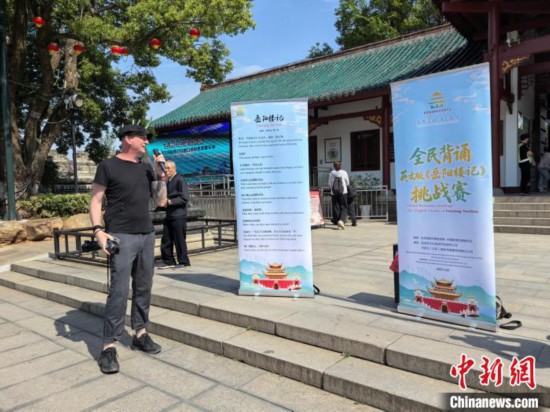
全民背诵英文版《岳阳楼记》挑战赛在湖南岳阳举行
Zhong Guo Xin Wen Wang· 2025-04-27 01:13
Core Viewpoint - The event of reciting the English version of "Yueyang Tower" took place in Yueyang, Hunan, attracting participants from various countries, including the UK, Russia, and the Czech Republic, showcasing cultural exchange and appreciation for Chinese literature [1][2]. Group 1: Event Details - The recitation challenge was held on the 26th of the month, drawing overseas friends, local university students, and tourists [1]. - The event is part of a broader initiative to promote cultural exchange and appreciation for classical Chinese literature through immersive experiences [4]. Group 2: Historical and Cultural Significance - Yueyang Tower, one of China's four famous ancient towers, was originally built in the Eastern Han Dynasty and has become a significant site for literary and cultural activities since the Tang Dynasty [2]. - The famous essay "Yueyang Tower" by Fan Zhongyan has elevated the tower's status beyond its architectural significance, embodying a spirit of collective concern and joy [2]. Group 3: Participant Experiences - Participants, including a Russian photographer and a Shanghai citizen, expressed curiosity and admiration for the cultural significance of the tower and the essay, highlighting the universal themes present in the text [2][4]. - The event has previously included initiatives like free admission for reciting "Yueyang Tower," aiming to awaken cultural awareness among the public [4]. Group 4: Future Initiatives - The event serves as a promotional activity for the upcoming Fourth Hunan Tourism Development Conference, with a global video recitation challenge already attracting participation from overseas Chinese communities [4].