
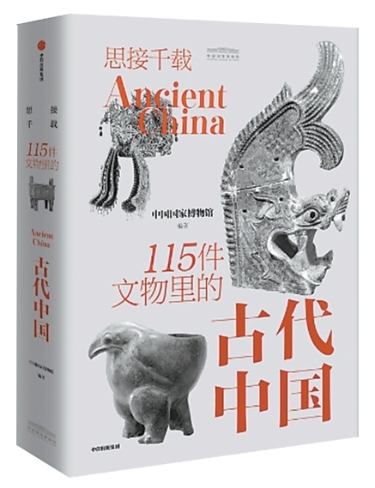
《思接千载:115件文物里的古代中国》

Search documents
卷中藏文韵 书香伴新春
Xin Lang Cai Jing· 2026-02-11 22:53
Group 1 - The core viewpoint emphasizes the importance of reading in building a culturally rich society and enhancing national cultural literacy, highlighted by the implementation of the "National Reading Promotion Regulations" on February 1 [1] - The publication "The Six Dialogues of Party History" records significant discussions by Mao Zedong during the New Democratic Revolution, reflecting the core values and experiences of the Communist Party of China [1] - The book "Innovation and Practicality Promote Development" addresses key theoretical issues such as the impact of artificial intelligence on the economy and the promotion of private sector growth [2] Group 2 - "The Economic History of the People's Republic of China" showcases the remarkable economic achievements under the leadership of the Communist Party over the past 70 years [2] - The book "Awakening: Science and Scientists in the War of Resistance" highlights the contributions of Chinese scientists during the Anti-Japanese War, showcasing their integration of Western technology with national needs [3] - "My War Story: Oral Histories of 20 Anti-Japanese Veterans" presents personal accounts from veterans, providing a panoramic view of the war efforts and experiences of the Eighth Route Army [3] Group 3 - "The Great Battlefield: Field Investigation Notes on the Anti-Japanese War" employs a micro-historical approach to document key battles through field research, enhancing the understanding of the war's realities [4][5] - "Connecting with a Thousand Years: The Cultural Heritage of Chinese Libraries" explores the significance of libraries in preserving Chinese cultural heritage and their evolution from private collections to public institutions [6] - "Thinking Across Millennia: 115 Artifacts of Ancient China" presents a selection of artifacts to help readers understand the origins and development of Chinese civilization [7] Group 4 - "Poetry China" and "Chinese Painting: From Yuan to Qing" offer insights into traditional Chinese poetry and painting, showcasing their historical significance and cultural richness [8] - "Humanity's Broad House" by Chen Yan delves into the complexities of human nature through narratives based on personal experiences during the 1990s housing allocation [10] - "The Salty Joke" by Liu Zhenyun uses humor to reflect on ordinary people's lives, illustrating the resilience and adaptability of individuals in the face of life's challenges [11] Group 5 - "Double Medicine" recounts the historical battle against malaria, emphasizing the role of traditional medicine in modern breakthroughs [12] - "Wukong's Journey: China's Plan for Dark Matter Exploration" details the development of the "Wukong" satellite, symbolizing China's advancements in scientific research [13] - "The World Inside China" provides a comprehensive view of Chinese civilization from a global perspective, highlighting its historical and cultural significance [14]
感受文明不息的脉动(序与跋)
Ren Min Ri Bao· 2025-06-12 22:10
Core Perspective - The book "Thinking Across Millennia: Ancient China in 115 Artifacts" invites readers to explore the ancient Chinese world through significant artifacts, showcasing the continuous and rich history of Chinese civilization [2][3]. Group 1: Exhibition Overview - The "Ancient China" exhibition at the National Museum of China attracts around 7 million visitors annually, featuring over 2,000 artifacts across a 10,000 square meter space [3]. - This exhibition is the only systematic display of the continuous and splendid civilization of the Chinese nation, serving as a model for the creative transformation and innovative development of traditional Chinese culture [3]. Group 2: Book Details - The book features 115 selected artifacts from the "Ancient China" exhibition, compiled by experienced museum educators and reviewed by over 20 renowned scholars [4]. - It includes nearly 700 high-definition images and 350 related artifacts, providing a comprehensive understanding of Chinese history and culture [4]. Group 3: Cultural Significance - The book aims to help readers understand the continuity, innovation, unity, inclusiveness, and peace of Chinese civilization, addressing fundamental questions about identity and heritage [4]. - It serves as a key to exploring Chinese civilization, encouraging readers to become witnesses and narrators of history [4].

2024年全国博物馆接待观众14.91亿人次,文创产品销售收入34.28亿元
Zhong Guo Chan Ye Jing Ji Xin Xi Wang· 2025-05-26 03:16
Core Insights - The museum sector in China is experiencing significant growth, with a total of 7,046 registered museums by the end of 2024, an increase of 213 from the previous year, achieving a ratio of one museum for every 200,000 people, and a free admission rate of 91.46% [1] - In 2024, museums across the country hosted 43,000 exhibitions and 511,000 educational activities, attracting 1.491 billion visitors, a year-on-year increase of 15.5% [1] - The sales revenue from cultural and creative products reached 3.428 billion yuan in 2024, marking a year-on-year growth of 63.7% [1] Museum Engagement - The "Museum Fever" is on the rise, with more audiences visiting museums, particularly the National Museum of China, which received nearly 7 million visitors in 2024, with over 6.8 million visiting the "Ancient China" exhibition [3][4] - The launch of the book "Thinking Across the Ages: 115 Artifacts in Ancient China" aims to enhance public understanding of Chinese civilization and is part of the effort to make museum experiences more accessible [2][3] Cultural and Creative Development - Museums are increasingly developing cultural and creative products to engage audiences and generate revenue, with the National Museum of China launching a series of products based on its exhibitions [6][8] - The Beijing Museum Season, running from May 18 to October 8, 2024, will feature a "Cultural and Creative Month" with various activities aimed at integrating museum experiences into daily life [7] Economic and Social Impact - The development of cultural and creative products can convert visitor traffic into revenue, providing significant economic benefits while also enhancing educational experiences for visitors [8] - The ongoing "Museum Fever" reflects a mutual engagement between traditional culture and audiences, suggesting that museums are evolving from mere storage of history to active participants in daily life and cultural transmission [8]