《时空弹性》

Search documents
强化艺术智性与人工智能的协同
Ren Min Ri Bao· 2025-11-15 21:51
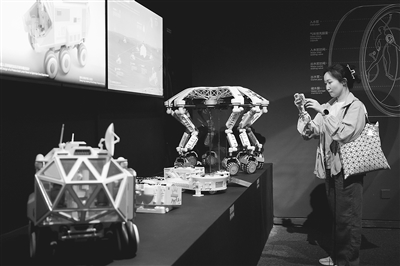
Core Insights - The article discusses the integration of art and science, emphasizing their mutual influence in advancing human society, particularly through the "China (Hangzhou) International Art and Technology Biennale" themed "Heaven, Earth, Human, and Machine" [2][5] - The event showcases over 160 artists and scientists from more than 20 countries, reflecting on cultural ecology's reconstruction and future prospects in the context of technological evolution [2][3] Group 1: Exhibition Themes - The biennale features four main sections: "Connection: Embodied Interaction," "Symbiosis: Digital Education," "Conjecture: Ecological Reconstruction," and "Declaration: Philosophical Inquiry," creating a multidimensional dialogue on the theme [2] - Notable works include interactive installations and wearable devices that allow audiences to experience the "human-machine connection," highlighting the shift from static art appreciation to dynamic co-creation [3] Group 2: Focus on Global Issues - The exhibition addresses global challenges such as climate crisis and technology misuse, with a focus on biotechnological speculation, sustainable design, and ecological philosophy [3] - Works like "Post-Insect Atlas: Beetle Prophecy" by domestic artist Xing Shangmei reflect on ecological crises through gene editing aesthetics, indicating that advanced technologies can both solve and exacerbate ecological issues [3] Group 3: Ethical and Philosophical Reflections - Several artworks challenge conventional narratives and provoke critical thinking about technology ethics and human existence, responding to the fundamental missions of art and science [4] - The biennale aims to initiate deep dialogues between humanities and technology, showcasing works that transition technology's role from merely recording cultural heritage to activating cultural life [4] Group 4: Future Prospects - The exhibition suggests a trend where art and science collaborate to explore the universe and expand unknown boundaries, with works like "Computational Satellite Model" and "Spacetime Elasticity" exemplifying this partnership [4] - The overarching mission of art and science remains the discovery of the world and humanity, inviting participants to engage in a dialogue that spans five millennia of civilization and future possibilities [5]

科学融合艺术,认知宇宙有了新“打开方式”
Ke Ji Ri Bao· 2025-07-03 00:52
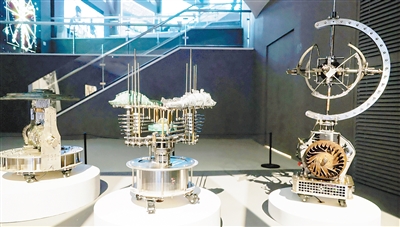
Core Viewpoint - The exhibition "Cosmic Archaeology: Time and Space Exploration" merges science and art to provide a new way for the public to understand the universe, showcasing interactive models and visualizations based on real astronomical data [1][3]. Group 1: Exhibition Overview - The exhibition is organized by the National Museum of China, the Swiss Embassy in China, and the Swiss Federal Institute of Technology in Lausanne, with collaboration from Tsinghua University's Department of Astronomy and Academy of Arts [3]. - It opened on July 2 and was officially opened to the public on July 3 at the National Museum of China [3]. Group 2: Interactive Installations - The exhibit "Dynamic Universe" utilizes a custom graphics rendering engine to transform vast astronomical data into interactive 3D models, allowing visitors to explore the universe across 27 orders of magnitude [4]. - "Cosmic Collision" is an interactive astrophysical visualization system that uses approximately 500 deep-space images from NASA telescopes to visualize phenomena like spiral nebula structures and galaxy collisions [4]. - The "Time-Space Elasticity" project visualizes gravitational lensing effects, providing a real-time simulation engine based on actual astronomical observation data [4]. Group 3: Themes and Reflections - The exhibition aims to make the invisible visible, transforming abstract cosmic data into understandable images and representations [5]. - It raises awareness about the sustainability of space exploration, highlighting the increasing amount of space debris from satellites and spacecraft [5]. - An interactive data visualization device presents the dynamic visualization of thousands of satellites and space debris, prompting a reconsideration of how to explore and manage space resources [5]. Group 4: Educational Aspects - The exhibition features works designed by students from Tsinghua University's Academy of Arts for future planetary journeys, emphasizing the integration of scientific thinking and experimental design [6]. - The curators believe that art serves as an effective medium to narrate scientific stories, making complex scientific data more accessible and relatable to the general public [6].