
《浴马图》

Search documents
古画里的骏影
Xin Lang Cai Jing· 2026-02-16 17:14
Core Viewpoint - The article explores the artistic representation of horses in ancient Chinese paintings, highlighting the emotional and cultural significance of horses across different dynasties, specifically through the works of Han Gan, Zhang Xuan, and Zhao Mengfu. Group 1: Artistic Techniques and Styles - Han Gan's "The Horse and the Official" is noted for its realism, showcasing detailed anatomical understanding and dynamic features of horses, emphasizing strength and vitality [1][3] - Zhao Mengfu's "Bathing Horses" exemplifies the expressive style, focusing on the rhythm of brushwork and the creation of an aesthetic atmosphere, simplifying horse forms into flowing lines [2][3] - The transition from realism to expressiveness in these artworks reflects the evolution of ancient painting techniques and a deeper understanding of beauty [3] Group 2: Cultural and Social Reflections - Zhang Xuan's "The Lady Guo's Spring Outing" captures the luxurious lifestyle of the Tang nobility, portraying a scene that reflects both the opulence of the era and a social philosophy of enjoying life with the people [4] - In contrast, Zhao Mengfu's "Bathing Horses" signifies a shift in artistic focus from aristocratic representation to a more personal and naturalistic expression, illustrating the scholar-official's connection to nature [4] - The three paintings collectively convey a timeless truth about art's value in recording history, celebrating beauty, and inspiring future generations [4]
马留史迹 从古今文物到岁月驰骋
Xin Lang Cai Jing· 2026-02-12 22:40
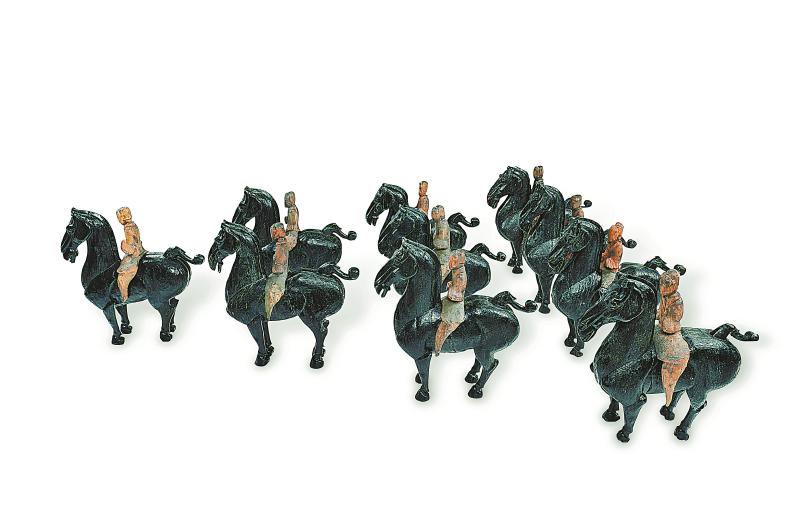
Core Viewpoint - The article highlights the significance of horse-related artifacts in Chinese history, particularly in Sichuan, showcasing their cultural and historical value through various museums and archaeological findings [5][10]. Group 1: Historical Significance of Horse Artifacts - The horse symbolizes speed, strength, and progress in Chinese culture, with a rich history reflected in numerous artifacts from different dynasties [5]. - The large bronze horse from the Eastern Han dynasty, discovered in Mianyang, is a notable example, measuring 110 cm in length and 134 cm in height, showcasing the craftsmanship of the era [6]. - The bronze horse and accompanying figurines exemplify the importance of horses in ancient Chinese society, serving as symbols of status and power [9]. Group 2: Archaeological Discoveries - The bronze chariot and horse, unearthed in Ziyang, is recognized as the largest Western Han bronze chariot horse, measuring 1.84 meters in length, and is significant for understanding transportation in the Han dynasty [7][8]. - Numerous horse-related artifacts have been found in Sichuan, including a collection of 66 lacquered wooden horses from the Han tombs, emphasizing the region's rich archaeological heritage [9]. - The discovery of a three-wheeled bronze horse cart model in the Salt Source Old Dragon Head cemetery is noted as the earliest of its kind in China, contributing to the understanding of ancient transportation [12]. Group 3: Cultural Representation - Horse artifacts serve as keys to deciphering historical narratives, with items like the horse-drawn carriage depicted in the Eastern Han image brick reflecting the social status of officials [10][11]. - The artistic representation of horses in Chinese painting, from ancient to modern times, illustrates their cultural significance, with notable works by artists like Xu Beihong symbolizing strength and freedom [14][15].

赵孟頫书院揭牌仪式暨“风樯阵马”书法展开幕活动举行
Xin Lang Cai Jing· 2026-02-04 23:41
Core Viewpoint - The establishment of the Zhao Mengfu Academy aims to promote and preserve Chinese calligraphy, leveraging the historical and cultural resources of Huzhou, the birthplace of Zhao Mengfu [1] Group 1: Event Overview - The Zhao Mengfu Academy was inaugurated alongside the "Wind and Flag Array Horse" calligraphy exhibition, attended by local government officials [1] - The event highlights the significance of calligraphy as an essential part of Chinese culture and Huzhou's cultural identity [1] Group 2: Academy Mission and Activities - The academy is a collaborative initiative between Huzhou Urban Group and Shenzhen Yimu Public Welfare Foundation, focusing on the inheritance of Zhao Mengfu's calligraphy and the promotion of Chinese calligraphy art [1] - Planned activities include academic exchanges, high-quality calligraphy exhibitions, cultural research programs, and the development of cultural products to creatively transform and innovatively develop Zhao Mengfu's calligraphy resources [1]