
《虢国夫人游春图》

Search documents
从博物馆到美术馆 跃马扬鞭踏进马年
Xin Lang Cai Jing· 2026-02-25 17:54
Core Viewpoint - The article highlights the significance of horses in Chinese culture, history, and art, emphasizing their role as symbols of power, vitality, and cultural identity throughout various dynasties and eras [2][4][15]. Group 1: Historical Significance of Horses - Horses have been integral to human civilization since their domestication, serving as partners in hunting and migration, with archaeological evidence dating back 45,000 years [2]. - In ancient China, horses were considered vital for agriculture and warfare, being included in sacrificial rites and depicted in various historical artifacts [2][3]. - The importance of horses is reflected in historical texts, where they are described as essential to national strength and military capability [2][4]. Group 2: Cultural Representations of Horses - The artistic representation of horses spans from ancient rock paintings to modern artworks, showcasing their significance in various cultural contexts [9][12]. - Notable examples include the "Copper Galloping Horse" from the Han Dynasty, which exemplifies advanced bronze casting techniques and symbolizes the spirit of the era [3][4]. - The depiction of horses in literature and art reflects their multifaceted roles in society, from symbols of nobility to representations of everyday life [11][15]. Group 3: Horses in Folklore and Beliefs - Horses are deeply embedded in Chinese mythology and folklore, often associated with auspicious meanings and cultural practices, such as the zodiac [13][14]. - The concept of horses as protectors and symbols of good fortune is prevalent in various cultural artifacts, including decorations and games [14][15]. - The integration of horses into daily life and celebrations illustrates their enduring significance in Chinese culture, representing vitality and progress [15].
古画里的骏影
Xin Lang Cai Jing· 2026-02-16 17:14
Core Viewpoint - The article explores the artistic representation of horses in ancient Chinese paintings, highlighting the emotional and cultural significance of horses across different dynasties, specifically through the works of Han Gan, Zhang Xuan, and Zhao Mengfu. Group 1: Artistic Techniques and Styles - Han Gan's "The Horse and the Official" is noted for its realism, showcasing detailed anatomical understanding and dynamic features of horses, emphasizing strength and vitality [1][3] - Zhao Mengfu's "Bathing Horses" exemplifies the expressive style, focusing on the rhythm of brushwork and the creation of an aesthetic atmosphere, simplifying horse forms into flowing lines [2][3] - The transition from realism to expressiveness in these artworks reflects the evolution of ancient painting techniques and a deeper understanding of beauty [3] Group 2: Cultural and Social Reflections - Zhang Xuan's "The Lady Guo's Spring Outing" captures the luxurious lifestyle of the Tang nobility, portraying a scene that reflects both the opulence of the era and a social philosophy of enjoying life with the people [4] - In contrast, Zhao Mengfu's "Bathing Horses" signifies a shift in artistic focus from aristocratic representation to a more personal and naturalistic expression, illustrating the scholar-official's connection to nature [4] - The three paintings collectively convey a timeless truth about art's value in recording history, celebrating beauty, and inspiring future generations [4]
马留史迹 从古今文物到岁月驰骋
Xin Lang Cai Jing· 2026-02-12 22:40
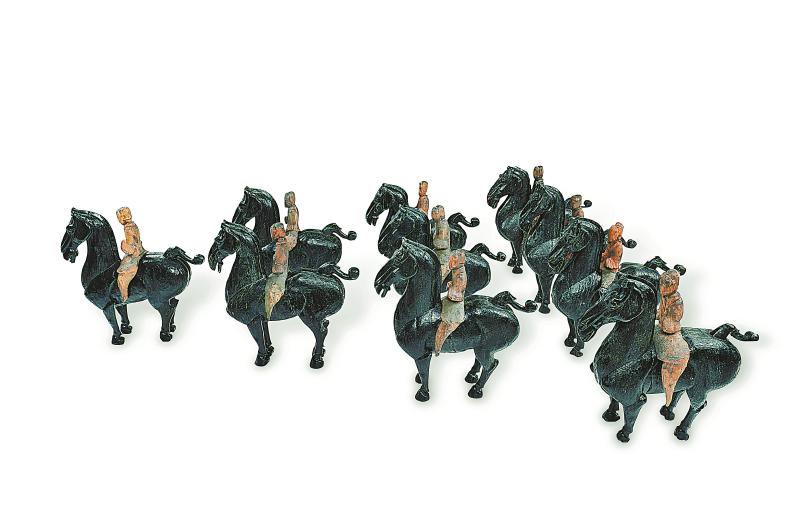
Core Viewpoint - The article highlights the significance of horse-related artifacts in Chinese history, particularly in Sichuan, showcasing their cultural and historical value through various museums and archaeological findings [5][10]. Group 1: Historical Significance of Horse Artifacts - The horse symbolizes speed, strength, and progress in Chinese culture, with a rich history reflected in numerous artifacts from different dynasties [5]. - The large bronze horse from the Eastern Han dynasty, discovered in Mianyang, is a notable example, measuring 110 cm in length and 134 cm in height, showcasing the craftsmanship of the era [6]. - The bronze horse and accompanying figurines exemplify the importance of horses in ancient Chinese society, serving as symbols of status and power [9]. Group 2: Archaeological Discoveries - The bronze chariot and horse, unearthed in Ziyang, is recognized as the largest Western Han bronze chariot horse, measuring 1.84 meters in length, and is significant for understanding transportation in the Han dynasty [7][8]. - Numerous horse-related artifacts have been found in Sichuan, including a collection of 66 lacquered wooden horses from the Han tombs, emphasizing the region's rich archaeological heritage [9]. - The discovery of a three-wheeled bronze horse cart model in the Salt Source Old Dragon Head cemetery is noted as the earliest of its kind in China, contributing to the understanding of ancient transportation [12]. Group 3: Cultural Representation - Horse artifacts serve as keys to deciphering historical narratives, with items like the horse-drawn carriage depicted in the Eastern Han image brick reflecting the social status of officials [10][11]. - The artistic representation of horses in Chinese painting, from ancient to modern times, illustrates their cultural significance, with notable works by artists like Xu Beihong symbolizing strength and freedom [14][15].

人民日报聚焦辽博展出《虢国夫人游春图》等名作:三百亿像素,览诗画意境
Ren Min Ri Bao· 2026-01-30 01:53
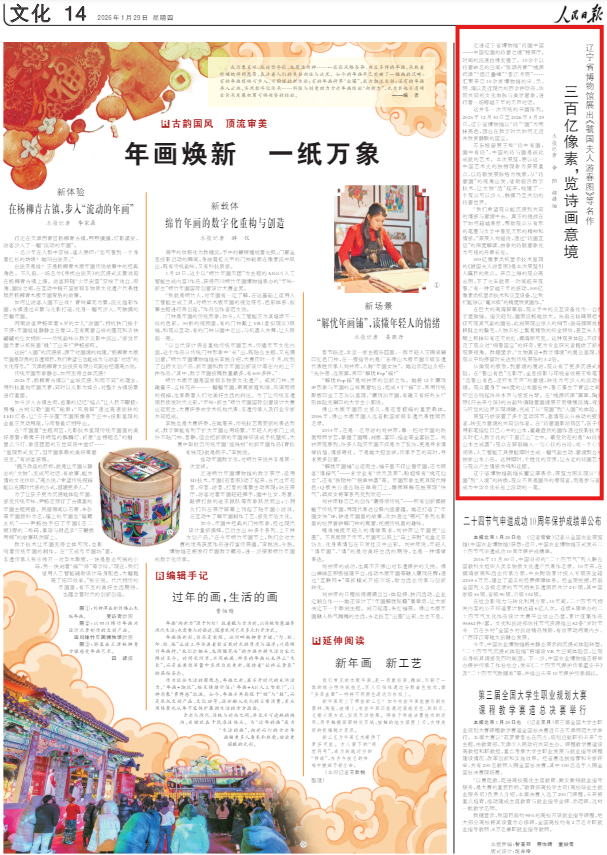
Core Viewpoint - The exhibition "Poetic China - The Poetic Realm of Chinese Painting" at the Liaoning Provincial Museum showcases over a hundred treasures from various dynasties, utilizing advanced digital technology to enhance the appreciation of traditional art and engage audiences in a more immersive experience [4][9]. Group 1: Exhibition Overview - The exhibition runs from December 30, 2025, to March 29, 2026, featuring a dialogue across centuries through the lens of poetry and painting [4]. - It includes over ten themed spaces named after poetic concepts, presenting artifacts from the Song, Yuan, Ming, Qing, and modern periods [4]. Group 2: Technological Integration - The use of 300 billion pixel display technology allows for unprecedented detail in viewing artworks, significantly enhancing the audience's experience [9]. - Interactive devices enable viewers to explore artworks at a microscopic level, increasing the average viewing time to 3.2 times that of traditional exhibitions [9]. Group 3: Immersive Experience - The exhibition transforms traditional viewing into an immersive experience, allowing visitors to step into a 360-degree landscape inspired by Wang Wei's poetry [10]. - Interactive elements invite visitors to become co-creators, such as drawing in the "Poetic Painting Shadow Doodle Area" and using an AI tool to generate personalized landscape art based on their input [10]. Group 4: Cultural Engagement - The exhibition aims to shift the audience's role from passive observers to active participants, fostering a deeper emotional connection with Chinese cultural heritage [10].
一周展讯|最近不少展览都跟马有关
Xin Lang Cai Jing· 2026-01-12 00:08
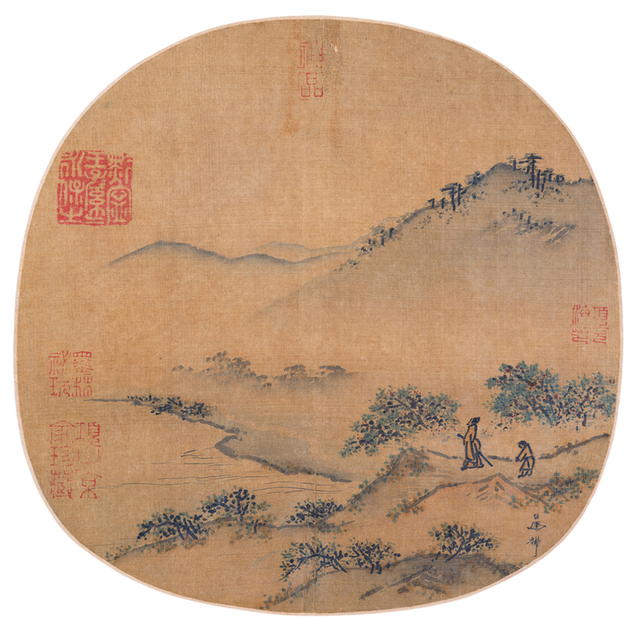
Group 1 - The article highlights various cultural exhibitions in Shanghai and other regions, showcasing significant artworks and historical artifacts [1][2][4][5][7][9][11][13][15][17][19][21][22][25][26][29][31][34][36][38][40][41][43][44][46][49][51][53][55][57][58][60][61][63][65][67][69][71][72][74][76][78][79][81][82][84][86][88][89][91][92][96][98][100][102][103][107][110][112][113][115][117][118] - The Shanghai Museum is hosting the "至扇至美" exhibition featuring historical fan paintings from various dynasties, running from November 14, 2025, to February 22, 2026 [2][4] - The "广东美术百年大展" at the Shanghai Art Museum presents around 800 pieces of Guangdong art, concluding on January 18, 2026 [5][7] - The "海昏侯大展" at the Beijing Lu County Museum displays artifacts related to the Han Dynasty, including gold items that reflect the economic landscape of the time [40] - The "春风得意马蹄疾" exhibition at the Hohhot Museum focuses on horse culture, featuring 145 exquisite artifacts [1][43] - The "奔腾尺幅间" exhibition at the Xu Beihong Memorial Museum showcases horse-themed artworks from various dynasties, including nearly 50 works by Xu Beihong [1][41] Group 2 - The article mentions multiple exhibitions across different provinces, including the "异趣同辉" exhibition in Shanghai, which features Qing Dynasty export art [15] - The "江口沉银" exhibition in Hangzhou highlights ancient gold and silver artifacts from the late Ming Dynasty [71] - The "碗礁瓷语" exhibition in Xi'an focuses on porcelain recovered from a sunken ship, illustrating maritime trade along the Silk Road [105] - The "弘道之行" exhibition in Henan showcases artifacts related to Confucius and the Eastern Zhou period [89] - The "古埃及文明展" in Hong Kong features 250 artifacts from ancient Egypt, emphasizing the civilization's historical significance [113]
辽博“虢国夫人”陪您在“诗情画意”中开启新年
Xin Lang Cai Jing· 2026-01-03 21:17
Core Viewpoint - The annual exhibition "Poetic China - The Poetic Realm of Chinese Painting" at the Liaoning Provincial Museum showcases 115 pieces/groups (210 individual items) of precious cultural relics, attracting significant public interest, particularly for the painting "The Lady of Guo's Spring Outing" [1][2] Exhibition Highlights - The exhibition features various poetic themes such as "Elegant Praise of Danqing," "Peach Orchard Inquiry," "Spring River Moonlight," and "Smoke and Mountains," connecting different periods and authors of poetry and painting, illustrating the poetic continuum of Chinese civilization [2] - "The Lady of Guo's Spring Outing" is highlighted as the most popular piece, with visitors willing to wait up to 45 minutes to view it, reflecting its cultural significance and the pride it instills in viewers [2][3] Cultural Significance - The Deputy Director of the Liaoning Provincial Museum, Dong Baohou, emphasizes that the painting is a remarkable representation of female figures in Chinese art and resonates with the poetic imagery from the Tang Dynasty, enhancing its allure [2][3] - The exhibition also includes a new showcase of 177 lacquerware pieces, illustrating the exquisite craftsmanship and cultural depth of ancient lacquerware, divided into five thematic units [2][3] Creative Products - The museum's creative products, particularly those inspired by "The Lady of Guo's Spring Outing," have become popular as New Year gifts, with items like metal relief refrigerator magnets and "Guo's Elegance Bracelet" gaining significant attention [3][4] - The "Guo's Elegance Bracelet" incorporates traditional color aesthetics and design elements from the painting, appealing particularly to female visitors and enhancing cultural confidence [4]