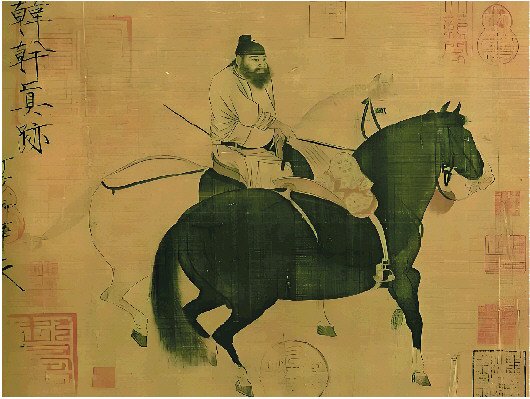
《秋郊饮马图》

Search documents
中国绘画“常青树”!马的艺术形象变化勾勒出深邃文化内涵
Xin Lang Cai Jing· 2026-02-16 22:32
Core Perspective - The article explores the cultural significance of horses in Chinese art, illustrating how the representation of horses has evolved through different life stages and artistic expressions, reflecting deeper cultural values and human experiences [1][10][12]. Group 1: Historical and Cultural Significance - Horses have been a prominent symbol in Chinese art for over 15,000 years, representing identity, power, and spiritual values [1]. - The evolution of horse imagery in Chinese art mirrors the cultural memory and character of the Chinese people, transcending their biological attributes [1][9]. - Early artistic representations of horses, such as those in the Yinshan rock paintings, emphasize a raw, instinctual connection to nature, similar to children's imaginative depictions [8]. Group 2: Children's Perception of Horses - Children view horses as magical and pure beings, often depicted in vibrant colors and whimsical contexts, such as in fairy tales and games [6][7]. - Their artistic expressions of horses lack burdens and constraints, focusing instead on freedom and joy, reflecting their emotional projections [7][10]. Group 3: Horses in Different Life Stages - As individuals mature, their perception of horses shifts from whimsical companions to symbols of responsibility and ideals, embodying qualities like loyalty and perseverance [10][12]. - Artistic representations of horses in adulthood, such as in works by Han Gan and Li Gonglin, highlight their practical value and aesthetic beauty, reflecting the realities of life [10][11]. Group 4: Modern Interpretations - In modern times, the portrayal of horses has transitioned from practical utility to a representation of contemporary ideals, as seen in Xu Beihong's works, which combine Western techniques with traditional Chinese aesthetics [11][17]. - Xu Beihong's horse paintings serve as a spiritual symbol of resilience and hope during challenging times in Chinese history, reflecting the national spirit [18][19].

赵孟頫书院揭牌仪式暨“风樯阵马”书法展开幕活动举行
Xin Lang Cai Jing· 2026-02-04 23:41
Core Viewpoint - The establishment of the Zhao Mengfu Academy aims to promote and preserve Chinese calligraphy, leveraging the historical and cultural resources of Huzhou, the birthplace of Zhao Mengfu [1] Group 1: Event Overview - The Zhao Mengfu Academy was inaugurated alongside the "Wind and Flag Array Horse" calligraphy exhibition, attended by local government officials [1] - The event highlights the significance of calligraphy as an essential part of Chinese culture and Huzhou's cultural identity [1] Group 2: Academy Mission and Activities - The academy is a collaborative initiative between Huzhou Urban Group and Shenzhen Yimu Public Welfare Foundation, focusing on the inheritance of Zhao Mengfu's calligraphy and the promotion of Chinese calligraphy art [1] - Planned activities include academic exchanges, high-quality calligraphy exhibitions, cultural research programs, and the development of cultural products to creatively transform and innovatively develop Zhao Mengfu's calligraphy resources [1]
笔墨为谁嘶鸣?马到自然成功!
Xin Lang Cai Jing· 2026-01-16 18:02
Core Perspective - The upcoming Year of the Horse in the Chinese lunar calendar highlights the deep cultural significance of horses in Chinese art and history, symbolizing strength, speed, freedom, and loyalty [2]. Group 1: Historical Significance of Horses - The relationship between humans and horses began with practical uses but evolved into a cultural and artistic phenomenon, with horses symbolizing power and dreams throughout Chinese history [3]. - Horses have been depicted in various historical contexts, from the mythological tales of the Zhou Dynasty to the grand terracotta army of the Qin Dynasty, reflecting their association with authority and ambition [3][4]. Group 2: Cultural Symbolism - In folk culture, horses represent auspiciousness and are associated with success and vitality, forming a strong cultural foundation for the emergence of horse paintings [4]. - The artistic representation of horses transcends mere animal depiction, embodying the aesthetic values, aspirations, and collective psyche of the era [4]. Group 3: Golden Age of Horse Paintings - The Tang Dynasty marked a flourishing period for horse paintings, characterized by a vibrant culture and the influx of exotic horses from the West, leading to a widespread appreciation for horses among all social classes [6]. - Two distinct aesthetic realms emerged during this period: one celebrating the wild essence of horses, represented by artists like Wei Yan and Han Huang, and the other reflecting courtly ideals, exemplified by artists like Cao Ba and Han Gan [6][7]. Group 4: Artistic Evolution in Song and Yuan Dynasties - The Song Dynasty brought a cultural shift towards introspection and subtlety, leading to a transformation in horse paintings that incorporated literati aesthetics and historical context [9]. - Artists like Li Gonglin introduced a new style of "fine outline" painting, emphasizing line quality and abstract beauty, which shifted the focus from opulence to elegance in horse art [9][10]. Group 5: Challenges and Innovations in Ming and Qing Dynasties - The Ming and Qing Dynasties saw a decline in the creative vigor of horse paintings, as the rise of literati painting and changing societal tastes diminished the genre's appeal [11]. - However, the Qing Dynasty also witnessed the introduction of Western artistic techniques by artists like Lang Shining, which revitalized horse paintings with new perspectives and dimensionality [11][12]. Group 6: Modern Transformation - In the 20th century, Xu Beihong revolutionized horse painting by integrating Western techniques with traditional Chinese aesthetics, using horses as symbols of resilience and national spirit [13]. - His works often depicted dynamic and powerful horses, reflecting the struggles and aspirations of the Chinese people during tumultuous times, thus elevating horse paintings to a modern symbol of national identity [13].