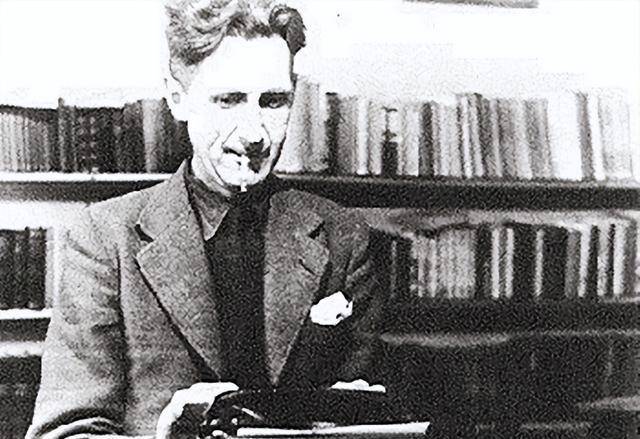
《1984》

Search documents
乔治奥威尔《1984》:身处互联网时代的我们,有自由可言吗?
Sou Hu Cai Jing· 2026-02-02 06:13
Core Perspective - The essence of true freedom is questioned, whether it is the ability to act without constraints or the possession of wealth to fulfill material needs [1][3] Group 1: Historical Context of Freedom - The concept of freedom has been a subject of contemplation since the dawn of human civilization, with various thinkers from ancient Greece to modern times offering differing definitions [3] - George Orwell's "1984" emerged from this ongoing discourse, serving as a profound reflection on human fate and the quest for freedom [5] Group 2: Themes in "1984" - "1984" illustrates a distorted and terrifying future, highlighting deep-seated anxieties in modern society and prompting reflection on the future [6] - The novel vividly depicts a totalitarian society where individual thought is controlled and oppressed, leading to a loss of privacy and the breakdown of human relationships [6][8] - The characters in "1984" live in a state of oppression without any awareness of their subjugation, akin to the metaphor of a frog in boiling water [8] Group 3: Power and Thought Control - Orwell reveals the corrosive nature of power on human thought, emphasizing that absolute power leads to absolute corruption [9] - As power becomes concentrated, individual thought and freedom are severely restricted, resulting in a pathological societal cycle [9] - The most frightening aspect of such a society is not direct violence but the numbness and extinction of thought, leading to an inability to discern truth [9] Group 4: The Nature of True Freedom - True freedom encompasses not just the absence of physical oppression but also the independence of thought and the ability to question everything [13] - In a totalitarian regime, the individual’s capacity for independent thought is stifled, leading to a distorted understanding of freedom [11][13] Group 5: Modern Implications of Freedom - The conveniences brought by modern technology and the internet raise questions about the true nature of freedom, as personal information and privacy become increasingly exposed [15] - The pervasive monitoring in the digital age mirrors the surveillance depicted in "1984," where individual actions are constantly tracked and analyzed [16] - Social platforms and digital environments, while appearing to offer freedom of choice, often manipulate and shape individual behavior and desires [17] Group 6: The Struggle for Individuality - The protagonist Winston in "1984" embodies the struggle against oppressive societal norms, ultimately succumbing to the pressures of conformity [19] - In the information age, individuals may feel like part of the internet, losing fundamental control over their identities and desires [21] - The narrative warns that true freedom should not be defined by external choices but by the ability to think independently and question everything [21]

《呼啸山庄》的色情化改编,将经典变成爱情闹剧?| 文化周报
Xin Lang Cai Jing· 2025-09-14 02:17
Group 1: Venice Film Festival and Political Themes - The film "The Voice of Hind Rajab," directed by Tunisian filmmaker Kaouther Ben Hania, premiered at the Venice Film Festival, receiving a 23-minute standing ovation and winning the Silver Lion award [3] - The film depicts the true story of a 5-year-old Palestinian girl, Hind Rajab, who becomes the sole survivor of an airstrike in Gaza, highlighting the humanitarian crisis in the region [3][5] - The Venice Film Festival has increasingly focused on political and social issues, with films addressing topics such as nuclear weapons and climate disasters, creating a platform for discussing real-world problems [5][6] Group 2: Cultural Boycotts and Industry Reactions - A cultural boycott debate emerged at the festival, with approximately 3,900 film professionals signing a pledge to not collaborate with Israeli film institutions, citing concerns over human rights violations [6][7] - Israeli filmmakers expressed strong opposition to the boycott, arguing it harms those promoting dialogue and understanding, and emphasizing the importance of separating creators from government actions [7] - The festival has become a stage for political discourse, with media describing films as "quasi-urgent response units" that help audiences interpret a chaotic reality [7] Group 3: Alberta Book Ban Controversy - The Alberta government in Canada faced backlash for removing numerous literary works, including "The Handmaid's Tale," from school libraries under the guise of eliminating "explicit content," igniting debates over free speech and educational control [10][11] - Author Margaret Atwood criticized the ban and created a satirical short story in response, highlighting the absurdity of the government's stance on protecting children from literature [8][10] - Following public pressure, the Alberta government announced a pause on the book ban, allowing classic literature to remain in school libraries while clarifying the policy's intent [10][11] Group 4: Controversy Surrounding "Wuthering Heights" Adaptation - The trailer for the film adaptation of "Wuthering Heights," directed by Emerald Fennell, sparked controversy due to its significant deviation from Emily Brontë's original work, described as overly sexualized and lacking depth [12][14] - Critics argue that the adaptation reduces the complex themes of class and family dynamics in the original novel to a simplistic love story, undermining its literary significance [14] - The casting choices, particularly the portrayal of Heathcliff, have also drawn criticism for not aligning with the character's original description, raising concerns about fidelity to the source material [12][14] Group 5: Baillie Gifford Prize Longlist Announcement - The 2025 Baillie Gifford Prize longlist was announced, emphasizing personal narratives and historical insights, with a focus on individual experiences [15][17] - Notable works include Yiyun Li's memoir about her sons' suicides, praised for its unique perspective and emotional depth [15][17] - The prize continues to attract attention due to its sponsorship ties to fossil fuel investments, raising questions about the intersection of literature and ethical considerations [17]
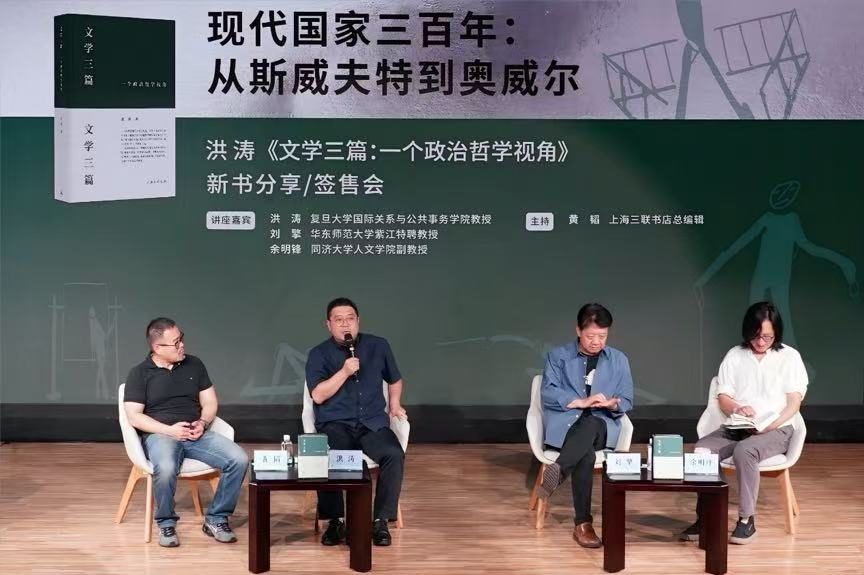
洪涛×刘擎×余明锋:现代国家三百年——从斯威夫特到奥威尔
Xin Lang Cai Jing· 2025-07-15 03:40
Core Insights - The book "Literature Three Essays: A Political Philosophy Perspective" by Professor Hong Tao explores the evolution of modern states over the past 300 years, emphasizing the tension between individuals and the state, which Hobbes referred to as Leviathan [1][19] - The discussion highlights the transformation of individual circumstances due to advancements in natural sciences and technology, leading to a complex relationship between freedom and control in modern governance [19][22] Group 1 - The book is structured around three literary works: "Gulliver's Travels," Kafka's novels, and Orwell's "1984," which serve as lenses to examine contemporary political philosophy issues [1][19] - The author argues that modern individuals are increasingly isolated and manipulated by powerful elites, leading to a societal condition akin to a concentration camp, where ordinary people are marginalized [7][10] - The historical context of modern states is discussed, noting that the 17th and 20th centuries were particularly violent, yet the prevailing narrative suggests that modern states have liberated individuals [8][9] Group 2 - The narrative emphasizes the need for individuals to reclaim their agency in the face of technological control and manipulation, suggesting that modernity has led to a loss of genuine human connection [10][30] - The book critiques the notion of modernity as a linear progression towards freedom, arguing instead that it has often resulted in greater subjugation of individual freedoms under the guise of security and order [26][30] - The author proposes a revival of classical literary concepts to address the shortcomings of contemporary social sciences, advocating for a human-centered approach to understanding political and social issues [13][14]