
东庄水利枢纽工程

Search documents
陕西水利工程建设“火力全开”
Shan Xi Ri Bao· 2026-02-24 00:21
Core Viewpoint - The news highlights the ongoing progress and strategic importance of various water conservancy projects in Shaanxi Province, emphasizing their role in enhancing water resource management, agricultural irrigation, and ecological protection. Group 1: Project Progress - The Dongzhuang Water Conservancy Hub has successfully begun water storage, with the reservoir water level reaching 660.46 meters and a total storage capacity of 87.08 million cubic meters [2] - The construction of the dam's concrete has been completed, and significant progress has been made in various components, including the diversion tunnel and water diversion power generation system [2] - The Tangyu River Happiness River Lake Construction Project has completed over 60% of its construction with an investment of over 48 million yuan [3] Group 2: Future Plans and Goals - The Dongzhuang Water Conservancy Hub aims for full completion by 2026, with ongoing safety monitoring and management during the water storage period [2] - During the 14th Five-Year Plan, Meixian County plans to invest nearly 5 billion yuan in 121 water security projects focusing on resource optimization and ecological protection [3] - The Yan'an Wangyao Reservoir Expansion Project is strategically significant for enhancing water resource allocation and is scheduled for completion by the end of 2028 [4] Group 3: Seasonal Construction Activities - Winter and spring are identified as critical periods for water conservancy construction, with various projects accelerating to improve agricultural water infrastructure [3] - Construction activities are ongoing across multiple sites in Shaanxi, with workers overcoming adverse weather conditions to ensure project progress [4]
三项治黄工程入选2025有影响力十大水利工程
He Nan Ri Bao· 2026-01-08 23:53
Core Viewpoint - The recent evaluations of significant water conservancy projects in China highlight the completion and operational readiness of key infrastructure aimed at enhancing flood control, water resource management, and ecological protection in the Yellow River basin [1][2][3] Group 1: Project Highlights - The Huanghe Guxian Water Conservancy Hub's diversion tunnel was successfully completed on December 28, 2025, marking a significant milestone for the project and facilitating subsequent construction phases [1] - The Huanghe Lower Flood Control Project was completed and put into operation in August 2025, with a total investment of 6.699 billion yuan, covering a governance area of 820 kilometers across 14 cities and 47 counties [2] - The Dongzhuang Water Conservancy Hub began water storage on November 4, 2025, featuring a maximum dam height of 230 meters and a total reservoir capacity of 3.276 billion cubic meters, aimed at addressing long-standing water and sediment issues in the Weihe River [3] Group 2: Impact and Significance - The Guxian project is a key component of the national strategy for ecological protection and high-quality development in the Yellow River basin, expected to play a vital role in flood control, water resource regulation, and irrigation [1] - The completion of the Huanghe Lower Flood Control Project is anticipated to enhance the overall flood resistance of the riverbanks and improve the strength of critical flood control structures [2] - The Dongzhuang project is projected to significantly reduce sediment inflow into the Weihe and Huanghe rivers, improve irrigation conditions in the arid regions of northern Shaanxi, and enhance the ecological environment of the Weihe River basin [3]
陕西加快推进重大水利工程建设——打通“水脉”惠三秦
Shan Xi Ri Bao· 2025-10-19 23:00
Group 1: Project Progress and Impact - The second phase of the Yinhanshui project is progressing rapidly, with the northern trunk line expected to be fully connected by the end of this year [2] - The Yinhanshui project has supplied 1.19 billion cubic meters of water to Xi'an in the first half of this year, accounting for over 50% of the main urban area's water consumption [1] - Since the project's inception, it has supplied over 3 billion cubic meters of water to Xi'an, significantly enhancing its functions in water supply, power generation, flood control, and ecology [1] Group 2: Water Resource Management and Investment - Water resources are crucial for national economic and social development, with significant investments in water infrastructure in Shaanxi during the 14th Five-Year Plan period [3] - As of June 30 this year, Shaanxi has completed water investment totaling 192.85 billion yuan, with numerous key water projects underway [8] - The East Zhuang Water Conservancy Hub is the only water conservancy project in the country under construction that has water diversion and sediment regulation functions, with completion expected by the end of 2026 [8] Group 3: Agricultural Support and Irrigation - The Jiao Kou Water Diversion Irrigation District has provided stable water sources for agriculture, allowing crops to withstand drought conditions [4] - The irrigation district has diverted a total of 360 million cubic meters of water this year, irrigating 3.3 million acres, setting a record since its establishment in 1970 [7] - The provincial irrigation projects are essential for ensuring food security and supporting agricultural production in the region [6]
行走江河看中国|智慧引领、精准调控 东庄水利枢纽“以坝御洪”护佑黄河安澜
Yang Shi Wang· 2025-10-18 07:11
Core Viewpoint - The construction of the Dongzhuang Water Conservancy Hub is a significant development project aimed at enhancing flood control, sediment management, and regional water supply in Shaanxi Province, contributing to the ecological protection and sustainable development of the Yellow River basin [1][3][4]. Group 1: Flood Control and Sediment Management - The Dongzhuang Water Conservancy Hub will improve flood control standards from a 10-year to a 20-year frequency, reducing the impact of 100-year floods to 50-year floods in the Weihe River downstream [3]. - The project is expected to intercept 3.051 billion tons of sediment from the Jing River and 2.5 billion tons from the Yellow River, significantly alleviating the sediment burden on the downstream waterways [3]. Group 2: Water Supply and Irrigation - Upon completion, the hub will provide an annual water supply of 435 million cubic meters to urban and industrial areas, achieving a water supply guarantee rate of 95% [4]. - The irrigation guarantee rate for the Jinghui Canal irrigation area will increase from 30% to 50%, supporting regional agricultural development [4]. Group 3: Power Generation and Environmental Impact - The hub will feature four mixed-flow generating units with a total capacity of 110 megawatts, generating an average of 285 million kilowatt-hours annually, saving 90,000 tons of coal and reducing carbon dioxide emissions by approximately 250,000 tons [4]. - The project will create a 97-kilometer long water surface area, improving local microclimates and providing better habitats for fish and migratory birds [5]. Group 4: Technological Innovations and Milestones - The planning and construction of the Dongzhuang Water Conservancy Hub have involved overcoming significant technical challenges, leading to the development of advanced systems such as digital twin technology and visual monitoring platforms [6]. - The project is recognized for several world-first achievements, including being the first high arch dam built primarily for flood control and sediment reduction [6].

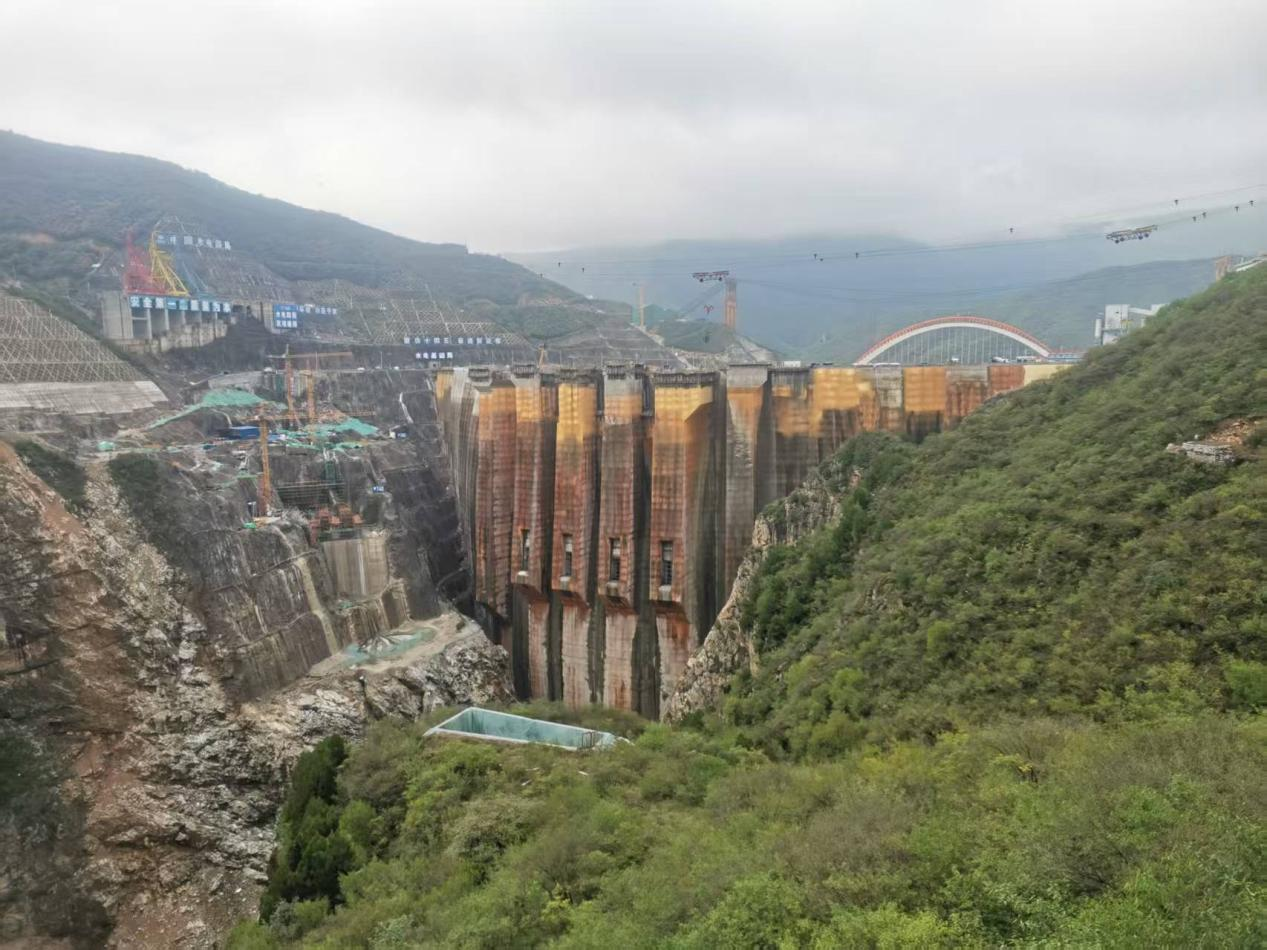
【省水利厅】东庄水利枢纽工程下闸蓄水阶段移民安置通过省级验收
Shan Xi Ri Bao· 2025-10-12 23:02
Core Viewpoint - The East Zhuang Water Conservancy Hub Project has successfully passed provincial-level acceptance for the resettlement of displaced residents, paving the way for the reservoir to begin water storage as scheduled [1] Group 1: Project Acceptance - The acceptance committee conducted on-site inspections in four counties (Liqian, Chuhua, Binzhou, and Yongshou) to verify the completion of resettlement and related facilities [1] - Experts assessed the living conditions of the displaced residents and reviewed reports on the implementation and management of the resettlement work [1] - The committee unanimously agreed that the resettlement measures and protective works were completed, allowing for the project to proceed to the water storage phase [1] Group 2: Future Plans and Recommendations - Relevant units are urged to address issues raised by experts and to implement a systematic approach to problem resolution [1] - By the end of October, a comprehensive population assessment for the four counties involved in the project is to be completed to ensure residents can benefit from support policies by 2026 [1] - The provincial water resources department emphasizes the importance of safety inspections for housing and infrastructure at resettlement sites, as well as expediting land allocation and supporting the development of displaced residents' livelihoods [1]