
丝绸商品

Search documents
中国桑蚕茧产量约占全球75%
Ren Min Ri Bao Hai Wai Ban· 2025-11-30 22:20
Core Insights - The silk industry in China maintains a strong global position, with approximately 75% of the world's silkworm cocoon production and over 60% of silk exports [1][2] Group 1: Industry Development - During the 14th Five-Year Plan period, the average annual production of silkworm cocoons reached 744,000 tons, marking an 11% increase compared to the end of the 13th Five-Year Plan [2] - The cultivation of mulberry and silkworm rearing has flourished in certain central and western regions, becoming a distinctive local industry [2] Group 2: International Market Expansion - The international reputation of Chinese silk has been enhanced, with a steady increase in market share [2] - Silk exports are projected to reach $1.44 billion in 2024, representing a growth of over 30% compared to the end of the 13th Five-Year Plan, with export destinations covering around 120 countries and regions globally [2] Group 3: Strategic Initiatives - The Ministry of Commerce has initiated a program to promote the "East Silk, West Solid" strategy, aimed at transferring the silk industry to central and western regions, optimizing regional industrial layout, and enhancing overall development quality and efficiency [1]
74.4万吨,增长11%!经纬交织“智造”创新机 科技赋能“织”出多元大市场
Yang Shi Wang· 2025-11-28 03:37
Group 1 - The average annual production of silkworm cocoons in China during the 14th Five-Year Plan period is 744,000 tons, representing an 11% increase compared to the end of the 13th Five-Year Plan [1] - China's cocoon production accounts for approximately 75% of the global total, while silk exports exceed 60% of the global market, indicating a sustained competitive advantage in the silk industry [5] - The development of sericulture has flourished in certain central and western regions, becoming a distinctive local industry [5] Group 2 - The number of new patents related to sericulture and silk has increased by 45.2% compared to the 13th Five-Year Plan, with advancements in functional silk fabrics and high-tech products [6] - The international reputation of Chinese silk continues to rise, with exports projected to reach $1.44 billion in 2024, reflecting a growth of over 30% compared to the end of the 13th Five-Year Plan, and covering around 120 countries and regions [9]

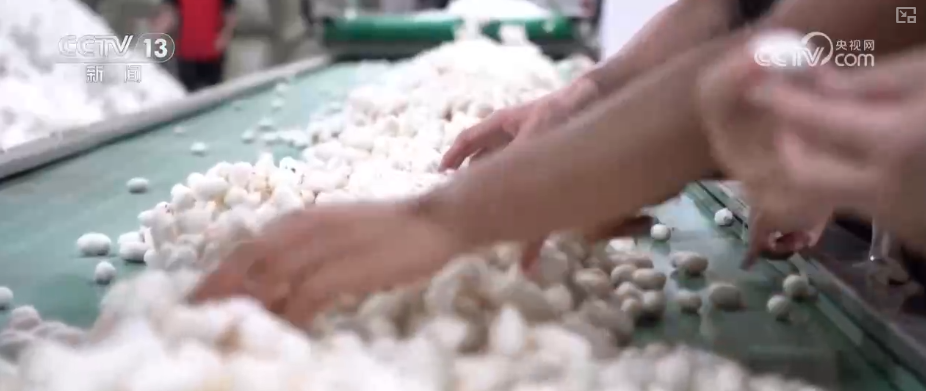
“十四五”时期我国桑蚕茧年均产量74.4万吨 约占全球75%
Yang Shi Xin Wen Ke Hu Duan· 2025-11-28 03:17
Core Viewpoint - The silk industry in China is experiencing significant growth, with a notable increase in production and exports, as well as advancements in technology and innovation [1] Production and Export Growth - During the "14th Five-Year Plan" period, the annual production of silkworm cocoons in China reached 744,000 tons, representing an 11% increase compared to the end of the "13th Five-Year Plan" [1] - China's cocoon production accounts for approximately 75% of the global total, while silk exports exceed 60% of the global market share, indicating a strong competitive advantage in the silk industry [1] Technological Advancements - The number of new patents in the silk and sericulture sector has increased by 45.2% compared to the "13th Five-Year Plan" period [1] - Significant progress has been made in the research and development of high-tech products, including functional silk fabrics with anti-wrinkle properties and flexible materials for brain-machine interfaces [1] International Reputation and Market Expansion - China's international reputation for silk is on the rise, with exports projected to reach $1.44 billion in 2024, marking an increase of over 30% compared to the end of the "13th Five-Year Plan" [1] - The export destinations for Chinese silk products now cover approximately 120 countries and regions worldwide [1] Future Development Plans - The Ministry of Commerce plans to strengthen policy support and collaborative efforts to accelerate the "East Silk, West Solid" initiative, improve the technological innovation system, and promote sustained growth in silk consumption [1] - The focus will be on cultivating new productive forces and driving high-quality development in the cocoon and silk industry [1]