中国环流四号

Search documents
专访核工业西南物理研究院副院长冯勇进:以强磁场与AI为翼 助力中国聚变能源加速产业化
Zhong Guo Zheng Quan Bao· 2026-01-17 02:56
Core Insights - The article discusses the advancements in nuclear fusion technology in China, particularly focusing on the Chengdu region's development as a hub for fusion energy, highlighted by the achievement of the "double hundred degree" breakthrough in the Chinese Circulation No. 3 project [1] Group 1: Technological Advancements - Strong magnetic field technology is becoming a crucial support for the commercialization of fusion energy, allowing for effective control of high-temperature plasma and reducing the size of Tokamak devices [2] - The Chinese Circulation No. 3 is the largest and highest-parameter magnetic confinement fusion device in China, achieving significant milestones such as the first domestic "double hundred degree" and a fusion triple product reaching 10^20 [2] - AI technology is being utilized to enhance plasma control, achieving near threefold energy confinement time through an "AI operator" that automates the adjustment of magnetic fields [4] Group 2: Industry Collaboration and Development - The Southwest Institute of Physics (西物院) plays a pivotal role in the fusion industry by driving the localization of key components and leading international collaborations, including participation in the ITER project [3] - The establishment of a controllable nuclear fusion innovation consortium aims to foster collaboration among various stakeholders, including state-owned enterprises and universities, to address key technological challenges [6] - The long-term goal is to achieve commercial fusion energy by 2045, with a roadmap that includes the development of experimental and demonstration reactors leading up to commercial deployment [6]
政策立法筑基 技术突破提速 万亿聚变能源赛道竞逐正酣
Zhong Guo Zheng Quan Bao· 2026-01-16 21:58
Core Insights - Controlled nuclear fusion is transitioning from conceptualization to engineering and commercialization, marking a significant shift in the industry [1][8] - The establishment of the "Fusion Financial Institutions Alliance" and the implementation of the Atomic Energy Law in 2026 are pivotal for the development of fusion energy in China [2][3] - The industry is entering a critical decade, with a trillion-level energy market on the horizon, driven by technological breakthroughs and policy support [1][8] Policy and Legislative Framework - The implementation of the Atomic Energy Law on January 15, 2026, signifies a move towards a regulated framework for fusion energy development [2] - The "14th Five-Year Plan" emphasizes controlled nuclear fusion as a key future industry, aligning with recent legislative efforts [2] Technological Advancements - Major breakthroughs in fusion technology include EAST achieving 1 billion degrees Celsius for 1066 seconds and the development of the BEST device, which aims for the first global fusion energy demonstration by 2027 [3][4] - The Chinese Circulation No. 3 has reached a dual billion-degree operation, enhancing the prospects for fusion energy commercialization [3] Regional Development and Industry Structure - A "golden triangle" of fusion industry development is forming in Anhui, Sichuan, and Shanghai, each focusing on different aspects of the fusion energy supply chain [4][5] - Anhui is central to fusion research with key facilities like EAST and BEST, while Sichuan focuses on manufacturing core components, and Shanghai targets high-temperature superconducting technologies [4][5] Commercialization Efforts - Private enterprises are increasingly involved in fusion energy, exploring alternative technological routes to avoid the lengthy development cycles of traditional methods [6][7] - Companies like Xianhuan Energy and Nengyuan Qidian are making significant strides in developing cost-effective fusion technologies, with some aiming for commercial viability by 2027 [6][7] Investment and Market Outlook - The fusion energy sector is expected to attract substantial investment, with a shift towards supporting mature technologies with high commercial value by 2030 [7][8] - The next five years are anticipated to be crucial for technological iterations in the industry, as private companies seek to gain a competitive edge [7][8]
万亿赛道“奇点”已至!核聚变板块涨停潮起,第二轮行情正启?
Ge Long Hui A P P· 2025-10-09 06:16
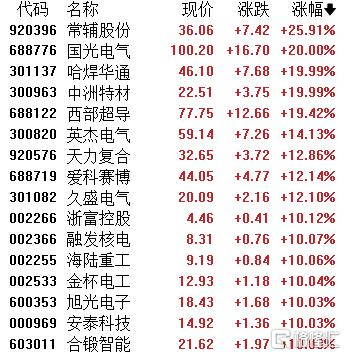
Core Viewpoint - The A-share controllable nuclear fusion sector experienced a surge in stock prices, driven by significant advancements in China's controllable nuclear fusion technology [1][3]. Group 1: Market Performance - Multiple stocks in the controllable nuclear fusion sector reached their daily limit up, including Guoguang Electric, Haheng Huaton, and Zhongzhou Special Materials, with increases of 20% and above [1][2]. - The overall market sentiment is positive, with several companies showing gains exceeding 10% [1][2]. Group 2: Technological Advancements - The recent surge is attributed to a key breakthrough in the construction of the compact fusion energy experimental device (BEST) in Hefei, Anhui, with the successful installation of the core component, the Dewar base [3]. - The completion of the Dewar base marks the beginning of the main assembly work for the BEST device, which is expected to be fully assembled by 2027 [3]. - BEST aims to demonstrate fusion energy generation for the first time globally, with the goal of lighting the first lamp by 2030 [3]. Group 3: Global Developments - The global nuclear fusion sector is witnessing rapid advancements, including a $1 billion power purchase agreement between CFS and Eni Group for a fusion power plant in Virginia, expected to be operational in the early 2030s [4][5]. - The international community is accelerating efforts towards the commercialization of fusion energy, with various countries investing significantly in fusion projects [5][6]. Group 4: Market Outlook - The global nuclear fusion market is projected to reach $496.55 billion by 2030, with a compound annual growth rate of 7.4% from 2024 to 2030 [7]. - Recent policy support in China, including the approval of the Atomic Energy Law, encourages research and development in controlled thermonuclear fusion, providing a favorable environment for industry growth [7][8]. - Analysts suggest that the second wave of market activity in the fusion sector is likely to commence, driven by intensified project financing and bidding processes [6][8].