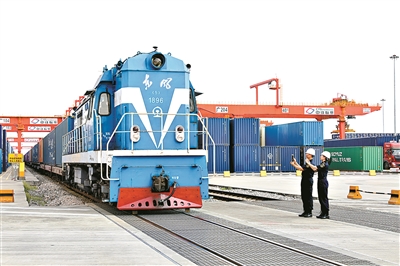
中欧班列货运服务

Search documents
江西中欧班列开行十年 助推打造内陆地区改革开放高地
Zhong Guo Xin Wen Wang· 2025-11-20 09:13
Core Viewpoint - The development of the China-Europe Railway Express has significantly enhanced the connectivity of Jiangxi province, transforming it into a highland for reform and opening up in inland regions, with a focus on international logistics and trade expansion [3][5]. Group 1: Development of China-Europe Railway Express - Since its launch in 2015, the Jiangxi China-Europe Railway Express has steadily increased its operational scale, with 12 international transport routes established, connecting 224 cities across 25 countries in Asia and Europe [3][5]. - The railway has seen improvements in operational efficiency, with the weight capacity increasing from 3,500 tons to 5,500 tons and the speed rising from 80 km/h to 120 km/h [3]. - As of now, over 1,700 trains have been operated, transporting goods worth over $9 billion, including daily necessities and cross-border e-commerce products [5]. Group 2: Economic Impact and Logistics Efficiency - The Jiangxi province's wood consumption, particularly in the furniture sector, heavily relies on imports, with 80% of the 10 million cubic meters consumed annually being imported. The railway has reduced the transportation time for wood imports from 37 days to 12 days, cutting logistics costs by 18% [3][4]. - The total cargo volume from the Nanchang International Port reached 218.37 million tons in the first ten months of the year, marking a year-on-year increase of 15.19% [5]. - The railway's operational model has evolved to include various transport methods, enhancing the overall logistics framework and supporting the growth of international trade [4][5].

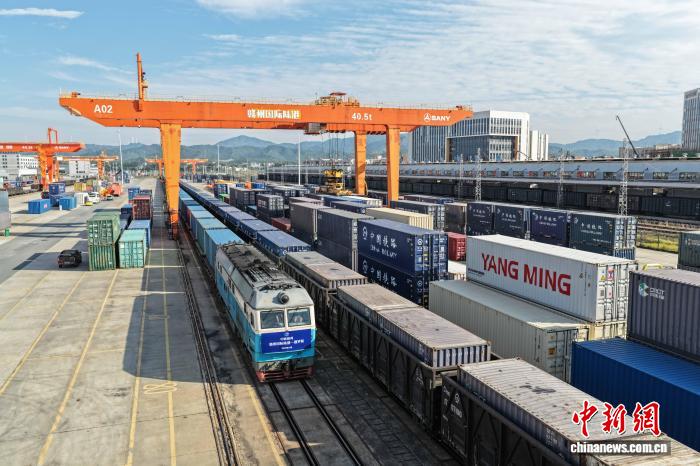
江西中欧班列已累计开行2185列 通达25国
Zhong Guo Xin Wen Wang· 2025-11-19 08:59
Core Points - The Jiangxi China-Europe Railway Express has operated a total of 2,185 trains, transporting over 570,000 tons of goods valued at more than $9 billion since its inception ten years ago [1][3][4] - The railway has established 12 international routes, connecting Jiangxi to 25 countries and 224 cities across Europe and Asia [3][4] Group 1 - The railway significantly reduces transportation time for wood imports, cutting the transit time to 12 days compared to 37 days via traditional sea routes, and lowers logistics costs by 18% [3] - The stable operation of the China-Europe Railway Express has led to an increase in European clients for local companies, with one furniture company exporting 68 standard containers from January to October this year [3][4] Group 2 - The railway has expanded its cargo offerings from daily necessities and home appliances to include cross-border e-commerce products and cold chain fresh goods [3] - Future plans include optimizing freight services represented by the China-Europe Railway Express and sea-rail intermodal trains to enhance Jiangxi's foreign trade [4]
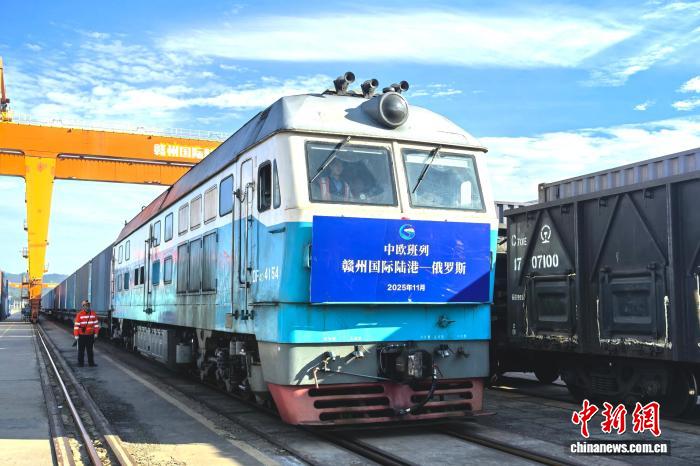
“跨两海”南通道中欧班列稳定性高时间缩短约1/3
Guang Zhou Ri Bao· 2025-09-07 01:39
Core Viewpoint - The launch of the "Cross Two Seas" South Passage train from Guangzhou International Port marks the official operation of a new logistics route that enhances the efficiency and cost-effectiveness of exporting goods to Turkey and Romania, significantly benefiting businesses in the Greater Bay Area [1][2]. Group 1: Logistics and Transportation - The inaugural train is loaded with 50 forty-foot containers and covers approximately 10,000 kilometers [2]. - The new route reduces shipping time to Turkey by about 15 days compared to traditional sea transport, while the freight cost is approximately 60% of air freight [2]. - The "Cross Two Seas" South Passage train employs a "rail-sea-rail" multimodal transport model, creating a more efficient and interconnected logistics network for the China-Europe Railway Express [2]. Group 2: Business Impact - The new train route offers greater stability and predictability in shipping schedules, allowing companies to plan their logistics more scientifically and accurately [2]. - The "Cross Two Seas" South Passage train's shorter and more stable route can save about one-third of the time compared to traditional sea transport, significantly improving transportation efficiency and reducing logistics costs for businesses [2].