内陆地区改革开放

Search documents
《长沙市打造内陆地区改革开放高地2026年行动方案》发布
Sou Hu Cai Jing· 2026-02-24 12:56
Core Viewpoint - Changsha aims to enhance its position as an inland reform and opening-up highland by implementing a comprehensive action plan for 2026, focusing on trade growth, foreign investment, and international cooperation [1] Group 1: Economic Growth and Trade - The total foreign trade import and export volume is expected to grow by over 3%, with a target of 30% growth in trade with African countries [1] - The actual use of foreign capital is projected to exceed the provincial average [1] - The establishment of over 10 national-level institutional innovation achievements in the Changsha Free Trade Zone [1] Group 2: Reform and Innovation - Changsha will deepen reform and innovation across four dimensions: institutional mechanisms, resource allocation, regional cooperation, and regulatory quality [2] - Key reforms include enhancing state-owned enterprise reforms and creating over 10 innovation and entrepreneurship incubation bases [2] - The city will promote market-oriented resource allocation and support overseas talent innovation [2] Group 3: Industry and Trade Integration - The focus will be on deepening the integration of industry and trade, with initiatives like "Xiang Trade Global" to enhance exports of high-tech products [3] - Support for the development of service trade and new business models such as cross-border e-commerce and offshore trade [3] - Efforts to establish international standards for various industries to enhance global competitiveness [3] Group 4: International Cooperation and Logistics - Changsha will strengthen international economic cooperation, particularly with Europe and Japan, and explore investment opportunities in Belt and Road countries [4] - The city plans to enhance international logistics by developing the China-Europe Railway Express and optimizing international shipping routes [5] Group 5: Business Environment Optimization - Aiming to create an international consumption environment, Changsha will support the establishment of international consumer zones and improve foreign payment services [6] - The city will implement measures to protect foreign enterprises and streamline processes for business operations [6] - Continuous efforts will be made to ensure a favorable business environment for foreign investments [6]
湖南省长沙市跻身全国先进制造业强市前列
Ke Ji Ri Bao· 2025-11-28 00:49
Group 1 - During the "14th Five-Year Plan" period, Changsha's GDP is expected to grow at an average annual rate of 5.4%, with major indicators such as industrial added value ranking among the top in national provincial capital cities [1] - Changsha has developed a modern industrial system characterized by the "4433" model, nurturing seven trillion-yuan industrial clusters and three national-level advanced manufacturing clusters [1][2] - The city has become the second globally to host more than five of the world's top 50 construction machinery companies and is the only city in China capable of fully designing core chips independently [1] Group 2 - The scale of industrial added value in Changsha is projected to grow by approximately 8% annually, reaching 9.6% in 2024, marking a ten-year high [2] - Changsha's total digital economy has surpassed 500 billion yuan, with the service sector's added value exceeding 900 billion yuan, contributing 51.7% to economic growth [1] - The number of high-tech enterprises in Changsha has doubled, and the total talent pool has exceeded 3.15 million, placing the city among the top ten in talent ecosystem index nationwide [2] Group 3 - Changsha is actively exploring the integration of culture with technology and tourism, with significant cultural industry output exceeding 200 billion yuan, ranking among the top cities in the country [3] - The city has established a cultural and technological integration development pattern, with several bases recognized as national demonstration bases for cultural and technological integration [3]
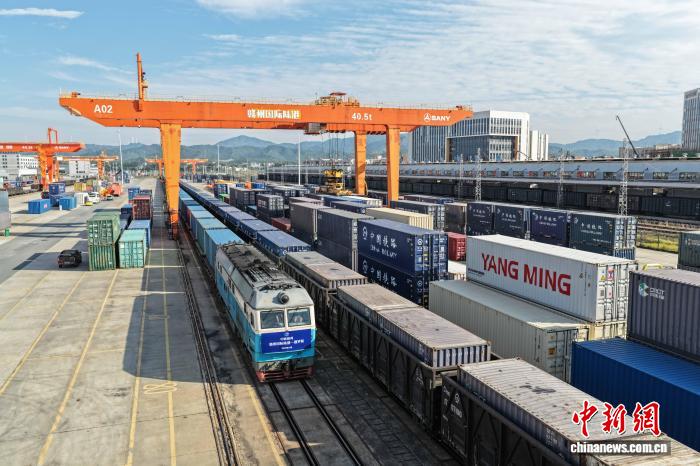
江西中欧班列开行十年 助推打造内陆地区改革开放高地
Zhong Guo Xin Wen Wang· 2025-11-20 09:13
Core Viewpoint - The development of the China-Europe Railway Express has significantly enhanced the connectivity of Jiangxi province, transforming it into a highland for reform and opening up in inland regions, with a focus on international logistics and trade expansion [3][5]. Group 1: Development of China-Europe Railway Express - Since its launch in 2015, the Jiangxi China-Europe Railway Express has steadily increased its operational scale, with 12 international transport routes established, connecting 224 cities across 25 countries in Asia and Europe [3][5]. - The railway has seen improvements in operational efficiency, with the weight capacity increasing from 3,500 tons to 5,500 tons and the speed rising from 80 km/h to 120 km/h [3]. - As of now, over 1,700 trains have been operated, transporting goods worth over $9 billion, including daily necessities and cross-border e-commerce products [5]. Group 2: Economic Impact and Logistics Efficiency - The Jiangxi province's wood consumption, particularly in the furniture sector, heavily relies on imports, with 80% of the 10 million cubic meters consumed annually being imported. The railway has reduced the transportation time for wood imports from 37 days to 12 days, cutting logistics costs by 18% [3][4]. - The total cargo volume from the Nanchang International Port reached 218.37 million tons in the first ten months of the year, marking a year-on-year increase of 15.19% [5]. - The railway's operational model has evolved to include various transport methods, enhancing the overall logistics framework and supporting the growth of international trade [4][5].