中欧航线机票

Search documents
中欧航线一票难求,经济舱票价飙升到2万以上
新浪财经· 2026-03-04 10:22
Core Viewpoint - The ongoing turmoil in the Middle East has significantly impacted the global aviation industry, leading to a dramatic increase in ticket prices for flights between China and Europe, with some routes seeing price hikes of over 500% compared to normal rates [2][10]. Group 1: Ticket Price Surge - Ticket prices for direct flights from Beijing to Paris have surged, with economy class tickets starting at 10,730 yuan on March 4, and rising to 26,104 yuan by March 5, while business class tickets reached 64,518 yuan [2]. - Similar trends are observed for flights from Shanghai to Paris, where economy class tickets for connecting flights started at 17,870 yuan on March 4, and direct flights were priced at 47,009 yuan for business class on March 5 [2]. - Other European routes, such as Chengdu to Rome, also experienced high prices, with economy class tickets starting at 21,345 yuan on March 5, and connecting flights priced at 18,680 yuan on March 6 [4]. Group 2: Supply and Demand Imbalance - The surge in ticket prices is attributed to a supply-demand imbalance, exacerbated by rising operational costs and the closure of Middle Eastern airspace affecting major airlines [8][11]. - The closure of airspace and airports in the Middle East has severely impacted airlines like Qatar Airways and Emirates, leading to the suspension of most commercial flights and leaving many passengers stranded [9]. Group 3: Shift in Travel Patterns - With Middle Eastern airlines unable to operate, travelers who previously preferred connecting flights through these hubs are now turning to direct flights between China and Europe, resulting in a significant increase in demand for limited direct flight capacity [10]. - The timing coincides with the end of the Chinese New Year holiday and a peak in business travel and student returns, further straining the availability of direct flights [10].


中加团队游开闸,但中加航线恢复与中美航线一样慢
Di Yi Cai Jing· 2025-11-03 14:33
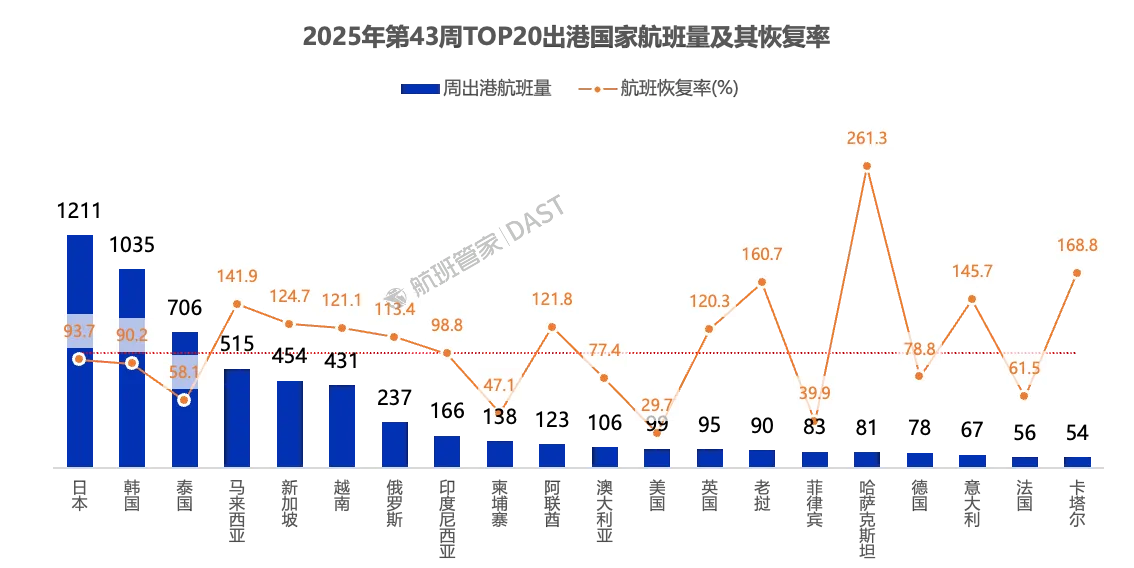
Core Insights - The recovery of the China-Canada route is lagging behind other international routes, similar to the China-US route, with a current recovery rate of only 35.6% compared to pre-pandemic levels in 2019 [1][3] - The number of international flight tickets to Canada from China has increased by 28.1% year-on-year from January to October this year [1] - The number of flights on the China-Canada route has significantly increased, with a total of 319 round-trip flights scheduled for October 2025, representing a growth of over 2.5 times [1] Flight Recovery Challenges - The slow recovery of the China-Canada flights is partly due to restrictions imposed by Canada on the number of flights allowed for Chinese airlines, initially limiting them to no more than six round-trip flights per week [3] - Although Canada has lifted the restriction on direct flights from Beijing, the approved flight volume remains significantly lower than pre-pandemic levels, which exceeded 70 flights per week [3][4] Airline Operations - Currently, six mainland Chinese airlines operate on the China-Canada route, with Air Canada being the only Canadian airline flying this route [4] - In October, the top three routes by flight volume were Shanghai Pudong to Vancouver (80 flights), Beijing Capital to Vancouver (70 flights), and Shanghai Pudong to Pearson (36 flights) [4] Market Dynamics - Domestic airlines currently hold a larger share of the flight volume on the China-Canada route, indicating that Air Canada has not fully utilized its approved flight rights [6] - Despite a year-on-year increase of over 2.1 times in Air Canada's flight volume in October, it still represents a decline of 65.3% compared to 2019 [6] International Route Landscape - The recovery of the China-US route is also hindered by similar restrictions, with Chinese airlines required to avoid Russian airspace, impacting operational efficiency [7] - The competitive landscape for international routes is changing, with domestic airlines increasing their market share from 59.1% in 2019 to 69.6% in the first half of this year, while foreign airlines' share has decreased correspondingly [8]