中证A500红利低波指数

Search documents
这才是真正的“睡后收入”:中证A500红利低波,让细分龙头为你“打工”
Sou Hu Cai Jing· 2025-12-15 09:23
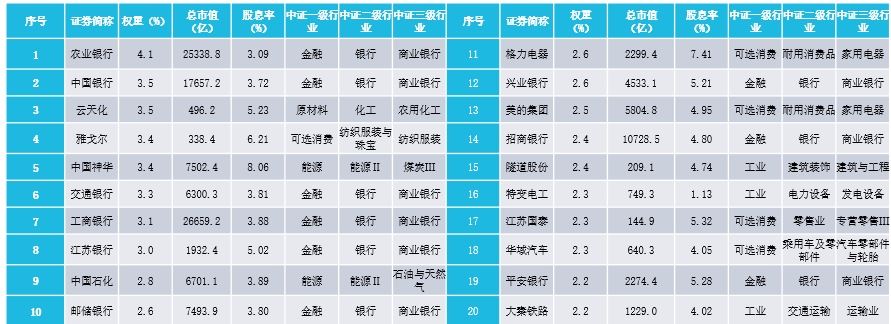
Core Viewpoint - The article discusses the Zhongzheng A500 Dividend Low Volatility Index, which aims to provide a balanced investment strategy that combines the safety of dividend stocks with the growth potential of leading companies across various sectors [1]. Group 1: Index Overview - The Zhongzheng A500 Dividend Low Volatility Index is derived from the Zhongzheng A500 Index, which selects 500 leading companies from over 5,000 stocks in the A-share market [1]. - This index further narrows down to 50 stocks that demonstrate continuous dividend payment capability, high dividend yield, and low volatility, ensuring high-quality asset selection [1][4]. Group 2: Selection Criteria - The index employs a rigorous selection process, starting with a "dividend willingness" criterion, requiring constituent stocks to have paid cash dividends for the past three years with a reasonable payout ratio [4]. - The second criterion focuses on "valuation and safety," ranking stocks by dividend yield to filter the top 50%, which typically indicates lower valuations [4]. - The final selection involves identifying the 50 stocks with the lowest volatility among those with high dividend yields, as historically, low-volatility stocks tend to outperform high-volatility ones over the long term [4]. Group 3: Industry Coverage - Unlike traditional dividend indices that are heavily weighted towards sectors like finance, the Zhongzheng A500 Dividend Low Volatility Index covers a broader range of industries, including 27 sub-industries compared to 19 in traditional indices [5]. - This diversified approach includes not only traditional high-dividend sectors like banking and energy but also leading companies in manufacturing and consumer discretionary sectors, such as home appliances and automotive parts [5]. Group 4: Performance Metrics - Since its inception, the Zhongzheng A500 Dividend Low Volatility Index has achieved an annualized return of 14.9%, outperforming both the parent Zhongzheng A500 Index and traditional dividend low volatility indices [8]. - Over the last decade, the index has recorded a cumulative return of 165.9%, significantly higher than the 133.8% return of traditional dividend low volatility indices [10]. - The index maintains a high Sharpe ratio of 82.9% and has a maximum drawdown of -39.3%, indicating better risk-adjusted returns compared to its peers [10]. Group 5: Investment Strategy - The Zhongzheng A500 Dividend Low Volatility Index represents an upgrade in investment strategy, utilizing the natural "buy low, sell high" characteristic of dividends while smoothing volatility and mitigating risks through careful stock selection [11]. - This index is particularly appealing for investors seeking consistent dividend income while also wanting to invest in core assets for long-term stable growth [11].

高分红股票与高分红基金,怎么选?90%的人都没想清楚!
Sou Hu Cai Jing· 2025-08-17 07:01
Group 1 - The core viewpoint emphasizes that high-dividend assets, due to their "stable cash flow + defensive attributes," have become a key choice for investors facing market volatility [1] - High-dividend strategies derive their core returns from two sources: dividend income and capital gains, focusing on mature companies with strong profitability and cash flow [3] - Common misconceptions include the belief that high dividends are only for bear markets, that dividends guarantee short-term gains, and that high dividend yields equate to high value [4] Group 2 - There are two typical categories of high-dividend stocks: traditional cash cows and transformation growth stocks, with telecom operators evolving into dual-driven growth stocks [7] - The report highlights specific companies like China Yangtze Power, which has a dividend payout ratio locked in at no less than 70% from 2026 to 2030, and the three major telecom operators committing to a payout ratio of over 75% in the next three years [7] - Dividend funds are characterized by their diversification, with Hong Kong dividend funds focusing on extreme yield and A-share funds on balanced allocation [9] Group 3 - The research emphasizes the need to analyze the sustainability of cash flows through business models, highlighting the importance of risk diversification in individual stock holdings [10] - The core advantage of high dividend yields is attributed to low valuations, with the Hong Kong Stock Connect high dividend index yielding between 5.8% and 7.75% [11] - Different investment strategies are recommended for various investor types, including small cash flow seekers, conservative investors, value hunters, and institutional investors [13] Group 4 - Specific operational guidelines suggest that investors with less than 50,000 should consider regular investments in dividend funds, while those with 500,000 should build a "core + satellite" portfolio [14] - For investments over 1 million, a mix of 3-5 high-dividend stocks and 2-3 complementary dividend funds is recommended, with caution against cyclical industries [14]