二氧化碳培养箱

Search documents
跨国日企本土化里程碑:首台“国产”二氧化碳培养箱正式下线
仪器信息网· 2025-11-12 09:35
Core Viewpoint - The successful launch of the first domestically produced carbon dioxide incubator by PHCbi marks a significant step in the company's localization strategy in China, indicating a commitment to deepening its presence in the life sciences sector [2][3][9]. Localization Strategy - The launch of the carbon dioxide incubator is a crucial part of PHCbi's strategic layout, representing a solid first step in the brand's commitment to "develop in China and serve China" [9]. - The domestically produced incubator adheres to PHC's global quality standards, ensuring that every production and testing phase is rigorously controlled, aimed at providing stable, reliable, and efficient cell culture solutions for researchers [9][11]. Future Outlook - PHCbi plans to continue its focus on innovation and quality while expanding its localization efforts and related business in the life sciences field [11]. - The company anticipates that the introduction of localized products will enhance service response times and product adaptability in the domestic market, offering more choices to research and medical institutions [9][11].


行业聚焦:全球二氧化碳培养箱市场头部企业份额调研(附Top10 厂商名单)
QYResearch· 2025-09-25 03:50
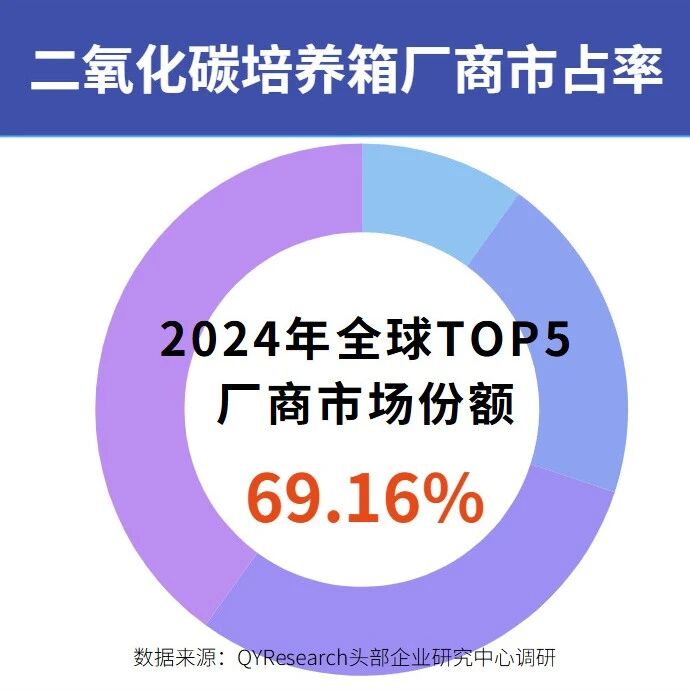
Core Viewpoint - The article discusses the CO2 incubator market, highlighting its growth potential, key players, and market dynamics, with a projected compound annual growth rate (CAGR) of 6.7% from 2025 to 2031, increasing the market size from $631.17 million to $932.19 million [5][8]. Group 1: Product Overview - CO2 incubators are designed to simulate natural cell environments with a relative humidity of about 95%, a temperature of 37°C, and a pH range of 7.2 to 7.5, commonly used in biological laboratories for cell culture [2]. Group 2: Production and Consumption - The CO2 incubator industry is highly concentrated, primarily located in the US, Europe, and China, with major companies like Thermo Fisher Scientific and Eppendorf leading the market [3]. - The industry is maturing, with a stable consumption growth rate expected [3]. Group 3: Marketing Channels - Different companies have unique marketing strategies; leading international firms often establish their own sales departments, while others rely on distributors [4]. - Chinese companies tend to focus on price advantages but may lack the quality and brand influence of leading firms [4]. Group 4: Pricing Dynamics - The market is influenced by both price and product performance, with leading companies capturing a significant share of the high-end market due to superior product quality and service [4]. - Prices are expected to rise slowly in the coming years, with increasing competition narrowing the price gap between brands [4]. Group 5: Market Outlook - The demand for CO2 incubators is anticipated to grow, particularly in developing regions with rapid economic growth [5]. - The global market size is projected to reach $932.19 million by 2031, with a CAGR of 6.7% from 2025 to 2031 [5]. Group 6: Market Share and Key Players - The top five manufacturers in the CO2 incubator market hold approximately 69.16% of the market share, with major players including Thermo Scientific, Eppendorf, and Panasonic Healthcare [8]. - The most significant product segment is the 100L to 200L range, expected to account for about 63.2% of the market share by 2025 [10]. Group 7: Application Segmentation - Biotechnology is identified as the largest downstream market for CO2 incubators, projected to hold a 47.2% share by 2025 [12].
DeepSeek加速AI医疗落地,建议关注相关企业投资机遇
Caixin Securities· 2025-03-13 09:04
Investment Rating - The industry investment rating is "Outperform the Market" [3][28] Core Viewpoints - The report emphasizes the potential of AI in healthcare, particularly through the DeepSeek model, which accelerates the implementation of AI in medical settings, enhancing diagnostic efficiency and resource allocation [7][23][27] - The industry is expected to transition from scale expansion to higher-level development, focusing on high-quality growth and long-term investment opportunities [28] Summary by Sections Industry Overview - The medical device sector has shown a monthly increase of 8.67%, outperforming the pharmaceutical sector and the CSI 300 index by 2.26 and 6.04 percentage points respectively [11][15] - The average PE ratio for the medical device sector is 28.93, which is a 9.74% premium over the pharmaceutical sector and a 154.06% premium over the CSI 300 index [15][21] Key Stocks - Major companies highlighted include: - Mindray Medical: EPS of 9.55 in 2023, rated "Buy" [4] - Weili Medical: EPS of 0.66 in 2023, rated "Add" [4] - New Industry: EPS of 2.10 in 2023, rated "Add" [4] - Yuyue Medical: EPS of 2.39 in 2023, rated "Add" [4] - Kefu Medical: EPS of 1.22 in 2023, rated "Add" [4] AI Medical Applications - AI in healthcare is categorized into several applications, including drug development, medical imaging, healthcare robotics, and health management, all aimed at improving service efficiency and quality [25][24] - The report suggests that AI will help address the growing medical demand and resource distribution issues in China, enhancing early disease detection and treatment [24][26] Investment Recommendations - The report recommends focusing on companies with strong innovation capabilities and international expansion potential, such as Mindray Medical, Union Medical, and Weili Medical [28] - It also highlights the importance of AI models like DeepSeek in improving medical efficiency and resource optimization, suggesting attention to companies like BGI and Shengxiang Biological [28]