
二氧化碳驱油技术

Search documents
吃碳吐油 变“废”为宝探访我国首个实现年注碳百万吨的油田
Zhong Yang Ji Wei Guo Jia Jian Wei Wang Zhan· 2026-01-26 02:28
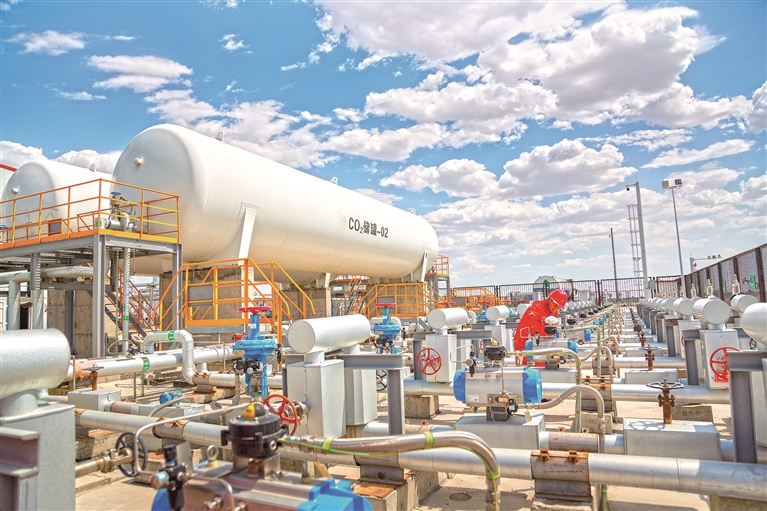
Core Viewpoint - The Xinjiang Oilfield has achieved a significant milestone by injecting over 1 million tons of carbon dioxide (CO2) annually by 2025, marking it as China's first oilfield to reach this target, which plays a crucial role in the country's carbon neutrality goals [8][16]. Group 1: CO2 Injection Technology - The CO2 injection method enhances oil recovery by increasing pressure and reducing viscosity, allowing for the extraction of oil that traditional methods cannot reach [9][10]. - Compared to water injection, CO2 injection can improve oil recovery rates by 10% to 20%, achieving total recovery rates of 40% to 60% [10]. - The Xinjiang Oilfield has been utilizing CO2 for enhanced oil recovery since 2019, with successful pilot projects demonstrating significant increases in oil production [12][14]. Group 2: Carbon Capture, Utilization, and Storage (CCUS) - CCUS technology is essential for achieving carbon neutrality, with Xinjiang Oilfield being a pioneer in its application for oil recovery [11][12]. - The CO2 used for injection is sourced from industrial emissions in the surrounding areas, ensuring a sustainable supply for the oilfield [15]. - Approximately 80% of the injected CO2 is permanently stored underground, while the remaining 20% is recycled for further use [15][16]. Group 3: Environmental Impact and Future Prospects - The ongoing CCUS projects in Xinjiang Oilfield are expected to significantly contribute to carbon reduction efforts, with current injection rates reaching over 4,800 tons per day [16]. - The technology not only aids in oil recovery but also provides a pathway for the utilization of industrial CO2 emissions, aligning with national carbon reduction strategies [18][19]. - The successful implementation of CCUS in Xinjiang Oilfield serves as a model for other regions and industries, showcasing the potential for green transformation in the energy sector [19][20].


黑色能源书写绿色传奇 大庆油田交出生态文明新答卷
Zhong Guo Xin Wen Wang· 2025-11-11 14:20
Core Viewpoint - Daqing Oilfield is committed to integrating green development into its operations, aiming to become a world-class modern oilfield while ensuring energy security and ecological protection [2] Group 1: Green Production - Daqing Oilfield is actively pursuing the construction of a "waste-free green oilfield" by enhancing pollution prevention and control systems, leading to a reduction in total pollutant emissions [3] - The oilfield has achieved a 100% utilization rate of drilling waste and a 95% comprehensive utilization rate through the use of environmentally friendly drilling fluids and advanced wellbore control technologies [3] - A closed-loop system for oil extraction, treatment, and reinjection has been established, achieving a 100% reuse rate of produced water and a 90% qualification rate for water injection [3][4] - The development of CO2 enhanced oil recovery technology has created a perfect loop for clean and environmentally friendly development, addressing challenges in low-permeability oilfield development [4] Group 2: Transformation and Development - Daqing Oilfield is following a three-step strategy of "clean substitution, strategic replacement, and green transformation" to promote low-carbon development [5] - Since 2021, the oilfield has established China's first water surface photovoltaic demonstration project and the largest low-carbon demonstration area in oilfields, contributing over 400 million kWh of green electricity [5] - The installed capacity of renewable energy projects has reached 3.28 million kW, with total power generation exceeding 2 billion kWh, resulting in a reduction of 106.8 million tons of CO2 emissions [5] Group 3: Ecological Restoration - Daqing Oilfield has transformed previously polluted areas into thriving ecosystems, with significant improvements in biodiversity and vegetation coverage [7] - The establishment of China's first carbon-neutral forest park in Daqing has created a multifunctional ecological area, achieving self-sustaining carbon neutrality [7] - The oilfield has built 120 million square meters of green space, achieving a greening coverage rate of 50%, surpassing the national average by 7 percentage points [8]

黑色能源书写绿色传奇,大庆油田交出生态文明新答卷
Zhong Guo Xin Wen Wang· 2025-11-11 14:13
Core Viewpoint - Daqing Oilfield is committed to green development, integrating low-carbon practices into its oil and gas exploration and production lifecycle while ensuring national energy security and ecological protection [1][2][3] Green Production - Daqing Oilfield is actively pursuing the construction of a "waste-free green oilfield," enhancing pollution prevention and control systems to reduce total pollutant emissions [1] - The oilfield has achieved a 100% utilization rate of drilling waste and over 95% comprehensive utilization rate through the use of environmentally friendly drilling fluids and advanced wellbore control technologies [1][2] Transformation Development - The oilfield is constructing a new low-carbon development model that includes renewable energy projects such as water surface photovoltaic and geothermal heating systems, contributing over 400 million kWh of green electricity [3] - Daqing Oilfield's renewable energy projects have a total installed capacity of 3.28 million kW, generating over 2 billion kWh of electricity, equivalent to a reduction of 106.8 thousand tons of CO2 emissions [3] Carbon Asset Development - Daqing Oilfield has developed nine carbon asset projects under various international carbon reduction mechanisms, achieving a total reduction of 2.92 million tons of emissions [4] - The oilfield has established a comprehensive carbon emission accounting system covering 15 categories of emission sources, enhancing data accuracy for carbon reduction goals [4] Ecological Restoration - Daqing Oilfield has transformed previously degraded areas into thriving ecosystems, with significant improvements in biodiversity, including the presence of protected bird species [5] - The establishment of China's first carbon-neutral forest park in Daqing has created a multifunctional ecological area, contributing to carbon offset and providing ecological benefits to the community [5] - The oilfield has achieved a green coverage rate of 50% in built-up areas, surpassing the national average by 7 percentage points, and has received multiple green development accolades [5]
CCUS收入超500亿!山东东营油田吃“碳”吐“油”
Xin Hua She· 2025-05-26 03:00
Core Viewpoint - The CCUS (Carbon Capture, Utilization, and Storage) technology is becoming a crucial method for achieving low-carbon transformation and carbon neutrality goals globally, with significant advancements in China's CCUS industry driven by policy and market incentives [1][3]. Group 1: CCUS Technology and Implementation - The CCUS project at the Shengli Oilfield in Dongying, Shandong, utilizes carbon dioxide to enhance oil recovery, potentially increasing oil production by nearly 100% [1][2]. - The project involves injecting carbon dioxide into complex underground oil reservoirs, which improves oil flow and reduces energy consumption compared to traditional water flooding methods [2][3]. - The Shengli Oilfield has been capturing nearly 1 million tons of carbon dioxide annually from local chemical plants and coal-fired power plants for oil recovery and storage, resulting in a reduction of carbon dioxide emissions by the same amount [3]. Group 2: Industry Growth and Future Plans - The number of planned CCUS projects in China is expected to grow from approximately 40 in 2021 to around 120 by July 2024, with annual carbon capture capacity increasing from 3 million tons to 6 million tons [1]. - Dongying has become a leading region in China for CCUS equipment, with a carbon capture capacity of 109.5 thousand tons and a chemical utilization capacity of 49.68 thousand tons annually [3]. - By 2035, Dongying aims to establish multiple million-ton-level CCUS projects and achieve a carbon capture capacity of 10 million tons, with projected main business revenue from the CCUS industry exceeding 50 billion yuan [4].