享界品牌车型

Search documents
北汽新能源:昔日销冠的落寞与重生挣扎
Zhong Guo Qi Che Bao Wang· 2025-11-27 09:11
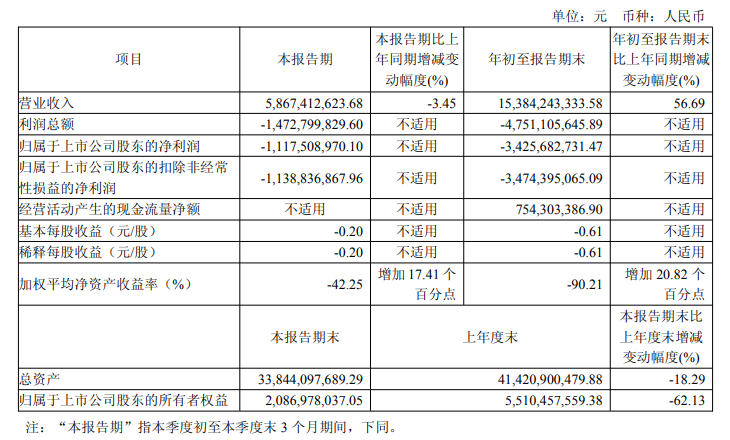
Core Viewpoint - Recently, BAIC Blue Valley received approval from the China Securities Regulatory Commission to issue shares to specific investors, raising 6 billion yuan, which is timely for the company's ongoing transformation [1] Group 1: Financial Performance - From January to October, BAIC Blue Valley sold 142,000 vehicles, a year-on-year increase of 73% [1] - For the first three quarters, the company reported revenue of 15.384 billion yuan, a year-on-year growth of 56.7% [1] - The net loss attributable to shareholders for the same period was 3.426 billion yuan, with a basic earnings per share of -0.61 yuan [1][3] Group 2: Historical Context - BAIC New Energy, established in 2009, was one of the first independent new energy vehicle companies in China and became the first listed new energy vehicle company in 2018 [4] - In 2017, the company achieved sales of 103,000 vehicles, a 98% increase, and became the global sales champion for pure electric vehicles [4][5] - The company's peak sales were supported by government subsidies and a strong B-end market presence, which accounted for over 70% of its business at one point [5] Group 3: Challenges and Strategic Shifts - The company faced challenges due to its reliance on the B-end market, leading to a lack of brand recognition in the C-end market and a perception of low-end products [6][7] - In 2019, the reduction of government subsidies triggered a decline in sales, with total sales dropping to 150,600 vehicles, a year-on-year decrease of 4.69% [6] - By 2020, the company experienced a drastic drop in sales to 25,900 vehicles, exacerbated by the COVID-19 pandemic and a lack of technological differentiation [7] Group 4: Future Outlook - In 2024, BAIC New Energy initiated a strategic transformation with a dual-brand strategy aimed at increasing sales and market penetration [9] - Despite projected sales growth, the company continues to report significant net losses, with cumulative losses exceeding 30 billion yuan by 2025 [9][10] - The recent 6 billion yuan financing is intended for new energy vehicle development and AI technology projects, but it may not resolve the underlying competitive challenges faced by the company [10]

三个央企新能源品牌,销量加起来不如一个新势力
Di Yi Cai Jing· 2025-11-01 11:25
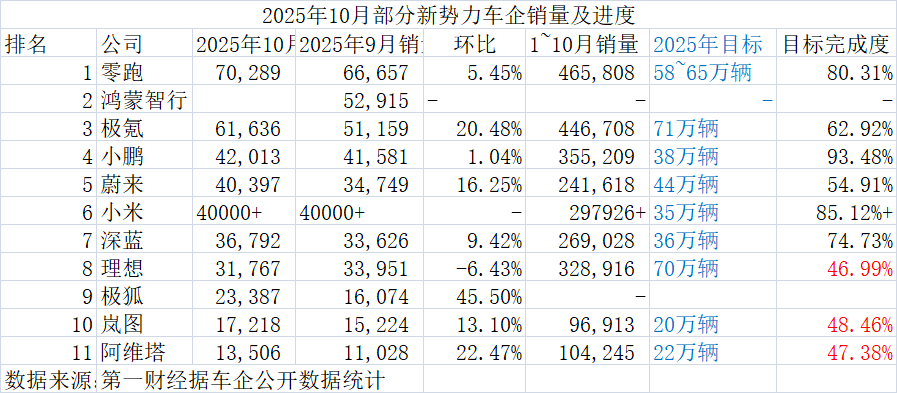
Core Insights - The sales gap among new energy vehicle companies is widening, with significant disparities in delivery numbers for October [1][2] Group 1: Sales Performance - Leap Motor delivered over 70,000 vehicles in October, achieving a record high of 70,289 units, representing a year-on-year increase of over 84% [2] - Xiaopeng and NIO both surpassed 40,000 deliveries, with 42,013 and 40,397 units respectively, marking their historical highs [3] - Li Auto's deliveries fell to 31,767 units in October, down 6.43% month-on-month and 38.25% year-on-year, making it the only new force car company with less than 50% of its delivery target achieved [4] Group 2: Competitive Landscape - The new energy vehicle first-tier group now has a monthly sales threshold of 40,000 units, including Leap Motor, Hongmeng Zhixing, Xiaopeng, NIO, and Xiaomi, while Li Auto has been excluded from this group [4] - Zeekr achieved a monthly sales record of over 60,000 units, with Zeekr brand sales at 21,423 units and Lynk brand sales at 40,213 units [7] - The combined sales of Deep Blue, Lantu, and Avita in October totaled 67,516 units, which is still lower than Leap Motor's single-month sales [9] Group 3: Market Trends - The market is witnessing a significant differentiation among new energy vehicle companies, with those lacking competitive advantages facing a harsher elimination process in the coming year [9] - The CEO of Leap Motor emphasized the importance of continuous improvement and leveraging strengths to succeed in the long-term automotive industry [9]