人民币衍生品

Search documents
2025年银行间市场人民币衍生品市场成交额58.5万亿元
Sou Hu Cai Jing· 2026-02-11 11:00
Core Insights - The central viewpoint of the news is the significant growth in the financial market operations projected for 2025, particularly in the interbank market for RMB derivatives and government bond futures. Group 1: Interbank Market - In 2025, the transaction volume of the interbank RMB derivatives market is expected to reach 58.5 trillion yuan, representing an increase of 58.6% compared to 2024 [1] - By the end of 2025, the average closing price of the 1-year FR007 swap rate is projected to be 1.50%, which is an increase of 3 basis points from the end of 2024 [1] Group 2: Government Bond Futures Market - The transaction volume of the government bond futures market in 2025 is anticipated to be 97.0 trillion yuan, marking a growth of 43.9% from 2024 [1] - At the end of 2025, the open interest in government bond futures is expected to be 648,000 contracts, an increase of 30.4% from the end of 2024 [1] - The closing price of the main contract for 10-year government bonds is projected to be 107.9 yuan, reflecting a decrease of 1.0% compared to the end of 2024 [1]
央行发布2025年金融市场运行情况
Xin Lang Cai Jing· 2026-02-11 09:41
Group 1: Money Market Operations - In 2025, the average daily transaction volume of interbank lending was 361.07 billion yuan, a decrease of 12.1% compared to 2024 [1] - The average daily transaction volume of bond repurchase in the interbank market was 6.9 trillion yuan, an increase of 3.0% compared to 2024 [1] - By the end of 2025, the outstanding balance of interbank lending was 1.0 trillion yuan, while the outstanding balance of bond repurchase in the interbank market was 12.0 trillion yuan [1] Group 2: Bond Market Operations - In 2025, net financing for government bonds reached 1.38 trillion yuan, an increase of 250 billion yuan compared to 2024 [5] - Net financing for corporate bonds was 240 billion yuan, an increase of 48.23 billion yuan compared to 2024 [5] - The bond market's custody balance was 196.7 trillion yuan by the end of 2025 [5] Group 3: Derivatives Market Operations - The transaction volume of the RMB derivatives market in the interbank market was 58.5 trillion yuan, an increase of 58.6% compared to 2024 [11] - The transaction volume of government bond futures was 9.7 trillion yuan, an increase of 43.9% compared to 2024 [11] - The closing price of the 10-year government bond futures main contract was 107.9 yuan, a decrease of 1.0% compared to the end of 2024 [11] Group 4: Commercial Paper Market Operations - In 2025, the acceptance amount of commercial bills was 42.7 trillion yuan, while the discount amount was 33.9 trillion yuan [13] - By the end of 2025, the acceptance balance of commercial bills was 21.2 trillion yuan, an increase of 7.2% compared to the end of 2024 [13] - The discount balance was 16.5 trillion yuan, an increase of 11.2% compared to the end of 2024 [13] Group 5: Stock Market Operations - By the end of 2025, the Shanghai Composite Index closed at 3968.8 points, an increase of 18.4% compared to the end of 2024 [15] - The Shenzhen Component Index closed at 13525.0 points, an increase of 29.9% compared to the end of 2024 [15] - The average daily transaction volume of both markets was 1.70454 trillion yuan, an increase of 61.9% compared to 2024 [15] Group 6: Bond Market Holder Structure - As of the end of 2025, there were 3923 institutional members in the interbank bond market, all of which were financial institutions [30] - The top 50 investors in corporate credit bonds held 53.4% of the total, mainly concentrated in state-owned commercial banks, public funds, and insurance financial institutions [30] - The top 200 investors held 84.5% of the total bonds [30]

环京津冀区域 银行间人民币衍生品业务发展交流会举办
Jin Rong Shi Bao· 2025-10-27 00:38
Core Insights - The recent development exchange meeting for interbank RMB derivatives aims to enhance the cultivation of the interbank derivatives market and promote the rational use of RMB derivatives by financial institutions to manage risks [1][2] Group 1: Market Development - The interbank RMB derivatives market has experienced rapid growth in recent years, with a continuous expansion of product offerings and an increase in market scale and participating institutions [2] - The market plays an increasingly important role in serving market risk management and promoting reasonable pricing in the bond market [2] Group 2: Institutional Collaboration - Shanghai Clearing House, as the only central counterparty clearing institution in the interbank market, collaborates with the People's Bank of China to establish a policy implementation coordination mechanism to promote high-quality development of the interbank RMB derivatives market [2] Group 3: Conference Highlights - The conference focused on the development of the interbank RMB derivatives market, with discussions on credit derivatives, interest rate derivatives, and the central counterparty clearing mechanism [1] - Representatives from active market institutions shared experiences on credit risk mitigation tools and interest rate risk management [1]
关税成催命符,亚洲去美元化愈演愈烈!
Jin Shi Shu Ju· 2025-05-09 08:47
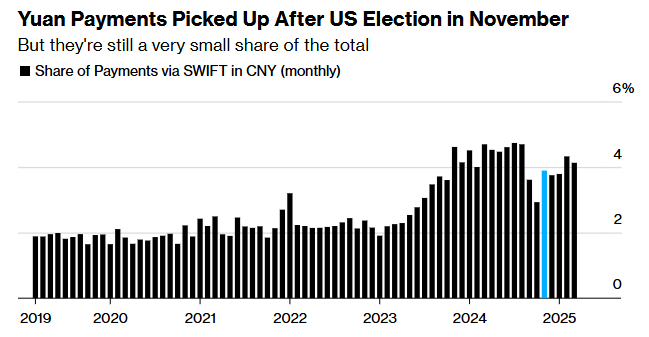
Core Viewpoint - The demand for currency derivatives that bypass the US dollar is rising due to heightened trade tensions, indicating a significant acceleration in the trend of de-dollarization [1][2][3]. Group 1: Increasing Demand for Non-Dollar Transactions - Companies are increasingly receiving requests for transactions involving currencies like the renminbi, Hong Kong dollar, UAE dirham, and euro, indicating a shift away from dollar-denominated trades [1][2]. - The use of non-dollar currencies is being driven by technological advancements and increased liquidity, with market participants believing that pricing in non-dollar currencies may not be worse than using the dollar [2][3]. - The trend of bypassing the dollar is evident in various regions, with tighter business ties between China, Indonesia, and the Gulf region stimulating demand for non-dollar hedging [2][3]. Group 2: Renminbi's Growing Role - The renminbi's share of global payments has increased to approximately 4.1% as of March, although it remains significantly lower than the dollar's 49% share [4]. - The Cross-Border Interbank Payment System (CIPS) processed about 175 trillion renminbi (approximately 24 trillion USD) in cross-border payments in 2024, reflecting a year-on-year growth of over 40% [4][7]. - Chinese exporters are increasingly converting dollar revenues into renminbi, reversing previous trends driven by concerns over renminbi depreciation [7]. Group 3: Structural Changes in Dollar Usage - The dollar's role as a dominant currency in global trade is being eroded, with its use as an intermediary currency accounting for about 13% of its daily trading volume [2][3]. - The ongoing geopolitical tensions and the perception of the dollar being weaponized have led to increased interest in de-dollarization among various countries [3][10]. - Analysts suggest that while the dollar's dominance is resilient, the risk of a significant shift in the international monetary landscape is increasing [10].
关税加速亚洲“去美元化”浪潮:非美货币交易增加,人民币结算量飙升
智通财经网· 2025-05-09 03:31
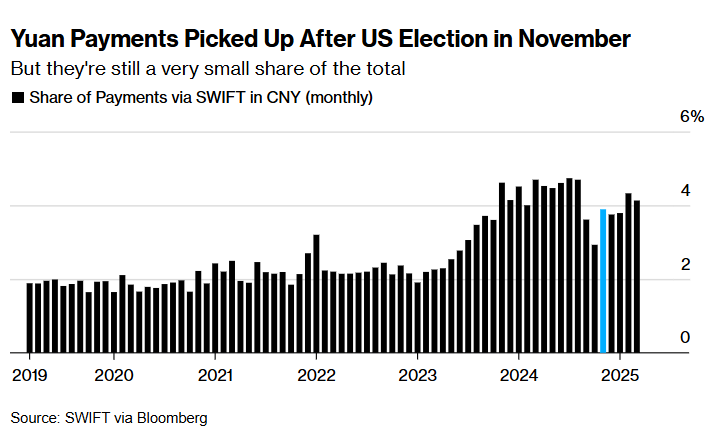
Core Insights - There is a rising demand for foreign exchange derivatives that bypass the US dollar, driven by trade tensions and a long-term trend towards de-dollarization [1][4][5] - Financial institutions are increasingly receiving requests for hedging transactions involving currencies like the Chinese yuan, Hong Kong dollar, UAE dirham, and euro [1][4] - The trend of de-dollarization is accelerating, with more companies and investors seeking alternatives to the dollar as a global reserve currency [4][5] Group 1: Demand for Non-Dollar Transactions - Financial institutions report a growing number of requests for transactions that avoid the dollar, particularly in regions with increasing commercial ties, such as between China, Indonesia, and the Gulf [4][5] - A Singapore-based commodity trading company noted that European financial institutions are launching more yuan derivatives that exclude the dollar [4] - The establishment of a dedicated team by a foreign bank in Indonesia to facilitate transactions in the Indonesian rupiah against the yuan indicates a shift towards non-dollar hedging [4] Group 2: Structural Changes in Dollar Usage - The dollar's role in global trade is being eroded, with estimates suggesting that transactions using the dollar as an intermediary account for about 13% of its daily volume [5][6] - The rise of the yuan in international transactions is supported by China's efforts to promote its currency through bilateral agreements with countries like Brazil and Indonesia [5][6] - The global payment company Swift reported that the yuan accounted for approximately 4.1% of global payments in March, while the dollar held a dominant 49% [7] Group 3: Cost and Liquidity Considerations - Although hedging based on the yuan is often more expensive than dollar-based hedging, the lower interest rates on yuan-denominated loans may still make it attractive for borrowers [7] - The cost of hedging against the dollar has increased over the past year, indicating heightened demand for options to protect against dollar depreciation [8] - Analysts suggest that significant changes in the international environment are necessary for a true replacement of the dollar, but the risk of such a shift is growing [10]