
依洛硫酸酯酶α药物(唯铭赞)

Search documents
从战略布局到清算退场,锐康迪折戟中国罕见病市场
2 1 Shi Ji Jing Ji Bao Dao· 2026-01-12 09:47
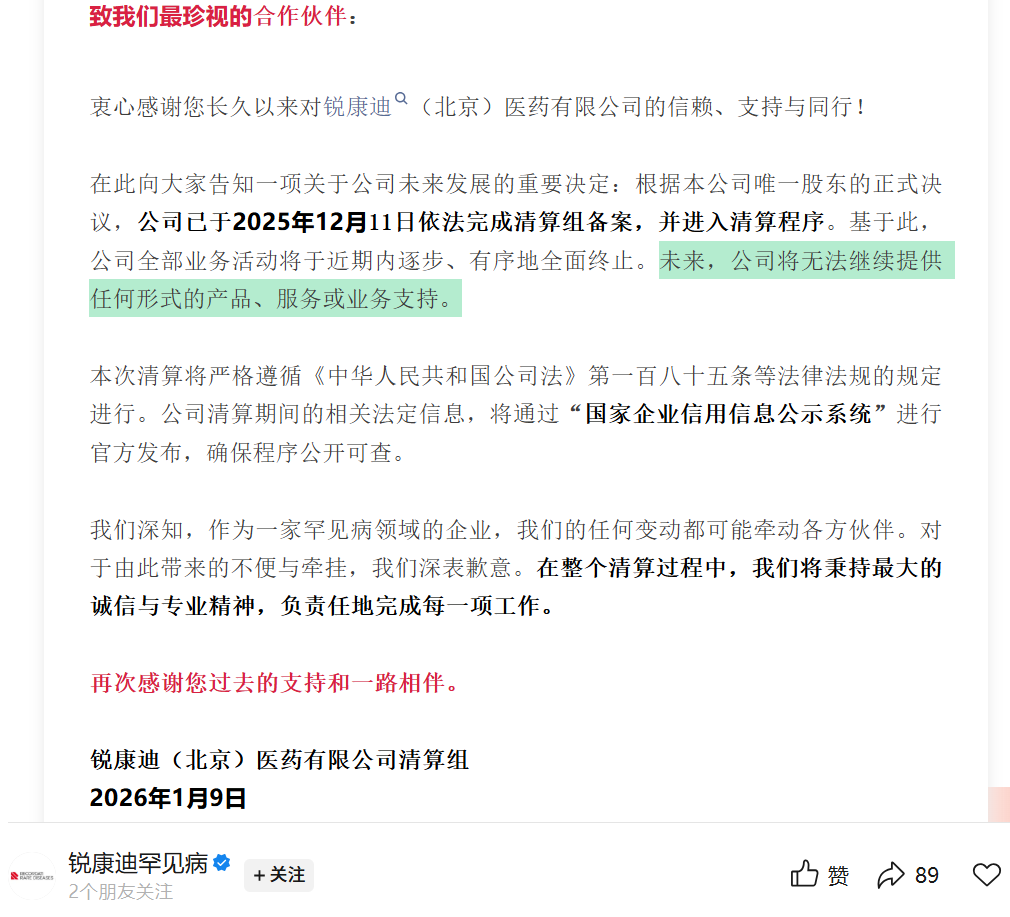
Core Viewpoint - Recordati's subsidiary, Ricordi, has officially entered liquidation and will cease all operations in the Chinese rare disease market, marking a significant exit from this sector [1][2]. Group 1: Company Operations and Products - Ricordi had three approved rare disease drugs in China: Carbamoyl Glutamic Acid Tablets (Kaba Guo®), Phosphate Ozoniside Tablets (Shi Rui Sa®), and Injection of Hydroxy-Naphthyl Acetic Acid Parepitide Microspheres (Sai Ni Fen®) [1][2]. - The company initiated its operations in China in 2021, focusing solely on the rare disease segment, which was experiencing a surge in policy support [2]. - The commercial launch timeline for Ricordi's products includes Carbamoyl Glutamic Acid Tablets approved in June 2023 and launched in November 2023, with Phosphate Ozoniside Tablets and Injection of Hydroxy-Naphthyl Acetic Acid Parepitide Microspheres expected to follow in 2024 and 2025 respectively [3]. Group 2: Market Challenges and Patient Impact - The exit of Ricordi from the Chinese market raises concerns about treatment continuity for rare disease patients, who already face challenges such as low awareness, difficult diagnoses, and insufficient insurance coverage [1][5]. - The company had previously attempted to improve drug accessibility through patient assistance programs and inclusion in local health insurance schemes [4]. - The challenges faced by Ricordi highlight broader issues in the commercialization of rare disease drugs in China, including high R&D costs and the need for a sustainable support system for patients [1][6]. Group 3: Industry Context and Future Outlook - The exit of Ricordi reflects a broader trend among multinational pharmaceutical companies reassessing their strategies in the Chinese market, particularly in the rare disease sector [7][8]. - Despite advancements in the rare disease drug coverage system, significant gaps remain, impacting the commercial viability of these drugs [8]. - Future discussions will focus on whether Ricordi's approved products can return to the Chinese market through policy channels or be taken over by other companies to continue supplying these essential treatments [6].

跨国药企的中国“棋局”:进退间找寻“价值竞争”定位
2 1 Shi Ji Jing Ji Bao Dao· 2025-10-27 07:02
Core Insights - The recent announcement by the National Medical Products Administration (NMPA) to cancel the registration of 80 drugs, primarily from foreign pharmaceutical companies, reflects strategic market adjustments rather than a long-term withdrawal from the Chinese market [1][2][11] - The Chinese medical market is projected to grow significantly, from $1.4 trillion in 2014 to $2.1 trillion by 2030, indicating strong potential for both foreign and domestic pharmaceutical companies [1][8] Group 1: Market Dynamics - Over 55% of the canceled drug registrations are from foreign or joint-venture pharmaceutical companies, highlighting their significant presence in the market [1] - The reasons for drug cancellations include raw material shortages, declining market performance, and competitive pressures from centralized procurement policies [2][3] - The market is experiencing a dual phenomenon of "exit and return," where some original research drugs are leaving the market while others are re-entering after strategic adjustments [1][4] Group 2: Strategic Adjustments - Companies like Sanofi and GSK have withdrawn certain products due to poor sales performance and competitive pricing pressures from domestic firms [2][3] - The trend of original research drugs exiting the market is seen as a temporary strategy to avoid damaging brand value in a highly competitive environment [5][11] - The return of some original research drugs, such as the enzyme replacement therapy for a rare disease, demonstrates the feasibility of re-entering the market through policy channels [4][5] Group 3: Future Opportunities - The Chinese pharmaceutical market is expected to see a shift towards innovative drugs, with their market share projected to increase from 34% in 2024 to nearly 60% by 2030 [9][10] - Cross-border collaborations are on the rise, with a significant increase in partnerships between Chinese and American companies, indicating a growing interest in the Chinese market [10][11] - Companies are encouraged to focus on value competition rather than price competition, particularly in the context of an aging population and increasing demand for quality medications in county-level markets [7][11]