
信用衍生品

Search documents
全球固收量化:四大流派、五大局限未来已来系列之一
GF SECURITIES· 2026-02-12 13:02
1. Report Industry Investment Rating No information provided in the content. 2. Core Viewpoints of the Report - The bond market is at a transformative moment, and the "Future is Here" series of reports focuses on exploring cutting - edge technologies affecting the bond market to empower investment research [3]. - Fixed - income quantification is an inevitable product of financial industrialization and the answer of the bond market in the AI - empowered era. It has evolved from subjective to systematic, model - based, and data - driven, and has moved from the edge to the core of the trading desk [3]. - Compared with relatively mature equity quantification, fixed - income quantification has unique characteristics, including more complex tools and market structures, stronger policy and institutional factors, and more prominent liquidity and data quality issues [3]. - The report aims to answer four questions: the main schools of fixed - income quantification and their basic logics, the applicable market environments for these quantification technologies, the problems that quantification technologies cannot solve or may amplify risks, and the future prospects and optimization spaces of fixed - income quantification [3]. 3. Summary According to the Table of Contents 3.1 Global Fixed - Income Quantification: Four Schools and Basic Logics 3.1.1 Fundamental Quant - Focuses on using economic logic, macro data, and fundamental factors to predict market directions or asset values. It tries to "model" the logic that traditional macro research relies on analysts' experience for [8]. - The process includes data input (such as GDP, CPI, and PMI), building models (e.g., a two - factor model of "growth" and "inflation" or a multi - dimensional macro - factor system), and formulating trading logics (e.g., going long on interest - rate bonds in the "loose money + tight credit" cycle) [8]. - With the development of data technology, it uses high - frequency data for nowcasting to capture economic temperature changes. However, it faces challenges such as "overfitting" risk, structural breaks, and the risk of "fundamental desensitization" and model failure [8][9][10]. 3.1.2 Technical Quant - Focuses on using market volume and price data to capture trading opportunities from trends, reversals, or micro - structures without relying on macro - economic explanations [11]. - Trend - tracking and CTA fixed - income strategies use time - series momentum trading on interest rates and bond prices, which has significant long - term trend premiums and is important in multi - asset CTA strategies. The strategies are applied through unified momentum/trend rules on multiple products and can be part of a cross - asset trend strategy [11][12][15]. - Market - making and micro - structure quantification focuses on using quantification technology to improve pricing and inventory management in aspects such as order - book modeling, quoting strategies, and execution algorithms [18][20]. 3.1.3 Relative Value Quant - Focuses on cross - sectional comparison or finding pricing deviations to earn mean - reversion returns or risk premiums, often involving long - short hedging or factor - based bond selection [18]. - Interest - rate term structure and curve trading use various interest - rate term structure models to factorize the yield curve and conduct relative - value trading based on the deviation between the theoretical and actual curves [18][23]. - Carry/Roll - down strategies aim to earn the "time value" of the interest - rate curve and bonds. It is effective in stable or downward - trending interest - rate environments and is often incorporated into the factor - investment framework [26][28]. - Credit and spread factor strategies map bond characteristics into a series of credit and style factors to construct long - short or over -/under - weighted portfolios to earn factor premiums [33]. - Relative value and basis arbitrage focus on price "dislocation" between different tools with the same or similar risk exposures and use methods like PCA, mean - reversion modeling, and high -/medium - frequency data mining to construct statistical arbitrage strategies [38]. 3.1.4 Multi - Factor Models - Aims to systematically integrate excess returns from different sources. The core logic is to decompose the expected return of bonds into a linear combination of several risk factors to build a portfolio with a higher Sharpe ratio and smaller drawdowns [39]. - It is related to the three previous schools. It uses a large amount of fundamental data, includes momentum factors from the technical school, and is mainly used for "bond selection" similar to the relative - value school [43][45]. 3.2 Market Environments Suitable for Quantitative Technologies - **Liquidity and Trading Systems**: High - liquidity, low - transaction - cost markets are suitable for curve trading, relative - value, CTA trend, market - making, and high - frequency strategies; medium - liquidity markets are suitable for term - structure models, carry, and some relative - value and factor strategies; low - liquidity, OTC - dominated credit markets are suitable for medium - to - low - frequency factor strategies, duration/barbell allocation, and some structured - product pricing [48][49]. - **Interest - Rate Levels and Volatility Environments**: When the interest - rate center is declining with mild fluctuations, carry and roll - down strategies perform well, and term - structure strategies can profit from the "loose - neutral" switch. When interest rates rise rapidly or policies change suddenly, term - structure and carry strategies are prone to net - value drawdowns, while CTA trend and duration - hedging strategies can provide some protection [50]. - **Credit Environments and Macroeconomic Cycles**: In a low - default - rate, credit - expansion period, credit factors and credit - sinking strategies have high "tailwind returns". In a credit - contraction and high - default period, quantitative models may underestimate tail risks and are difficult to capture sudden "black - swan events" [51][53]. 3.3 Five Limitations of Fixed - Income Quantification - Policy and institutional inflection points are "unquantifiable" because central - bank monetary policies and regulatory reforms often show "discrete" and "mutant" characteristics, and historical - data - trained models may fail when regime shifts occur [55]. - "Liquidity black holes" and "out - of - model" risks exist because most models assume a "frictionless market", but the credit - bond market often faces liquidity shortages, which can lead to the failure of traditional strategies [56]. - Credit defaults have "small - sample" and jump risks. Bond defaults are sparse events, resulting in model overfitting or non - convergence, and the non - standardized information in the default process is difficult to cover [57]. - Complex terms and game behaviors are non - modelable. Many fixed - income products have complex option terms, and their triggering depends on issuers' subjective will, causing the deviation between the theoretical option value calculated by quantitative models and the market price [58]. - Crowded trading and endogenous instability occur when quantitative strategies are highly homogeneous. Once the market fluctuates in the opposite direction, the concentrated stop - loss orders can cause a stampede and more severe fluctuations [59][60]. 3.4 Outlook: The Future Landscape of Fixed - Income Quantification - **Quantamental (Quantitative + Fundamental)**: Quantitative analysis will empower fundamental analysis. Future mainstream models include "quantitative support with subjective decision - making" or "subjective logic with quantitative verification", applicable in macro - asset allocation and credit screening [62]. - **In - Depth Penetration of Alternative Data and AI Technologies**: With the development of large - language models, non - structured data can be processed, providing new sources of alpha. Applications include semantic and sentiment analysis of text data and using satellite and geographical data for investment analysis [63]. - **Algorithmic and Automated Trade Execution**: The increasing proportion of electronic trading in the Chinese bond market provides a foundation for algorithmic trading. Intelligent order - splitting algorithms can reduce impact costs, and machine - learning - based market - making strategies can adjust quotes and control inventory risks [64][66].
持续减费降负 推进信用衍生品清算业务创新发展
Jin Rong Shi Bao· 2026-01-06 02:17
Core Viewpoint - Shanghai Clearing House announced a phase-wise exemption of clearing fees for credit derivatives contracts in 2026 to reduce costs for market institutions and enhance financial services for the real economy [1] Group 1: Development of Credit Derivatives Market - The exemption period for clearing fees will be from January 1, 2026, to December 31, 2026, with further adjustments to be notified later [1] - The Shanghai Clearing House aims to innovate and develop credit derivatives clearing services, focusing on policy direction and market demand [1] Group 2: Functions of Credit Derivatives - Credit derivatives serve as important pricing and hedging tools, enhancing the efficiency of bond issuance and broadening financing channels for real enterprises [1] - They enable market institutions to manage credit risk exposure effectively, smooth credit spread fluctuations, and improve investment efficiency in sectors like technology and green bonds [1] - Credit derivatives can hedge against credit spread volatility, expanding trading demand and diversifying application scenarios [1] Group 3: Centralized Clearing Function - The Shanghai Clearing House aims to enhance its clearing services to support the real economy and mitigate financial risks [2] - It has expanded the central counterparty clearing to include 32 new quality production enterprises, providing services for 145 standardized CDS contracts linked to technology and green sectors [2] - The introduction of the first Sci-Tech CDS index will help market institutions manage credit risk and provide a pricing benchmark for credit risk in Sci-Tech enterprises [2] - The clearing house continues to diversify its clearing targets, covering various types of bonds to meet market demands [2] - A one-stop online service for the lifecycle of credit derivatives has been established, significantly improving clearing efficiency and market transparency [2] Group 4: Future Plans - The Shanghai Clearing House will continue to leverage its financial infrastructure advantages under the guidance of the People's Bank of China, enriching the product spectrum of credit derivatives [3] - It aims to enhance the risk management, credit enhancement, and price discovery functions of credit derivatives, effectively guiding financial resource allocation [3]
中资离岸债风控双周报(12月15日至26日):一级市场发行趋缓 二级市场涨跌不一
Xin Hua Cai Jing· 2025-12-27 13:56
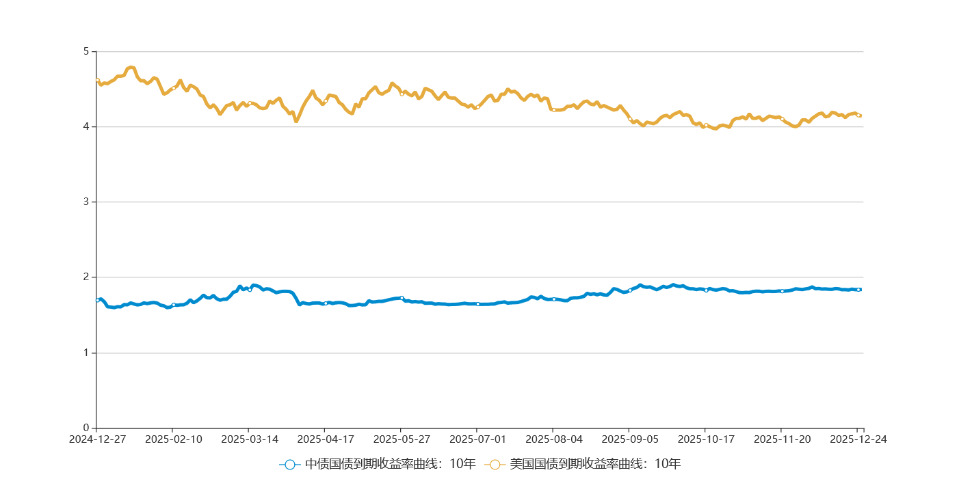
Primary Market - In the past two weeks (from December 15 to December 26), a total of 12 offshore bonds were issued by Chinese entities, including 6 offshore RMB bonds and 6 USD bonds, with issuance scales of 43.058 billion RMB and 296 million USD respectively [2] - The largest single issuance of RMB bonds was 1.05 billion RMB by Nan'an Development Investment Group Co., Ltd., while the highest coupon rate for RMB bonds was 6.9% issued by Zibo High-tech State-owned Capital Investment Co., Ltd. [2] - In the USD bond market, the largest single issuance was 100 million USD by Industrial Bank Co., Ltd. Hong Kong Branch, with the highest coupon rate of 4.35% issued by Ganzhou Urban Investment Holding Group Co., Ltd. [2] Secondary Market Overview - As of December 26, the Markit iBoxx Chinese USD bond composite index rose by 0.06% to 251.26, while the investment-grade USD bond index increased by 0.08% to 244.35. The high-yield USD bond index fell by 0.14% to 241.3 [3] - The real estate USD bond index increased by 0.12% to 178.37, while the city investment USD bond index decreased by 0.01% to 153.9, and the financial USD bond index fell by 0.06% to 290.9 [3] Benchmark Spread - As of December 26, the yield spread between 10-year U.S. and Chinese government bonds narrowed to 229.47 basis points, a decrease of 2.13 basis points from the previous week [4] Rating Changes - On December 24, Fitch downgraded Vanke's long-term issuer rating to "RD" due to ongoing concerns regarding its debt management [6] - On December 23, Fitch downgraded Wanda Commercial Management and Wanda Hong Kong's long-term foreign currency issuer ratings to "C" [6] - On December 19, China Chengxin International withdrew the "BBBg-" long-term credit rating of Renshou Xingxin Industrial Investment Co., Ltd. for commercial reasons [6] - On December 18, United Ratings withdrew the "BBB-" international long-term issuer credit rating of Sichuan Hengji Industrial Group Co., Ltd. for commercial reasons [6] - On December 17, Dagong International withdrew the "BBB" rating of Fuzhou Industrial Investment Group Co., Ltd. for commercial reasons [6] Default and Extension - On December 26, Tianan Life Insurance Co., Ltd. announced that it would be unable to repay the principal and interest of the "15 Tianan Life" bond, which is due on December 29, 2025, with a total issuance of 2 billion RMB and a 10-year term [7] Domestic News - The People's Bank of China issued the "Rules for the RMB Cross-Border Payment System," allowing operating institutions to open clearing accounts at the PBOC for CIPS business settlement funds [9] - As of the end of November, foreign institutions held 3.61 trillion RMB in the interbank bond market, accounting for approximately 2.1% of the total custody amount [10] - On December 19, the first offshore RMB sci-tech bond credit derivative transaction was completed between SPDB and Huatai Securities, marking a significant step in supporting the development of technology innovation and the internationalization of the RMB [11] Overseas News - Japan's government approved a budget proposal for the fiscal year 2026, with a total budget of 122.3 trillion yen, which includes a record high for debt repayment and interest, raising concerns among market participants [12] Offshore Debt Alerts - On December 23, Sunac China announced the completion of its comprehensive offshore debt restructuring, relieving approximately 9.6 billion USD of existing debt [13] - On December 25, Aoyuan Group announced that the bondholder meeting approved the adjustment of the principal and interest payment arrangement for "H20 Aoyuan 1" [14] - On December 24, Jinlun Tiandi Holdings announced that its major creditors agreed to extend the deadline for offshore debt restructuring from December 31, 2025, to June 30, 2026 [15] - On December 24, Sunshine City Group announced that it had overdue unpaid debt principal totaling 65.916 billion RMB, with 2.244 billion USD in offshore bonds and 16.463 billion RMB in domestic public market bonds unpaid [16]




怎样理解稳步发展期货、衍生品和资产证券化
Xin Lang Cai Jing· 2025-12-21 05:18
Group 1: Core Insights - The proposal from the Central Committee emphasizes the need to steadily develop futures, derivatives, and asset securitization as essential measures for establishing a well-structured financial market system and accelerating the construction of a financial powerhouse [1] - The derivatives market in China is projected to exceed 230 trillion yuan in trading volume by 2024, highlighting the importance of derivatives in price discovery and risk management [2] - The current development of the derivatives market in China is lagging, with the daily trading volume of interest rate derivatives being only about 0.8% of the outstanding government bonds, compared to 8%-9% for USD and EUR derivatives [2] Group 2: Derivatives Market Development - To enhance the derivatives market, it is crucial to optimize regulatory approaches, allowing more qualified entities like insurance companies and banks to access derivatives, thus diversifying participants and trading scenarios [3] - Strengthening regulatory capabilities is essential to avoid systemic risks, improve transparency, and enhance regulatory effectiveness [3] - Financial institutions should develop internal management systems tailored to derivatives business characteristics, improve hedge accounting, and build talent in pricing and risk control [3] Group 3: Asset Securitization - Asset securitization plays a vital role in revitalizing existing assets, stabilizing macro leverage ratios, optimizing asset-liability structures, and broadening financing channels [4] - The asset securitization market in China has entered a normalization phase since 2014, with annual issuance reaching around 2 trillion yuan, but faces challenges such as unclear underlying legal relationships and high issuance management costs [4] - There is significant potential for asset securitization to support the real economy, particularly in infrastructure, public utilities, and advanced manufacturing sectors [5] Group 4: Future Directions - The focus should be on serving key areas of the real economy, enhancing innovation in standards, financial products, and policy guidance [5] - It is necessary to improve the legal framework and supporting arrangements for the market, ensuring clear rights and obligations among participants [5] - Diversifying investors and enhancing the secondary market's liquidity are critical for the long-term healthy development of the asset securitization market [5]
学习规划建议每日问答 | 怎样理解稳步发展期货、衍生品和资产证券化
Xin Hua She· 2025-12-21 03:16
Group 1: Core Insights - The proposal from the Central Committee emphasizes the need to steadily develop futures, derivatives, and asset securitization as essential measures for establishing a well-structured financial market system and accelerating the construction of a strong financial nation [1] - The derivatives market in China is expected to exceed 230 trillion yuan in trading volume by 2024, highlighting the importance of derivatives in price discovery and risk management [2] - The current development of the derivatives market in China is lagging, with the daily trading volume of interest rate derivatives being only about 0.8% of the outstanding government bonds, compared to 8-9% for USD and EUR derivatives [2] Group 2: Derivatives Market Development - To enhance the derivatives market, it is crucial to optimize regulatory approaches, allowing more qualified entities like insurance companies and banks to engage in derivatives trading [3] - Strengthening regulatory capabilities is essential to avoid systemic risks, improve transparency, and enhance regulatory effectiveness [3] - Financial institutions should develop internal management systems tailored to derivatives business characteristics and improve talent development in pricing and risk control [3] Group 3: Asset Securitization - Asset securitization plays a vital role in revitalizing existing assets, stabilizing macro leverage ratios, optimizing asset-liability structures, and broadening financing channels [4] - The asset securitization market in China has entered a normalization phase since 2014, with annual issuance reaching around 2 trillion yuan, but faces challenges such as unclear legal relationships and high issuance costs [4][5] - To promote the long-term healthy development of the asset securitization market, it is necessary to focus on serving key sectors of the real economy and enhance the legal and regulatory framework [5]
多家机构线上化入市信用衍生品双边清算业务
Jin Rong Shi Bao· 2025-08-05 02:29
Core Points - The Shanghai Clearing House has launched an online bilateral clearing service for credit derivatives to enhance market participation convenience and support market expansion [1][2] - The first batch of institutions to complete the online application includes China Construction Bank, Changsha Bank, Southwest Securities, and Zhongyu Guarantee [1] - The clearing services provided cover various aspects such as cash flow calculation, fund settlement, credit event settlement, valuation management, and counterparty credit risk management [1] - Currently, there are 47 participants in the credit derivatives clearing, accounting for 96% of the trading scale in the interbank market for contract-based credit derivatives [1] Future Plans - The Shanghai Clearing House plans to continue enhancing clearing service capabilities and product offerings under the guidance of the People's Bank of China [2] - The aim is to support various institutions in managing risks with credit derivatives and to improve the effectiveness of credit derivatives in serving the real economy [2] - The initiative is part of efforts to effectively prevent and resolve financial risks, thereby supporting high-quality development of the real economy [2]
信用衍生品“加持”科创债发行 市场呼吁加快完善制度释放增信潜力
Shang Hai Zheng Quan Bao· 2025-06-15 17:58
Core Viewpoint - The expansion of credit derivatives in the technology bond market is accelerating, serving as both a "risk mitigator" and a "confidence amplifier" for financing [1][2][6] Group 1: Role of Credit Derivatives - Credit derivatives are becoming a key mechanism to address financing challenges for technology enterprises by reducing credit risk through external mechanisms [2][6] - They enhance market confidence and improve financing efficiency by connecting issuers and investors, thereby alleviating concerns about repayment capabilities [2][3] - The use of credit derivatives allows for better risk management for investors, enabling them to hedge against valuation risks associated with high-volatility technology bonds [3][6] Group 2: Recent Developments - Several financial institutions, including Bank of Communications and Shanghai Pudong Development Bank, have successfully completed credit derivative transactions linked to technology enterprises, marking a significant step in the development of the technology bond market [4][5] - The first credit derivative transaction involving a technology enterprise was completed by Bank of Communications, providing credit risk protection through a credit default swap (CDS) [4] - The issuance of a 300 million yuan credit derivative transaction by Shanghai Pudong Development Bank demonstrates the growing acceptance and implementation of these financial instruments [4][5] Group 3: Challenges and Recommendations - Despite the growing application of credit derivatives, there are still institutional shortcomings in capital relief, pricing mechanisms, and legal applicability that need to be addressed [6][7] - The current market shows a lack of participation from commercial banks in credit derivatives due to accounting treatment issues, which may increase capital requirements instead of reducing them [6][7] - Recommendations include clarifying the capital savings potential of credit derivatives, developing a valuation system suited to the Chinese market, and enhancing legal training to mitigate disputes [7][8]