
储能资产

Search documents
AI引爆绿电狂潮! 清洁能源迎来崛起时刻 华尔街押注绿色巨浪卷土重来
智通财经网· 2026-01-15 07:29
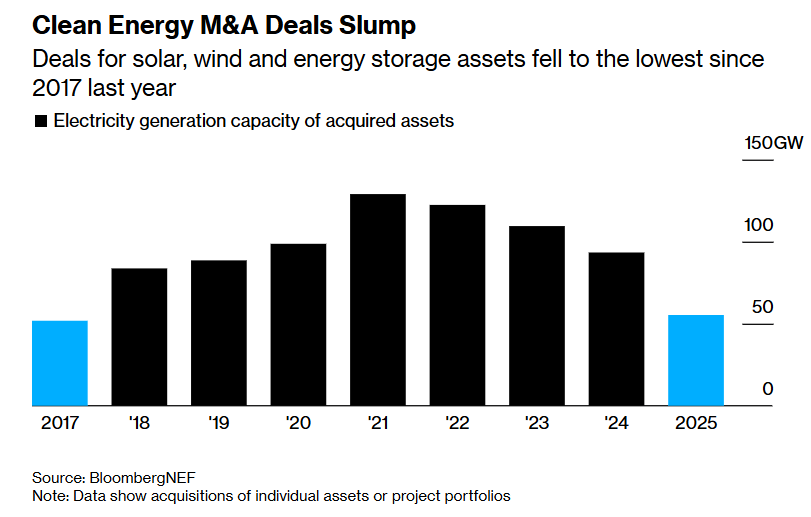
Core Viewpoint - The surge in AI data center construction is driving a strong demand outlook for clean energy, leading to a potential revival of large-scale clean energy projects in the global M&A market, making "green pioneers" the hottest trading assets again [1][4]. Group 1: Market Trends - The past year saw a significant decline in clean energy M&A activity, with solar, wind, and storage asset transactions dropping to the lowest level since 2017 [4]. - It is anticipated that as demand grows, developers and sellers will become more realistic in their valuations, leading to an increase in M&A activity in the renewable energy sector by 2026 [4]. - The average premium for renewable energy company transactions fell to approximately 12% in 2025, down from 46% a year earlier, indicating a shift in market dynamics [6]. Group 2: Investment Insights - Investors are increasingly attracted to large operational projects with reliable off-takers rather than those still in development, which carry higher risks [10]. - Nuveen is currently negotiating a potential large transaction for a wind power asset in the European market, signaling a renewed interest in clean energy investments [5]. - Brookfield raised approximately $20 billion for its global energy transition strategy last year, indicating strong investor interest in renewable energy projects [10]. Group 3: Future Projections - The International Energy Agency (IEA) projects that by 2035, the demand for renewable energy, particularly solar, will grow faster than any other major power source, driven by the adoption of large AI data centers, electric vehicles, and air conditioning systems [7]. - Goldman Sachs predicts a significant increase in electricity demand driven by AI data centers, with a forecasted expansion of 175% by 2030 compared to 2023 [12]. - UBS analysts note that the demand for utility-scale solar projects in the U.S. is gradually exceeding supply, bolstered by the construction of AI data centers aiming for 100% clean energy [13].

电力设备新能源:穿越周期,扬帆远航(二)
2025-04-15 14:30
Summary of Conference Call Notes Industry Overview - The discussion revolves around the energy sector, particularly focusing on the dynamics between traditional energy and renewable energy mechanisms, as well as the implications for energy storage solutions [1][2][3]. Key Points and Arguments 1. **Resource Constraints and Production Capacity**: The primary contradiction in the early stages of the market is the limitation of resources, such as those from lithium mines, and the production costs associated with available capacity. Companies with advanced production technologies in the upstream sector have become attractive to capital [1]. 2. **Emerging Investment Opportunities (2025)**: - **Traditional vs. Renewable Energy**: There is a significant conflict between traditional energy rules and new energy mechanisms, particularly in the electricity spot market and pricing discovery mechanisms. Energy storage presents a substantial regulatory advantage, creating value for asset holders [2]. - **Regional Development Imbalances**: The disparity in regional economic development and carbon constraints has led to gaps in renewable electricity supply, highlighting investment opportunities in these areas [2]. - **High-Growth Applications**: There is a mismatch between high-growth sectors (like data centers and agriculture) and renewable energy supply, indicating a growing demand for renewable applications [3]. 3. **Electricity Pricing Structure**: The composition of electricity prices remains largely unchanged between traditional and renewable markets, but the structural ratios among key components (production costs, transmission, and distribution) are shifting due to the increasing share of wind and solar energy [4]. 4. **Market Signals from Germany**: In Germany's electricity market, daily trading prices show significant fluctuations, with intra-day price spreads reaching over €80 and weekly peaks exceeding €400. This indicates a need to focus on application strategies, particularly in energy storage [5]. 5. **Cost Reduction Projections**: By 2025, the expected installation cost for energy storage systems is projected to be around $190 per kWh, with cost reductions primarily driven by production optimization rather than significant technological breakthroughs [6]. 6. **Arbitrage Opportunities**: The frequency of negative pricing events has increased, providing more opportunities for energy storage systems to capitalize on price fluctuations, thus shortening investment payback periods [7]. 7. **Global Energy Storage Projects**: In 2024, the global addition of energy storage projects is expected to reach 726 GWh, with China leading in new demand, followed by the U.S. and Europe [8]. 8. **Investment Themes**: Key investment themes include: - **International Expansion**: The focus on overseas markets remains crucial due to high demand and production barriers for leading companies [9]. - **Information Arbitrage**: Profiting from price discrepancies and trading service capabilities is highlighted as a lucrative opportunity [10]. - **Off-Grid Applications**: Special attention is drawn to energy storage technologies in off-grid areas, particularly in remote regions and sectors like mining and agriculture [10]. Additional Important Insights - The discussion emphasizes the importance of optimizing energy storage strategies and the need for a deeper understanding of market dynamics to capture future investment opportunities effectively [5][8]. - The potential for energy storage to play a critical role in balancing supply and demand in the evolving energy landscape is underscored, particularly as the market transitions towards more renewable sources [3][9].