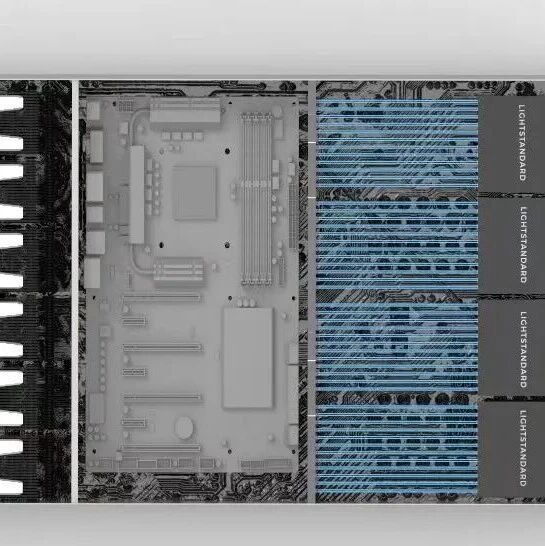
全光计算系统

Search documents
AI计算或迎来“光的时代”
Xin Lang Cai Jing· 2026-01-10 09:09
Core Viewpoint - The company Guangbenwei Technology is developing glass-based optical computing chips to replace silicon substrates, aiming to achieve a new era of "1000 tops computing power and 1000 tops/W energy efficiency" for AI applications [1][2]. Group 1: Technology and Innovation - The glass optical computing chips are designed for AI inference scenarios, with the market expected to reach $255 billion by 2030, as inference will account for 75% of total AI computing [1]. - The company has completed its first commercial-grade optical computing chip, with a matrix size of 128mm x 128mm and a peak computing power exceeding 1000 tops [1]. - Glass is chosen over silicon due to its superior properties such as flatness, thermal stability, and compatibility with optical waveguide processes, allowing for larger chip designs and improved performance [2]. Group 2: Performance and Efficiency - The glass optical computing chip can achieve a computing power of 2600 tops when sized at 200mm x 200mm, significantly enhancing computational capabilities [2]. - The company has developed a zero static power consumption feature for its optical computing chips, predicting an energy efficiency ratio exceeding 1000 tops/W, which is over 200 times that of TPU [2]. Group 3: Future Developments - Guangbenwei Technology aims to create a next-generation all-optical computing system that allows light signals to perform repeated calculations and dynamic storage, moving beyond the limitations of single-core optical computing [3]. - The ultimate goal is to package the glass optical computing chip into a high-performance all-optical computing system, defining the next generation of AI computing standards and providing comprehensive solutions for various user scenarios [3].
震惊沙特的玻璃光计算来了,比Groq更好的AI推理“最终解”?
投中网· 2026-01-04 06:35
Core Viewpoint - The article discusses the potential disruption in the global AI computing landscape due to the advancements made by Guangbenwei Technology, which is set to launch the world's first commercially viable optical computing chip with a 128×128 matrix scale in 2024, utilizing glass instead of silicon as the substrate, thereby addressing the limitations of traditional computing methods [2][4][6]. Group 1: Company Overview - Guangbenwei Technology has completed five rounds of financing within three years, attracting investments from top venture capitalists, domestic internet giants, and state-owned funds from Shanghai and Suzhou [2]. - The company showcased its optical computing products at the Saudi Industrial Transformation Exhibition, receiving high praise from Saudi officials and extensive media coverage [2]. Group 2: Technological Advancements - The new optical computing chip is expected to achieve "thousand POPS-level computing power and thousand TOPS/W energy efficiency," significantly surpassing current GPU and TPU capabilities [2][4]. - Guangbenwei Technology's optical computing products are primarily designed for AI inference scenarios, which are projected to account for 75% of total AI computing by 2030, with a market size of $255 billion [3]. Group 3: Performance Metrics - The 200mm×200mm glass optical computing chip is anticipated to deliver a computing power of 2600 POPS, which is 1400 times that of Google's TPU and 1300 times that of NVIDIA's H200 [6][9]. - The energy efficiency of the glass optical computing chip is expected to exceed 1000 TOPS/W, over 200 times that of TPU, due to its unique material properties [9][11]. Group 4: Market Implications - The shift to glass as a substrate for optical computing chips is seen as a revolutionary step that could redefine the AI computing landscape, moving towards a "full optical era" and potentially disrupting the dominance of companies like NVIDIA [4][15]. - Guangbenwei Technology aims to establish a full-stack optical computing solution that caters to various user needs, from small-scale applications to large data centers, positioning itself as a key player in the upcoming technological revolution [16].