全新BMW iX3长轴距版

Search documents
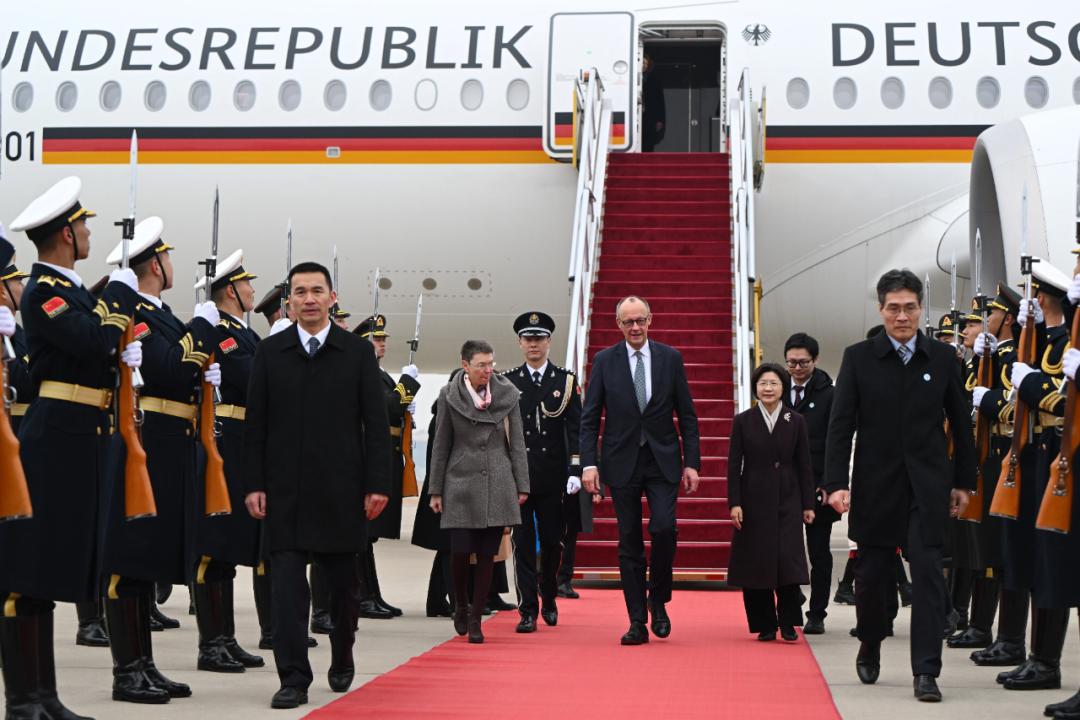
德国总理访华,带着大众、奔驰、宝马的CEO来“取经”
3 6 Ke· 2026-02-26 02:57
Group 1 - The recent visit of German Chancellor Merz to China highlights the growing importance of China in the global economic landscape, particularly for Germany [1][8] - Accompanying Merz is a high-profile economic delegation consisting of around 30 executives from leading German companies in sectors such as automotive, chemicals, pharmaceuticals, and machinery [2] - In 2025, Germany's trade volume with China is projected to reach €251.8 billion, marking a 2.1% increase year-on-year, with China surpassing the US as Germany's largest trading partner [2] Group 2 - Despite the impressive trade figures, there are structural concerns, as a study indicates that Germany's automotive exports to China are expected to plummet by two-thirds by 2025 compared to 2022 [2] - Major German automakers are experiencing significant declines in sales in China, with Volkswagen's deliveries down 7% to 2.69 million units, BMW down 12.5% to 625,500 units, and Mercedes-Benz down 19% to 575,000 units [2] - The market share of German luxury cars has decreased from a peak of 24.2% in 2019 to an estimated 15.4% in 2025, with domestic brands rapidly gaining ground in the premium segment [3] Group 3 - In response to declining sales, German automakers are increasing their investments in China, with projected investments exceeding €7 billion (approximately 57.7 billion RMB) in 2025, the highest since 2021 [4] - The strategy of German car manufacturers is shifting from "producing in China" to "researching in China" and "creating for China," indicating a fundamental change in their operational approach [4][6] - Collaborative efforts with Chinese companies are seen as essential for reducing R&D cycles and costs, which are critical for survival in the competitive automotive industry [6][7] Group 4 - The establishment of a research and development center by Volkswagen in Hefei, which can develop vehicles throughout their entire lifecycle, exemplifies the shift towards localized innovation [7] - The deepening partnerships with local firms, such as Mercedes-Benz's investment in local tech and BMW's collaborations for battery supply and AI, are reshaping the automotive landscape [7] - The visit of top executives from major German automakers underscores the necessity of establishing a strong presence in China, as success in this market is crucial for global competitiveness [8]