兴盛优选

Search documents
中年女性成“人肉补丁” 亲历乡村团购退潮
Sou Hu Cai Jing· 2025-10-14 01:04
Core Insights - The article discusses the transformation of traditional lifestyles and consumption patterns among middle-aged women in a village in Hunan, who have taken on the role of community group buying leaders, referred to as "slash aunties" [2][3][4] - The shift from competition to a more relaxed approach among these group leaders is highlighted, particularly after many platforms withdrew from the market, leading to a decrease in earnings and increased complexities in their roles [2][15][16] Group 1: Community Group Buying Dynamics - The village has ten group leaders, predominantly women over 45, who juggle multiple roles including running small businesses [3][4] - The initial enthusiasm for group buying led to a surge in the number of group leaders during the "Battle of the Hundreds of Groups," but many platforms have since exited the market, leaving the remaining leaders to adapt to new realities [4][15] - The article emphasizes the importance of personal relationships and community ties in the success of these group leaders, as they often rely on their social networks for business [10][22] Group 2: Individual Experiences and Challenges - Individual stories of group leaders like Wu Chunfang illustrate their proactive approach to delivering goods and maintaining customer relationships, often going above and beyond to meet community needs [6][10][20] - The article notes that while some group leaders initially sought to supplement their income, many now view their roles as secondary to their primary occupations, with earnings often seen as "pocket money" [18][19] - The challenges faced by these leaders include managing customer expectations and navigating the complexities of platform rules, which often conflict with local customs and relationships [11][16][22] Group 3: Economic Impact and Future Outlook - The community group buying model has altered consumption habits, with villagers purchasing a wide range of products beyond just groceries, indicating a shift in local economic dynamics [15][18] - The article suggests that while some group leaders have expressed a desire to exit the business due to declining profits, others like Wu Chunfang have solidified their roles within the community, becoming integral to local life [22][23] - The ongoing evolution of this model reflects broader trends in rural consumption and the adaptation of traditional roles in response to modern economic pressures [2][15][22]

社区团购的泡沫破了!美团优选突然关停!多多买菜还能撑多久?
Sou Hu Cai Jing· 2025-06-24 13:07
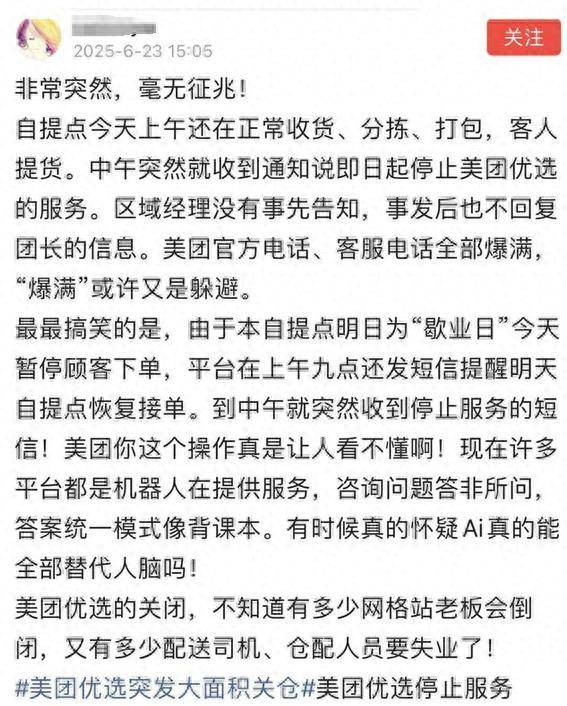
Group 1 - The sudden shutdown of Meituan's community group buying service has disrupted the lives of many stakeholders, including self-pickup point owners, delivery drivers, and warehouse employees [1][2] - Meituan's decision to halt operations is seen as a reflection of the unsustainable nature of the community group buying model, which has resulted in significant financial losses, exceeding hundreds of millions annually [3][11] - Competitors like Duoduo Maicai are poised to capitalize on Meituan's exit, indicating a highly competitive and opportunistic market environment [5][16] Group 2 - The community group buying sector faces inherent challenges, as consumers often find little price advantage compared to traditional supermarkets, which can offer fresher produce and immediate returns [7][9] - Meituan's official statements about focusing resources and exploring new models are perceived as a cover for its inability to sustain losses in less profitable regions [11][15] - The overall sentiment reflects a lack of long-term planning among companies in this sector, leading to high risks for ordinary investors and stakeholders [13][16]