农银汇理新能源主题A

Search documents
背靠农行陷发展困局 农银汇理基金业绩规模双承压 |基金观察
Sou Hu Cai Jing· 2026-02-06 11:25
Core Viewpoint - Agricultural Bank of China-backed fund company, Agricultural Bank of China Huiri Fund, has faced multiple development bottlenecks over the past year, including poor product performance, ineffective fund managers, continuous shrinkage in management scale, and failed shareholder meetings, leading to a significant decline in net profit from 648 million yuan to 248 million yuan, a drop of 61.7% [1] Performance Decline: Equity Products Hit Hard - Despite a recovering public fund market, Agricultural Bank of China Huiri Fund's performance remains sluggish, particularly in equity products, which have seen an absolute return rate of -32.43% over the past three years, placing it in the bottom 10% of the industry [2] - The Agricultural Bank of China Huiri Quality Agriculture Fund, launched in November 2022, has consistently underperformed, with its A-class share net value at 0.8485 and a one-year return of 16.76%, significantly lower than the benchmark of 22.74% and the CSI 300's 23.63% [2] Scale Shrinkage: Weakening Channel Advantage - The management scale of Agricultural Bank of China Huiri Fund has decreased from a peak of 267.9 billion yuan to 226 billion yuan, a nearly 13% reduction, with its industry ranking dropping to 38th [14] - The fund's equity assets have seen a dramatic decline from nearly 80 billion yuan to less than 30 billion yuan, with a 46% drop in equity fund scale and a 23.4% drop in bond fund scale [14] Fund Manager Turmoil: Core Talent Loss - The departure of key fund managers has contributed to the fund's performance decline, with former star manager Zhao Yi leaving after a year, leading to significant losses in the funds he managed [8] - Current fund manager Gu Chao has seen all four funds under his management incur losses, with a maximum loss of 24.11% [9] Fund Management Challenges: High Turnover and Lack of Stability - The fund's research and investment team is relatively small, with high turnover rates among core personnel, making it difficult to establish a stable investment logic and core competitiveness [15] - The company has attempted to launch new products, such as the Agricultural Bank of China Ruiheng Bond Fund, but market response remains to be seen [15]

背靠农行陷发展困局 农银汇理基金业绩规模双承压
Zhong Guo Neng Yuan Wang· 2026-02-06 11:14
Core Viewpoint - Agricultural Bank of China-backed fund management company, Agricultural Bank of China Huiri Fund, has faced significant challenges over the past year, including poor product performance, ineffective fund managers, and a continuous decline in management scale, leading to a net profit drop from 648 million yuan to 248 million yuan, a decrease of 61.7% [1] Performance Decline - The company's performance has been particularly poor in equity products, with a three-year absolute return rate of -32.43%, placing it in the bottom 10% of the industry [2] - Key equity products have suffered losses significantly greater than their peers, with some struggling near the liquidation threshold [2] Fund Performance Data - Agricultural Bank of China Huiri Quality Agriculture Fund has consistently underperformed since its inception, with A-class shares showing a net value of only 0.8485 yuan as of January 23, 2026, and a cumulative loss of 23.21% since inception [3] - The fund's annualized return over the past three years is -15.66%, significantly lagging behind the benchmark and the CSI Agricultural Index [3] Fund Size Reduction - The fund's management scale has drastically decreased from an initial 2.7 billion yuan to 320 million yuan, a reduction of over 88% [4] - The fund's actual holdings have deviated significantly from its agricultural theme, with 73.66% of its holdings in manufacturing sectors [4] Liquidation Risk - The fund has faced liquidation risks since its inception, with multiple announcements regarding potential liquidation due to low net asset values [5] - The company has modified its liquidation terms to make it more difficult to liquidate the fund, but subsequent shareholder meetings have failed due to lack of participation [8] Management Turmoil - The fund has experienced significant turnover in its management team, with previous star fund manager Zhao Yi leaving and subsequent managers failing to deliver positive returns [9] - Current managers have also struggled, with one manager's funds showing a maximum drawdown exceeding 40% [9] Industry Position - The company's management scale has decreased by nearly 13% from its peak, with its industry ranking dropping to 38th [15] - The company has faced increasing challenges in raising new funds, with many new products failing to meet their fundraising targets [16]

昔日“牛基”今何在?
Zheng Quan Shi Bao Wang· 2025-12-23 09:20
Core Viewpoint - The article discusses the performance of actively managed equity funds in the Chinese stock market, highlighting the emergence of new "bull funds" and the fading glory of past top-performing funds, emphasizing the need for a shift towards long-term investment strategies and stable fund management practices [1][9]. Group 1: Performance of Active Equity Funds - As of December 22, the Shanghai Composite Index has increased by 12.67% in 2024, with an additional 16.87% rise for the year, indicating a likely two consecutive years of gains [1]. - Nearly 40 actively managed equity funds have doubled their annual returns, with Yongying Technology Smart Selection A achieving approximately 219% annual return, marking it as the first "double fund" since 2008 [1]. - Historical analysis shows that only 5 out of 30 top-performing funds from previous bull markets have maintained strong performance, while the majority have returned to mediocre status [2]. Group 2: Reasons for Declining Performance of Past "Bull Funds" - Many former "bull funds" have lost their luster due to excessive growth in fund size, which hampers investment flexibility and increases transaction costs [4]. - Over-reliance on a single star fund manager has led to significant performance declines when key personnel leave or fail to adapt to market changes [5]. - Short holding periods and frequent style shifts have also contributed to the underperformance of many funds, as they chase short-term trends without a stable investment framework [6]. Group 3: Structural Changes in the Fund Industry - The public fund industry is undergoing a structural transformation, moving from a short-term ranking focus to a value investment approach aimed at achieving stable returns [7]. - Successful long-term funds are characterized by stable research teams, strong risk control capabilities, and robust company support systems [8]. - The industry is exploring new active investment models, integrating industrialized concepts into research processes to enhance efficiency [8]. Group 4: Long-Term Investment Philosophy - The fate of past "bull funds" reflects the evolution of the A-share market and the industry's changing development philosophy, emphasizing the importance of long-term investment strategies [9]. - Investors are encouraged to focus on funds with clear investment philosophies, stable teams, and proven cross-cycle capabilities rather than chasing annual performance champions [10]. - Funds that may not shine in a single bull market can still create value through solid strategies, rigorous research, and strict risk control [11].
规模突破8200亿元!ESG投资基金跑步扩容,20只产品年内收益超20%
Hua Xia Shi Bao· 2025-06-06 10:00
Core Insights - The ESG investment funds are gaining significant attention in the financial market, with approximately 1200 funds and a total scale exceeding 820 billion yuan as of June 6 [3][4] - Various types of ESG funds are emerging, including pure ESG theme funds, ESG strategy funds, and environmental protection theme funds, reflecting a growing recognition of sustainable investment [3][4] Fund Performance - Among the ESG funds, 84 funds have achieved over 10% returns this year, with 20 funds exceeding 20% and 8 funds surpassing 50% [4][5] - Notable performers include the Bank of China Hong Kong Stock Connect Medical A/C with over 60% returns and the Huatai-PineBridge Health Living One-Year Holding A/C with over 55% returns [5] Market Trends - The increasing number of ESG funds indicates a rising investor interest in corporate social responsibility and sustainable development [4][7] - Fund companies are strategically positioning themselves to attract a broader client base, particularly younger generations and institutional investors who prefer investments aligned with their values [4][7] Regulatory Environment - Since 2020, there has been a growing emphasis on ESG regulations, with various policies being introduced to guide enterprises in ESG practices [7][8] - Central and local governments are actively promoting ESG development, with initiatives aimed at enhancing the quality of state-owned enterprises and fostering sustainable urban development [7][8]

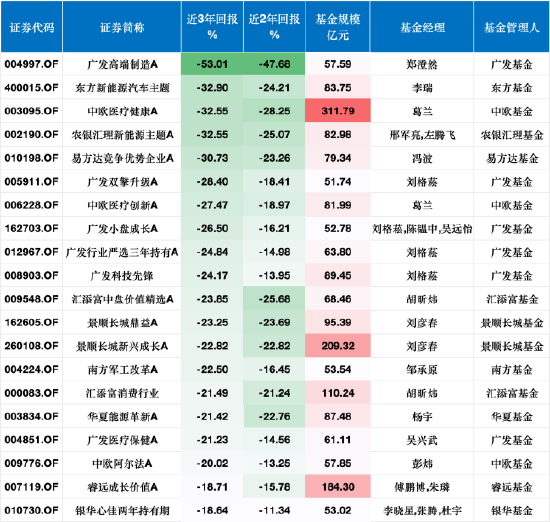
广发高端制造A三年跌53%垫底,管理费累计4.56亿,刘格菘或面临浮动费改大考
Xin Lang Ji Jin· 2025-05-07 08:37
Core Viewpoint - The China Securities Regulatory Commission (CSRC) aims to address the issue of high management fees in public funds despite poor performance through a floating management fee mechanism, highlighting the industry's long-standing problem of "guaranteed returns" regardless of fund performance [1]. Group 1: Fund Performance and Management Fees - The report indicates that the fund "Guangfa High-end Manufacturing A" has the worst three-year return at -53.01%, while it collected management fees totaling 456 million yuan over the same period [3]. - "China Europe Medical Health A," with a scale of 31.179 billion yuan, experienced a 32.55% decline in three-year performance but still charged 2.2 billion yuan in management fees [3]. - The trend shows that larger funds tend to incur greater losses while charging higher fees, raising concerns about the reasonableness of fees relative to fund managers' performance [3][4]. Group 2: Fund Manager Performance - Fund manager Liu Gesong's funds have underperformed, with a three-year return of -27% and a two-year return of -17%, significantly lagging behind the CSI 300 index [4]. - The total assets under Liu's management decreased by 5.7% to 32.171 billion yuan as of the end of the first quarter of 2024 [4]. - The floating management fee reform may lead to a significant reduction in management fee income for fund managers like Liu, as poor performance could result in a "double whammy" effect [4]. Group 3: Industry Outlook - The CSRC's reform is expected to shift the focus of fund companies from merely pursuing scale to emphasizing investment returns, marking a significant change in the industry [11]. - The industry may witness a trend where stronger firms thrive while smaller institutions face accelerated elimination, making investment research capabilities and risk control systems increasingly critical [11]. - In the long run, more competitive products are likely to attract additional capital and new investors, benefiting investors and promoting sustainable industry development [11].