科技成长行情

Search documents
博时宏观观点:风险偏好上行,春季躁动或可期
Xin Lang Cai Jing· 2026-01-07 08:16
Group 1: Overseas Economic Insights - The US Q3 GDP exceeded expectations, but the December PMI indicates a weakening growth margin, suggesting that the Federal Reserve will remain in an easing cycle for the foreseeable future, which may provide some support to the weak segments of the US economy to prevent a recession, although the recovery may be limited [10] Group 2: Domestic Economic Developments - In December, the manufacturing PMI significantly exceeded expectations, returning to the expansion zone since mid-year, with service and construction PMIs also rebounding, likely boosted by resilient external demand and accelerated progress on major year-end projects, with both supply and demand indicators showing upward movement [10] Group 3: Market Strategy - In the bond market, supply concerns have increased again, coupled with tightening year-end liquidity, leading to a slight adjustment in the bond market, with short-term adjustments being more pronounced than long-term ones. The government bond issuance plan for January 2026 is significantly higher than January of the previous year, and with banks likely facing tight liquidity in January, the bond market's support may be limited [10] - The new public fund redemption regulations before the holiday are more moderate than the draft for public consultation, alleviating some redemption pressure in the bond market, but trend opportunities still require clear monetary policy easing or a return of allocation strength [10] Group 4: A-Share Market Outlook - The macro environment is favorable for the A-share market due to the easing of US-China relations, continuous appreciation of the RMB, and proactive growth-stabilizing policies, suggesting a potential spring rally. Structurally, it is advisable to focus on technology growth sectors that are at low congestion levels and have industrial catalysts [10] Group 5: Hong Kong Stock Market Insights - The appreciation of the RMB is beneficial for improving the liquidity environment in the Hong Kong stock market, and the recent marginal recovery in domestic growth is also favorable for the beta of Hong Kong stocks [11] Group 6: Commodity Market Analysis - In the oil market, global economic fundamentals indicate weak oil demand, continuous supply release, inventory accumulation, and price pressure. US military actions against Venezuela may increase short-term oil price volatility, while long-term capacity release could suppress oil prices [11] - In the gold market, the recent easing of US-China tariff frictions and a shift in Trump's policy focus from trade to domestic issues have reduced uncertainty. Coupled with high short-term congestion in gold, the risk premium may gradually converge, and the pace of gold price increases may slow down, although the long-term development trend remains positive [11]
A股走出独立上涨行情:价值板块领涨,市场风格切换已至?
Xin Lang Cai Jing· 2025-11-05 13:07
Core Viewpoint - The A-share market is showing an independent trend amidst global market fluctuations, with significant gains in certain sectors such as coal, power equipment, and retail, while technology stocks are experiencing adjustments [2][4]. Market Performance - On November 5, the Shanghai Composite Index rose by 0.23% to 3969.25 points, the Shenzhen Component Index increased by 0.37% to 13223.56 points, and the ChiNext Index surged over 1% by 1.03% to 3166.23 points [2]. - Key sectors driving the A-share rebound include power equipment (+3.4%), coal (+1.39%), retail (+1.22%), and environmental protection (+1.06%) [3]. Sector Analysis - The rebound in value sectors suggests a potential market style shift, with analysts noting that November is a critical time for portfolio adjustments due to calendar effects and earnings realizations [5][6]. - Historical patterns indicate that November often marks a transition from focusing on current fundamentals to anticipating future performance, particularly in low-valued and undervalued sectors [5][9]. Investment Strategy - Analysts recommend a balanced allocation to navigate market volatility during the style-switching period, while maintaining a focus on technology growth stocks, which are expected to continue leading the market [12][11]. - The current market environment suggests that while high-dividend stocks like coal may provide returns, technology stocks remain a crucial part of the ongoing market narrative [14].


红利基金:节后资金转向致近期集中限购
Sou Hu Cai Jing· 2025-10-19 23:46
Core Viewpoint - After the holiday, funds are shifting towards dividend assets due to demand for "high-cut-low," adjustments in the technology sector, and the calendar effect in the fourth quarter, leading to a concentration of fund purchases in dividend funds [1] Group 1 - There is a notable trend of funds flowing into dividend assets following the holiday period [1] - A number of dividend funds have implemented concentrated purchase limits recently [1] - Industry insiders suggest that after the technology growth market, dividend assets have returned to relatively low levels, making them an attractive direction for the market [1]
含“科”量空前提升,如何捕获科技股行情?
Hu Xiu· 2025-09-25 09:09
Core Insights - The article highlights the impressive performance of the A-share market in 2023, particularly in the technology growth sector, driven by advancements in AI, robotics, and other tech industries [2][4] - The article emphasizes the importance of professional fund management in capturing long-term growth opportunities in technology stocks, as evidenced by the success of various funds managed by experienced teams [6][7] Group 1: Market Performance - The technology growth sector has been the main driver of the A-share market's performance in 2023, with significant contributions from humanoid robots, innovative pharmaceuticals, AI computing, new energy batteries, and military industries [2][4] - As of September 19, 2023, the average return of active equity funds has reached 31.47%, reflecting a strong market environment [2] - The market capitalization of technology companies now exceeds 25% of the A-share market, surpassing the combined market cap of the banking and real estate sectors [2][4] Group 2: Investment Opportunities - The article discusses the potential for sustained growth in technology stocks, driven by factors such as technological breakthroughs, policy support, and capital allocation [4][5] - The engineer dividend in China, with the number of engineers increasing from approximately 5.2 million in 2000 to about 17.7 million in 2020, is a key factor supporting the long-term development of the technology sector [4] - The article notes that the technology sector's valuation has increased significantly, leading to greater uncertainty and investment difficulty [4][5] Group 3: Fund Management and Strategy - The article outlines the importance of having a specialized technology investment team within fund management companies to effectively capture growth opportunities [6][7] - The performance of the CSI Technology 100 Index, which has seen a return of 82.44% over the past year, indicates the success of technology-focused funds [7] - The article highlights the investment philosophy of the Invesco Great Wall Technology Team, which emphasizes long-term opportunities rather than short-term trends, and the importance of deep research in identifying industry trends [19][20][23] Group 4: Team Composition and Expertise - The Invesco Great Wall Technology Team consists of 12 fund managers with diverse backgrounds and expertise in various technology sectors, enhancing their research capabilities [12][13] - The team has a strong focus on long-term investment strategies, with an emphasis on maintaining a stable investment framework to navigate the volatility of technology stocks [20][21][23] - The article mentions specific fund managers and their investment philosophies, highlighting their commitment to identifying sustainable growth opportunities within the technology sector [21][22]
机器人指数ETF(560770)逆市翻红,当前科技行情进展到哪里了?
2 1 Shi Ji Jing Ji Bao Dao· 2025-09-02 06:17
Core Viewpoint - The A-share market experienced a pullback with all three major indices declining, while the robotics sector showed resilience with significant gains in related stocks and ETFs [1][2]. Market Performance - As of September 2, the A-share market saw a rapid increase in trading volume, surpassing 2 trillion yuan, marking the 15th consecutive trading day above this threshold [1]. - The TMT (Technology, Media, and Telecommunications) sector accounted for approximately 40% of total trading volume, indicating strong market interest [1]. Robotics Industry Insights - The robotics industry is accelerating due to continuous technological advancements and the realization of industrial orders, with significant orders such as a 124 million yuan contract from China Mobile marking a shift towards large-scale production [3][6]. - The integration of AI language models and multi-modal sensor technology is enhancing the capabilities of humanoid robots, improving their understanding and perception [3]. Investment Opportunities - The robotics sector is highlighted as a potential area for investment, particularly in sub-sectors like semiconductors and battery technology, which have shown resilience and potential for future growth [6]. - The Robot Index ETF (560770) tracks the robotics industry and includes major companies such as Huichuan Technology and iFlytek, indicating a diversified exposure to the sector [6][7]. Future Projections - According to forecasts, the number of humanoid robots in use in China could exceed 100 million by 2045, with a market size reaching approximately 10 trillion yuan, covering various applications from industrial manufacturing to healthcare [7]. Fund Management Perspective - The fund manager of the Robot Index ETF believes that the robotics industry is in a rapid development phase, with increasing capital allocation, suggesting a positive outlook for future investments [8].

超30亿,跑了!
Zhong Guo Ji Jin Bao· 2025-08-13 05:58
Group 1 - The stock ETF market experienced a net outflow of over 3 billion yuan yesterday, despite the A-share market showing strength and the Shanghai Composite Index reaching a new high for the year [1][3] - The ChiNext 50 Index saw significant net outflows, with 3.68 billion yuan leaving the fund, indicating a trend of "selling into strength" among investors [6] - In contrast, the Hang Seng Technology Index and the Hong Kong Stock Connect Internet Index attracted substantial inflows, with related ETFs seeing notable net inflows [1][3] Group 2 - The total scale of all stock ETFs in the market reached 3.85 trillion yuan, with a decrease of 39.5 million units in total shares yesterday [3] - The Hong Kong market ETFs saw a net inflow of nearly 5 billion yuan, with the Hang Seng Technology Index leading the inflows at 1.16 billion yuan [2][3] - Major fund companies like E Fund and Huaxia Fund reported significant net inflows in their ETFs, particularly in sectors like technology and military [4] Group 3 - Broad-based ETFs experienced the largest net outflows, totaling 5.3 billion yuan, while the overall market saw an increase in broad-based ETF scale by 9.77 billion yuan [5][6] - Despite some sectors experiencing outflows, institutions remain optimistic about the A-share market's future performance, citing factors like liquidity and upcoming positive catalysts [7]
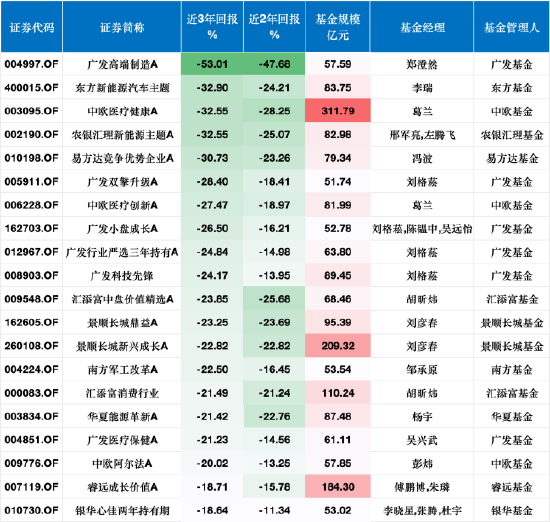
广发高端制造A三年跌53%垫底,管理费累计4.56亿,刘格菘或面临浮动费改大考
Xin Lang Ji Jin· 2025-05-07 08:37
Core Viewpoint - The China Securities Regulatory Commission (CSRC) aims to address the issue of high management fees in public funds despite poor performance through a floating management fee mechanism, highlighting the industry's long-standing problem of "guaranteed returns" regardless of fund performance [1]. Group 1: Fund Performance and Management Fees - The report indicates that the fund "Guangfa High-end Manufacturing A" has the worst three-year return at -53.01%, while it collected management fees totaling 456 million yuan over the same period [3]. - "China Europe Medical Health A," with a scale of 31.179 billion yuan, experienced a 32.55% decline in three-year performance but still charged 2.2 billion yuan in management fees [3]. - The trend shows that larger funds tend to incur greater losses while charging higher fees, raising concerns about the reasonableness of fees relative to fund managers' performance [3][4]. Group 2: Fund Manager Performance - Fund manager Liu Gesong's funds have underperformed, with a three-year return of -27% and a two-year return of -17%, significantly lagging behind the CSI 300 index [4]. - The total assets under Liu's management decreased by 5.7% to 32.171 billion yuan as of the end of the first quarter of 2024 [4]. - The floating management fee reform may lead to a significant reduction in management fee income for fund managers like Liu, as poor performance could result in a "double whammy" effect [4]. Group 3: Industry Outlook - The CSRC's reform is expected to shift the focus of fund companies from merely pursuing scale to emphasizing investment returns, marking a significant change in the industry [11]. - The industry may witness a trend where stronger firms thrive while smaller institutions face accelerated elimination, making investment research capabilities and risk control systems increasingly critical [11]. - In the long run, more competitive products are likely to attract additional capital and new investors, benefiting investors and promoting sustainable industry development [11].