分体式AR眼镜

Search documents
2025年国内消费级AI/AR市场销量增幅109%,雷鸟夺冠
CINNO Research· 2026-03-01 09:29
Core Insights - The domestic consumer-grade AI/AR market is projected to achieve a historic breakthrough in 2025, with annual sales reaching 696,000 units, marking a year-on-year increase of 109% [2] - The growth is characterized by a dual feature of "mature categories showing steady growth and emerging categories experiencing explosive breakthroughs" [2] - The market is transitioning from "hardware stacking" to "ecosystem competition," with expectations of a 65% year-on-year growth in 2026 [2][9] Market Performance - In 2025, the sales of split AR glasses reached 368,000 units, growing by 53% year-on-year, despite facing challenges such as functionality limitations and homogenized competition [2] - All-in-one AR glasses saw a dramatic increase in sales by 176%, driven by brands like Leqi, Meizu, and Yingmu, establishing themselves as benchmarks for "all-day wear, lightweight, and high immersion experience" [2] - The market for non-screen AI glasses led the year with a staggering 319% year-on-year growth, particularly showing explosive momentum in the second and third quarters [3] Brand Landscape - Leqi holds the top market share at 32%, with a year-on-year sales increase of 125%, attributed to its multi-product line strategy and strong product capabilities [6] - Xiaomi ranks second with a 15% market share, but faces challenges with high return rates and a lack of new product iterations, leading to a 70% decline in fourth-quarter sales [7] - XREAL, with a 12% market share, has established a reputation among professional users through its high-resolution displays and low-latency interactions [7] - Rokid emerged as a highlight in the second half of 2025, showcasing strong market competitiveness with its AR all-in-one glasses [8] Future Trends - The core value of AI/AR glasses lies in their ability to provide "all-day wear and visual/auditory perception," aiming for deep service value through "data accumulation and decision support" [9] - The market is expected to evolve through breakthroughs in lightweight technology, integration of AI large models, and the construction of cross-platform content ecosystems [9] - The positive cycle of "consumer recovery - scene expansion - ecosystem improvement" is anticipated to drive the growth of the AR glasses market [9]


CINNO Research:1H’25新品和政策助推 国内消费级AI/AR市场销量同比激增73%
智通财经网· 2025-09-04 23:49
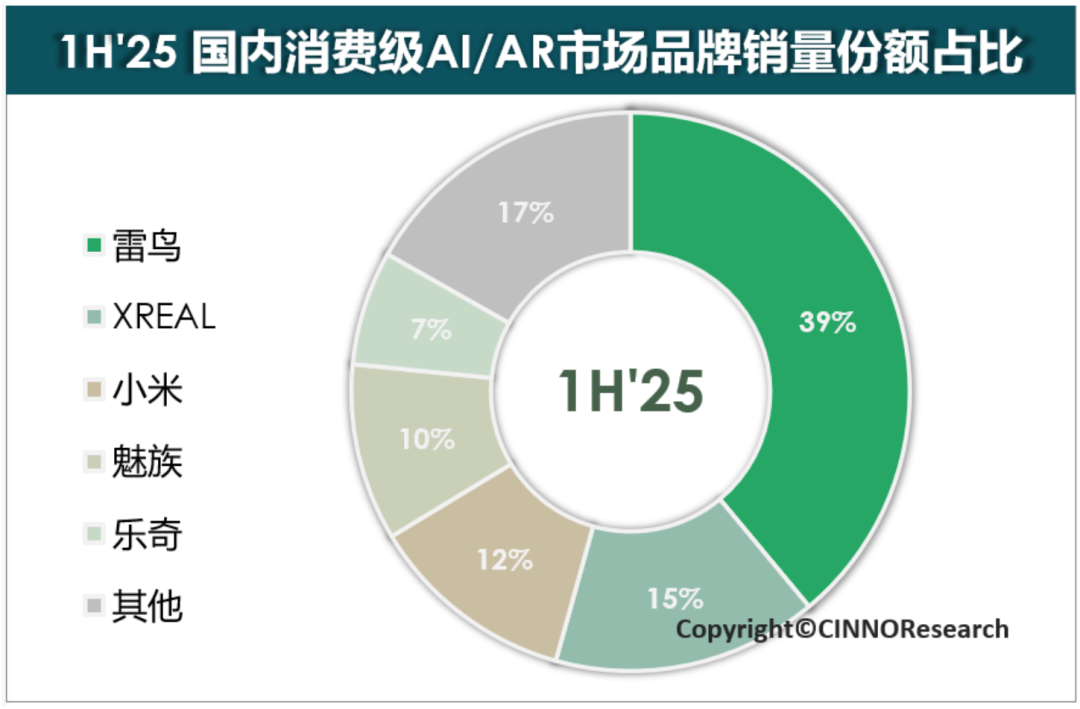
Group 1 - The Chinese consumer-grade AI/AR glasses market experienced explosive growth, with sales reaching 262,000 units in the first half of 2025, a year-on-year increase of 73% [1][2] - The market is driven by government subsidies and the 618 e-commerce promotion, leading to a new wave of product iteration across three major segments: split AR glasses, screen AI glasses, and non-screen AI glasses [2][6] - Non-screen AI glasses led the market with a staggering year-on-year growth of 463%, driven by products like Thunder V3 and Xiaomi AI smart glasses, which integrate AI voice interaction and health monitoring features [2][4] Group 2 - Local brands are diversifying the market, with Thunder leading with a 39% market share and a year-on-year sales increase of 113%, while Xiaomi entered the market with a 12% share, achieving rapid sales growth [4][5] - Thunder's new product launches, including the Air 3S series and X3 Pro AR glasses, have contributed to its strong market position, while Xiaomi's AI glasses achieved 31,000 units sold in the first week [4][5] Group 3 - The dual engines of government policy and e-commerce promotions have significantly boosted the AI/AR market, with consumers benefiting from a 15% subsidy and promotional discounts during the 618 shopping festival [6] - During the core promotional period from May 20 to June 20, sales of AI/AR products across major e-commerce platforms reached 59,000 units, with AR products seeing an increase of over 130% [6] Group 4 - Local brands are focusing on building a content ecosystem to achieve breakthroughs, emphasizing cross-device collaboration, cross-domain applications, and cross-industry cooperation [8] - The integration of AR devices with mobile phones and partnerships with cloud services and content platforms are key strategies for enhancing user experience and expanding market applications [8]