
列车客运服务

Search documents
武汉客运段平均2分钟发送一趟列车
Chang Jiang Shang Bao· 2026-02-24 08:34
Core Viewpoint - The Wuhan Railway Bureau is experiencing a significant increase in passenger flow as the Spring Festival holiday concludes, with measures in place to ensure safe and orderly transportation for travelers returning to work and school [1][2]. Group 1: Passenger Flow and Train Operations - On February 22, the Wuhan passenger segment operated 326 pairs of trains, with an expected increase to 327.5 pairs on February 23, marking a historical high with an average of less than 2.2 minutes between train departures [1]. - Long-distance passenger flow is primarily directed towards major cities such as Beijing, Shanghai, Guangzhou, Shenzhen, Chengdu, and Hangzhou, while short-distance travel is concentrated in nearby cities like Yichang, Xiangyang, Shiyan, Huangshi, and Macheng [1]. Group 2: Safety and Service Enhancements - Train crew members are actively providing safety reminders, particularly focusing on the safe boarding and alighting of vulnerable passengers such as the elderly and children, ensuring a smooth and secure travel experience [2]. - The Wuhan passenger segment is enhancing its "Fengwu Chutian" service brand by optimizing service measures to meet the needs of returning travelers, including the provision of emergency supplies and comfort items like heating pads and blankets [3]. - New initiatives include the introduction of a "one-click accompaniment" service with clear signage and call buttons in newly added train services, as well as the promotion of quiet carriages to enhance passenger comfort [3].
视频丨两张列车时刻表跨越十年 三个变化见证中国铁路发展
Yang Shi Xin Wen Ke Hu Duan· 2026-02-15 13:38
Group 1 - The core point of the article highlights the significant improvements in China's railway system during the Spring Festival travel season, showcasing increased train frequency, efficiency, and expanded network coverage [1][3][5] Group 2 - The first notable change is the synchronization of train departures from the same station to the same destination, indicating a denser railway network. For instance, multiple trains departed simultaneously from major stations like Beijing South and Guangzhou North [1] - The second change is the substantial increase in train numbers during peak travel days, with an approximate 80% growth compared to 2017. The proportion of high-speed trains (D and G types) has risen from 60% a decade ago to 85% now, significantly reducing travel times [3] - The third change involves the addition of nearly 1,000 new passenger stations, particularly in western, border, and mountainous regions, allowing direct train access to previously less accessible areas [5]

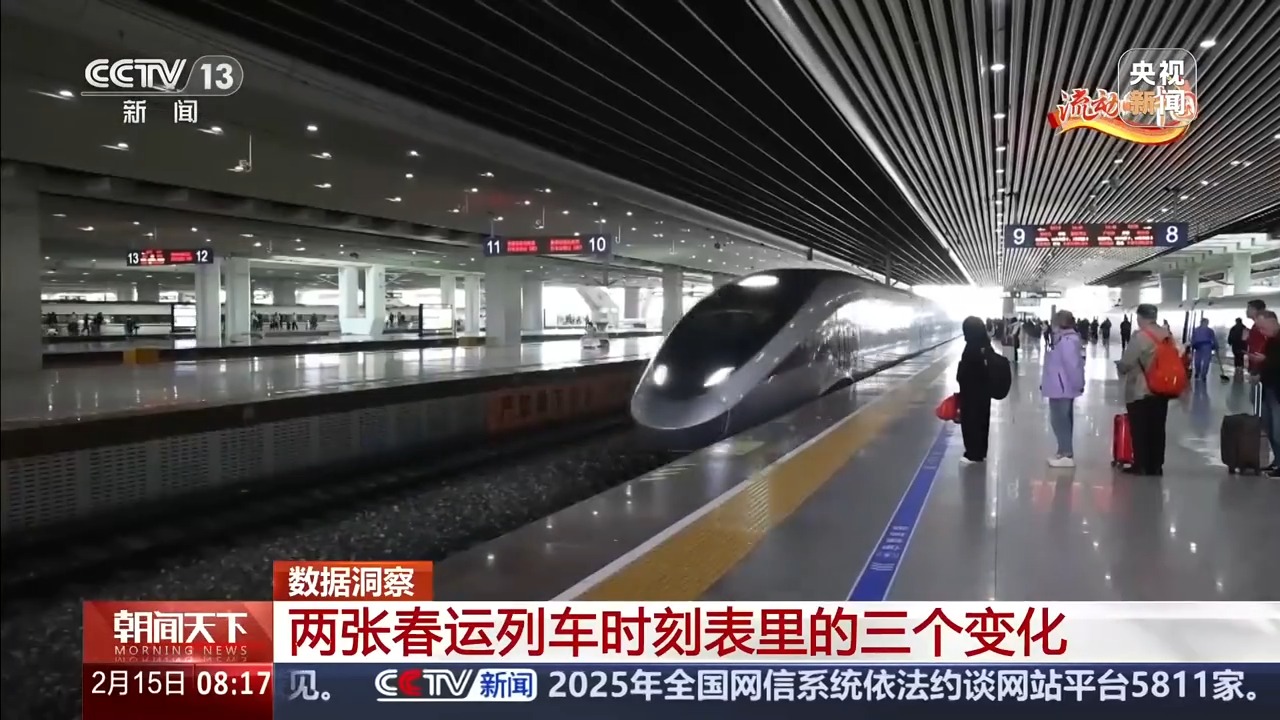
两张列车时刻表跨越十年 三个变化见证中国铁路发展
Yang Shi Xin Wen· 2026-02-15 02:13
Core Insights - The article highlights significant improvements in China's railway system during the Spring Festival travel season, showcasing increased train frequency, efficiency, and expanded network coverage compared to a decade ago. Group 1: Train Frequency and Scheduling - The average daily passenger flow during this year's Spring Festival is over ten million, supported by a denser railway network that allows for simultaneous departures to the same destination from the same station [1] - The number of trains during peak days of this year's Spring Festival has increased by approximately 80% compared to 2017, with a notable rise in the proportion of S, C, D, and G trains from 60% ten years ago to 85% now [3] Group 2: Travel Efficiency - The travel time for long-distance routes has significantly decreased, with high-speed trains now capable of covering the distance from Beijing to Kunming in just over ten hours, compared to thirty to forty hours a decade ago [3] - The efficiency of train operations has improved, allowing for a "just-in-time" travel experience where passengers can almost board a train as soon as they arrive at the station [1] Group 3: Network Expansion - Nearly one thousand new passenger stations have been added, primarily in western, border, and mountainous regions, enhancing accessibility to previously hard-to-reach areas [3] - The expansion of the railway network has enabled direct train services to many locations that previously required transfers, reflecting a broader reach of the railway system [3]
7月1日起长三角铁路实行新列车运行图
Mei Ri Shang Bao· 2025-06-18 05:34
Core Points - The new train operation schedule will be implemented nationwide starting from July 1, focusing on optimizing the structure of high-speed train services in the Yangtze River Delta region to meet summer travel demands [1] - The total number of passenger trains operating in the Yangtze River Delta will reach 1,407.5 pairs after the adjustment [1] - New routes will enhance connectivity between eastern and northeastern regions, with notable new services including trains from Hangzhou to Mudanjiang and multiple high-speed routes to cities like Xiamen and Rizhao [1] - The adjustments aim to improve the accessibility of the rail network and expand the radius of passenger services [1] Commuter Services - New commuter trains have been added to facilitate early morning travel for passengers in Zhejiang, Jiangsu, and Shanghai, including services from Ningbo to Shanghai Hongqiao and from Jiangyin to Shanghai Hongqiao [2] - Additional trains have been introduced to cater to tourism demand, such as the service from Shanghai South to Wenzhou North, allowing travelers to visit popular tourist destinations [2] - Tickets for the third quarter have been on sale since June 17, with plans for temporary trains to be added based on passenger flow [2]