
功能型无人车管理服务平台

Search documents
无人车上月配送129万单 创造价值1110万
Nan Fang Du Shi Bao· 2025-12-22 23:14
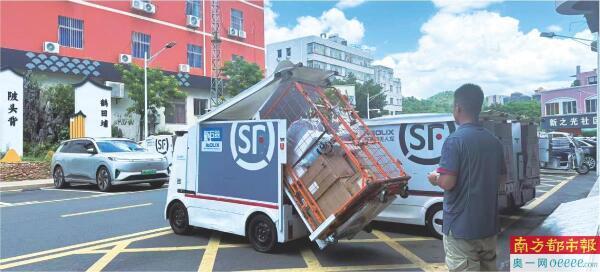
Core Insights - The article highlights the successful implementation and scaling of autonomous logistics vehicles in Shenzhen, which are transforming various sectors including healthcare, community services, and industrial operations [2][3][4]. Group 1: Autonomous Logistics Vehicles in Healthcare - The Longgang District People's Hospital has launched a project utilizing autonomous logistics vehicles to enhance the efficiency of medical supply transportation between the main hospital and community health service centers [3]. - The vehicles are equipped with L4 autonomous driving systems and specialized compartments for transporting medical supplies, ensuring safety and quality during transit [3][4]. - By the end of this year, five routes are expected to be operational, connecting 20 community health centers, thereby optimizing the logistics of grassroots medical services [4]. Group 2: Operational Scale and Efficiency - SF Express operates 135 autonomous vehicles across 180 routes in Shenzhen, significantly reducing transportation costs and labor intensity for delivery personnel [5][6]. - During peak periods, these vehicles can handle up to 90,000 packages in a single day, with November's delivery volume surpassing 710,000 orders, demonstrating substantial commercial value [6][9]. - The operational scale of autonomous vehicles in Shenzhen has reached 916 units, with total running mileage exceeding 550,000 kilometers, marking a 50% increase in November alone [9]. Group 3: Integration with Broader Logistics Systems - SF Express has partnered with Shenzhen Metro Group to create a seamless logistics network integrating aerial drones, ground stations, and underground autonomous vehicles, enhancing efficiency in logistics operations [7]. - The establishment of a smart logistics management system allows for real-time monitoring and management of vehicle operations, significantly improving safety and reliability [4][8]. - By 2026, Shenzhen aims to deploy at least 2,000 functional autonomous vehicles, further developing a collaborative ecosystem involving drones and autonomous logistics vehicles [9].


深圳正以“系统革命”赢得无人车产业未来
2 1 Shi Ji Jing Ji Bao Dao· 2025-12-21 09:15
Core Insights - Shenzhen is witnessing a significant rise in the use of autonomous delivery vehicles, with a monthly operational mileage of 240,000 kilometers and approximately 1.29 million orders completed by November 2025, indicating a clear signal of profitability and a critical "economies of scale inflection point" in the commercialization of autonomous driving technology [1] - The competition in the autonomous vehicle sector has evolved from "which vehicle is smarter" to "which city system can better nurture and accelerate industry maturity," with Shenzhen leading due to its comprehensive "system empowerment" revolution [1] - Shenzhen has established itself as a "chief architect" and "risk partner" in the regulatory landscape for autonomous vehicles, creating a conducive environment for industry growth [2] Regulatory and Infrastructure Developments - In July, Shenzhen launched the first "functional autonomous vehicle management service platform" in the country, which integrates approval processes, dynamic monitoring, accident handling, data connectivity, and insurance services, facilitating compliance for enterprises and enabling "sandbox regulation" for the government [2] - This platform institutionalizes and marketizes "road rights" and "data resources," providing enterprises with a clear and predictable regulatory environment, thus reducing policy risk premiums and accelerating technological iteration and business model convergence [2] Integration with Urban Systems - Shenzhen's autonomous vehicles are designed as "smart plugins" within the existing logistics and transportation systems, exemplified by the innovative "autonomous vehicle + subway" model that enhances last-mile delivery efficiency [3] - The integration of autonomous vehicles with public transport systems not only optimizes land resources but also redefines logistics nodes, transforming the subway network into a dynamic urban logistics hub [3] - The business model has shifted from simple transportation service fees to revenue sharing based on system efficiency improvements, making autonomous vehicle solutions essential for urban smart upgrades [3] Capital and Standards Dynamics - Shenzhen is experiencing significant capital aggregation, with major companies like Meituan and JD.com investing heavily, and unicorns like New Stone and Jiushi receiving substantial funding, such as New Stone's 1 billion yuan financing in February 2025 [5] - The city is proactively establishing the first national standard system for the autonomous logistics industry, which serves as both a technical guideline and a market entry ticket, influencing the distribution of value within the industry [5] - The interplay between capital influx and the establishment of authoritative standards is enhancing investor confidence and attracting further investment, demonstrating Shenzhen's success in integrating policy, infrastructure, data, application scenarios, and innovative enterprises into a cohesive ecosystem [5]