华宸未来稳健添利债券

Search documents
罕见!转让“独苗”,这家公司公募产品要“归零”
Zhong Guo Ji Jin Bao· 2026-01-26 14:14
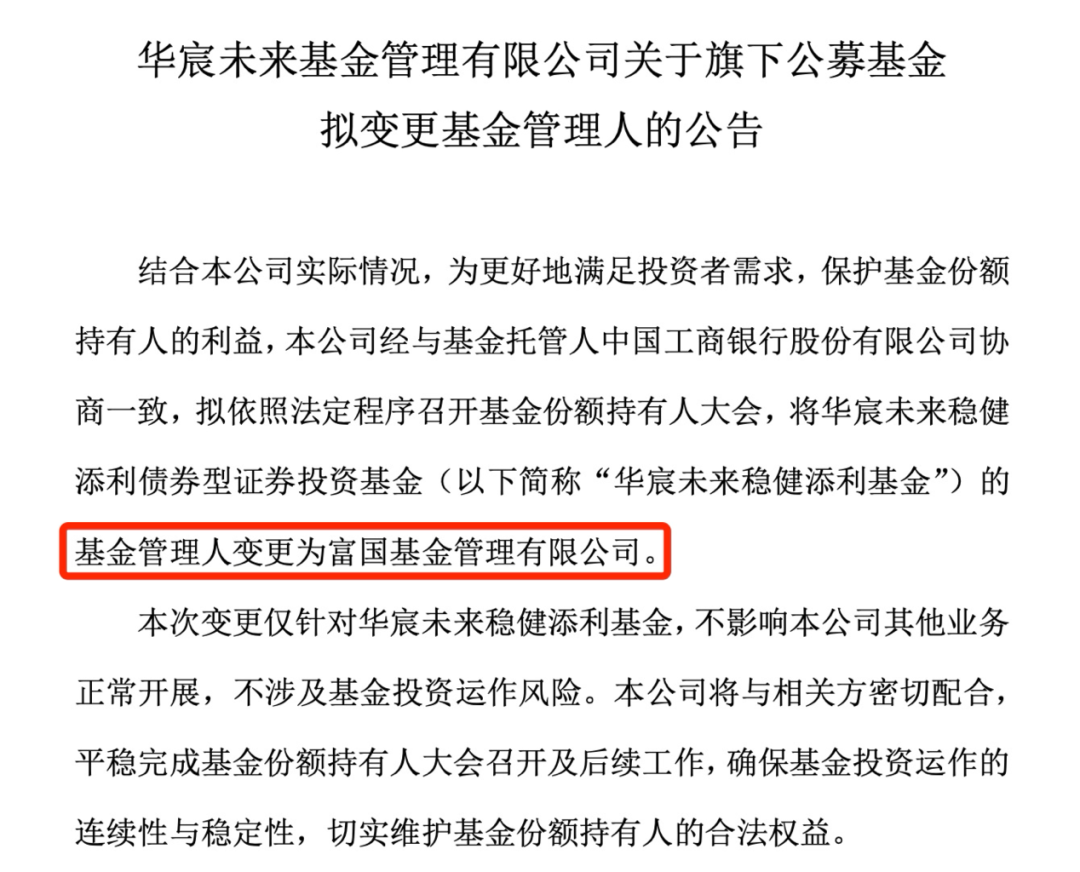
Core Viewpoint - Huachen Future Fund plans to transfer its only fund, Huachen Future Steady Income Bond Fund, to Fortune Fund, indicating a trend of "survival of the fittest" in the public fund industry as smaller asset management firms face potential exit or acquisition [1][2][5] Group 1: Fund Management Change - Huachen Future Fund announced a meeting to change the fund manager of Huachen Future Steady Income Fund to Fortune Fund, aiming to better meet investor needs and protect their interests [2][4] - The change only affects the Huachen Future Steady Income Fund and does not impact the company's other operations or involve investment risk [4][6] Group 2: Fund Performance and Financial Health - The Huachen Future Steady Income Fund experienced a significant net value drop of 7.41% over four trading days from November 27 to December 2, 2025, leading to a total annual decline of 6.60%, ranking in the bottom quartile among peers [4] - The fund's total scale decreased from 189 million yuan at the end of Q3 2024 to 43 million yuan [4] - Huachen Future Fund has struggled financially, reporting a revenue of 4.01 million yuan and a net loss of 20.01 million yuan in 2024, with a further loss of 11.40 million yuan in the first three quarters of 2025 [9] Group 3: Ownership and Market Position - Huachen Future Fund was established in 2012 with a registered capital of 200 million yuan, but has faced challenges in growth, with its fund scale only briefly exceeding 1 billion yuan in late 2023 and early 2024 [8][9] - The major shareholder, Huachen Trust, is looking to sell a 40% stake in Huachen Future Fund for 4.8 million yuan, a significant drop from the initial listing price of 17.2 million yuan [9]

受个券影响,华宸未来基金旗下债基暴跌
Guo Ji Jin Rong Bao· 2025-12-05 11:57
Core Viewpoint - The recent significant decline in the net value of Huachen Future Fund's bond fund has raised concerns among investors and industry professionals, highlighting the challenges faced by small public fund management companies [1][3][9] Group 1: Fund Performance - Huachen Future Stable Income Bond Fund experienced a cumulative decline of 7.75% from November 25 to December 2, with a notable drop of 7.61% over four trading days from November 27 to December 2 [3] - The fund's net value had previously shown stability, but recent performance has been likened to a "waterfall" drop, with the latest net value recorded at 1.1921 yuan as of December 4 [3] - The fund's net value decline has surpassed the annual gains of previous years, with 2023 and 2024 gains recorded at 4.59% [3] Group 2: Fund Management and Strategy - The fund's investment strategy includes a focus on short-term and long-term government bonds, with a 36.55% allocation to these securities as of the third quarter [4] - The fund management team has been actively adjusting the investment portfolio in response to market changes, aiming to optimize performance and control credit risk [4][6] Group 3: Company Background - Huachen Future Fund, established in 2012, has struggled with a small public fund management scale, with assets dropping from a peak of 13.18 billion yuan in early 2024 to just 1.95 billion yuan by the end of the third quarter [9] - The fund company currently manages only two public funds, with the other being a mixed fund that has also underperformed significantly [9]
华宸未来稳健添利债基金大BOSS出来道歉了,但我想说:踩雷万X债不是基金经理的错
Xin Lang Cai Jing· 2025-12-03 11:02
Group 1 - The core message emphasizes the importance of treating investors with goodwill, even in the face of significant investment setbacks, and acknowledges the need for market price adjustments to avoid future liabilities [1][8] - A recent incident involving a bond product linked to WanX debt has led to a decline of over 4% in a private fund's value, prompting an apology from the fund manager [3][10] - The market had previously perceived WanX debt as relatively safe due to assurances from its major shareholder, but the sudden drop in value highlights the unpredictability of risk in investment [4][11] Group 2 - The article discusses the limitations of fund managers in completely eliminating risks, emphasizing that risk management and diversification are essential strategies [6][14] - The impact of WanX debt on various bond funds raises questions about the scale and diversification of investments, suggesting that investors should reflect on their choices [7][15] - Current market conditions indicate that there is no definitive statement on non-repayment of these bonds, suggesting that the market price reflects ongoing uncertainties [5][12]


百亿私募净值崩了!又一个踩雷WK债?
Xin Lang Cai Jing· 2025-12-03 08:36
Core Viewpoint - Recent market turbulence has led to significant losses in both equity and bond markets, challenging the perception of bond funds as stable investments [2][14]. Group 1: Bond Fund Performance - A lesser-known bond fund, Huachen Future Stable Bond, experienced a dramatic decline of 6.81% over three days, erasing two years of gains [3][15]. - The fund's net asset value dropped sharply starting November 27, with daily declines of 1.77%, 3.56%, and 1.48% [3][15]. - The fund's previous stability attracted many retail investors, but the recent downturn has raised concerns about its reliability as a safe investment [3][15]. Group 2: Causes of Decline - The significant drop in the fund's value is likely linked to exposure to Vanke bonds, with estimates suggesting a holding of 7.6% to 15% in these securities [5][17]. - The decline triggered a wave of redemptions, forcing the fund to sell assets, which further exacerbated the drop in net value, creating a vicious cycle [5][17]. - The fund's management attributed the decline to market conditions affecting specific bonds and stated they are optimizing the investment portfolio [5][17]. Group 3: Private Fund Issues - Concurrently, private equity firm Hosheng Asset reported a drop of over 4% in several of its pure bond strategy products, with one fund, Hosheng Tonghui Hengxin X, falling 4.35% in a single week [6][18]. - Hosheng Asset, known for its conservative investment approach, faced challenges due to heavy exposure to Vanke bonds, leading to significant volatility in its products [9][21]. - The founder of Hosheng Asset acknowledged the impact of market price adjustments on their investment returns, indicating a near-zero return since the second quarter [21]. Group 4: Changing Perceptions - The recent events have shattered the stereotype that bond funds are inherently stable and that large private equity firms are reliable [10][22]. - Investors often misjudged bond funds as risk-free, overlooking potential risks, especially in the case of first-tier bond funds that allow greater credit risk-taking [10][22]. - The volatility experienced by both small and large funds highlights the need for investors to reassess their understanding of bond fund risks [10][22]. Group 5: Investor Guidance - Investors are advised to abandon the "buying the dip" mentality when bond funds plummet, as past examples show that such strategies can lead to significant losses [11][23]. - It is crucial to consider institutional ownership when selecting funds, as higher institutional investment often indicates greater reliability [11][23]. - A balanced investment approach is recommended, emphasizing diversification to mitigate risks associated with market fluctuations [11][23].