南方沙特ETF

Search documents
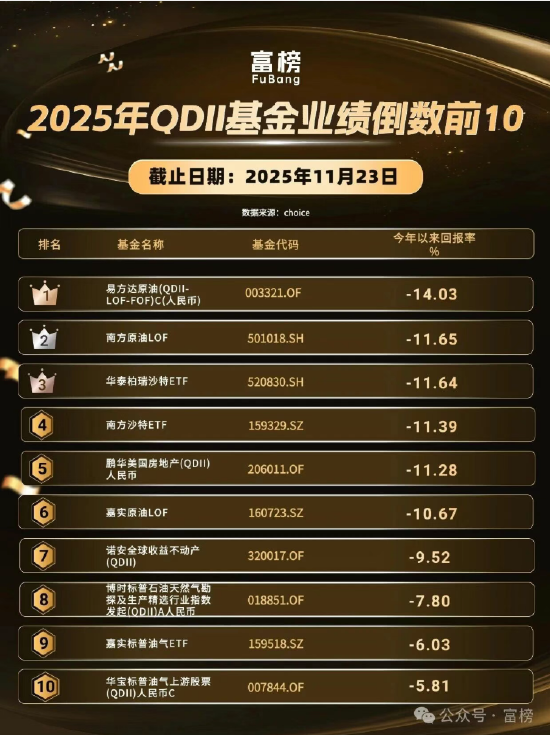
榜单|易方达垫底 2025年QDII基金业绩倒数榜
Xin Lang Cai Jing· 2025-12-24 14:38
Core Viewpoint - The performance of QDII funds in 2025 has been disappointing, with many funds failing to achieve positive returns, particularly those focused on energy, real estate, and Middle Eastern markets [2][3][4]. Group 1: QDII Fund Performance - A total of 43 QDII funds have underperformed the market this year, with the E Fund Oil (QDII-LOF-FOF) C (RMB) recording the lowest return at -14.03% [2][3]. - Other poorly performing funds include Southern Oil LOF (-11.65%), Huatai-PB Saudi ETF (-11.64%), and Saudi ETF (-11.39%), all reflecting significant declines due to international oil price trends and geopolitical issues in the Middle East [2][3][4]. Group 2: Industry and Market Analysis - The energy sector has faced severe adjustments in 2025, with lower-than-expected oil demand due to sluggish global economic recovery and accelerated energy transition, leading to a downward trend in Brent and WTI oil prices [3][8]. - The Saudi stock market has been negatively impacted by a slowdown in domestic economic transformation and foreign capital outflows, resulting in a weak MSCI Saudi Index and declining net asset values for related ETFs [3][8]. - Real estate-focused QDII funds have also struggled, with Penghua US Real Estate (QDII) RMB at -11.28% and Northern Global Income Real Estate (QDII) at -9.52%, primarily due to high financing costs and valuation pressures from the Federal Reserve's sustained high interest rates [3][8]. Group 3: Investment Strategy Recommendations - Investors are advised to avoid excessive concentration in single countries or industries when allocating QDII funds and to prioritize products with strong management research capabilities and robust risk control mechanisms [4][9]. - Implementing strategies such as dollar-cost averaging is recommended to smooth out volatility rather than making large, one-time investments [4][9].

盘中“叫停”!炒作资金再度盯上这类基金
证券时报· 2025-03-21 09:34
Core Viewpoint - The article discusses the recent surge in cross-border ETFs, highlighting significant price premiums and the associated risks of market volatility and potential corrections [1][3][7]. Group 1: Market Performance - On March 21, multiple cross-border ETFs experienced substantial gains, with the Guotai S&P 500 ETF seeing a temporary suspension due to a premium rate reaching 28.55% [1][3]. - Other ETFs, such as the Southern Saudi ETF and the Invesco S&P Consumer ETF, also reported significant increases, with trading volumes exceeding 8 billion yuan and 38.73 billion yuan respectively [3][4]. Group 2: Premium Rates and Risks - The premium rates for several ETFs have surged, with the Invesco S&P Consumer ETF exceeding 43% and the Southern Saudi ETF reaching 11.83% [3][4]. - Fund managers have issued multiple risk warnings regarding high premiums, indicating that the trading prices are significantly above the net asset values, which could lead to substantial losses for investors [4][7]. Group 3: Market Dynamics - Since the beginning of the year, cross-border ETFs have been subject to high premiums and volatility, driven by speculative trading behavior [6][7]. - Despite a decline in U.S. stock indices, certain cross-border ETFs have shown resilience, with the Guotai S&P 500 ETF rising 10.24% while the S&P 500 index fell by 7.61% [6][8]. Group 4: U.S. Market Context - The U.S. stock market has been experiencing fluctuations, with major indices like the Dow Jones and Nasdaq down 5.99% and 11.79% respectively since late February [9][10]. - Factors contributing to market uncertainty include policy changes, geopolitical events, and concerns over economic growth, which may affect short-term stock performance [9][10].

盘中"叫停"!炒作资金再度盯上这类基金……
券商中国· 2025-03-21 06:05
Core Viewpoint - The recent surge in cross-border ETFs has led to significant price premiums, resulting in temporary trading halts due to high volatility and risks associated with speculative trading [2][3][4]. Group 1: Market Performance - On March 21, multiple cross-border ETFs experienced substantial gains, with the Guotai S&P 500 ETF rising over 7% before a second trading halt, reflecting a premium rate of 28.55% [2][3]. - Other ETFs, such as the Southern Saudi ETF and the Invesco S&P Consumer ETF, also saw notable increases of 5.26% and 3.17%, respectively, with trading volumes exceeding 8 billion yuan for the Guotai S&P 500 ETF [3][4]. - The premium rates for these ETFs have reached alarming levels, with the Invesco S&P Consumer ETF exceeding 43% and the Southern Saudi ETF at 11.83% [3][4]. Group 2: Risk Factors - Fund managers have issued multiple risk warnings regarding the high premiums of cross-border ETFs, indicating that the market prices are significantly above the net asset values [4][5]. - The phenomenon of high premiums and volatility has been attributed to speculative trading, which poses risks for investors who may be caught in a "hot potato" scenario if the market corrects [5][6]. - The divergence between ETF performance and underlying indices has been stark, with the Guotai S&P 500 ETF rising 10.24% while the S&P 500 index fell by 7.61% since February 19 [5][6]. Group 3: Broader Market Context - The U.S. stock market has been experiencing high volatility, with major indices like the Dow and Nasdaq declining by 5.99% and 11.79%, respectively, since late February [6][7]. - Concerns over economic growth and geopolitical events have contributed to market uncertainty, with expectations of potential interest rate cuts later in the year [6][7]. - Compared to 2022, the current market conditions are less extreme, as the Federal Reserve has more room to maneuver with interest rates, which may stabilize the market [7].