跨境ETF溢价风险

Search documents
【财富周刊】多家银行上调积存金门槛,9月以来数百只公募基金调整风险等级
Sou Hu Cai Jing· 2025-10-26 11:53
Group 1: Gold Accumulation Business - Several banks have raised the minimum investment threshold for gold accumulation business to between 950 to 1200 yuan, an increase of 300 to 550 yuan compared to the beginning of the year [1] Group 2: Deposit Rate Adjustments - Multiple small and medium-sized banks have lowered deposit rates, leading to a phenomenon where long-term deposit rates are lower than short-term rates, with some banks showing that "three-year deposits yield less than one-year deposits" [2] - On October 20, Pingyang Pudong Development Bank announced adjustments to various deposit rates effective from October 21 [2] - Fujian Huatuo Bank and Shanghai Huarui Bank also announced reductions in their deposit rates, with the three-year fixed deposit rate dropping from 2.3% to 2.15% [2] Group 3: Capital Increase by Cambrian - Cambrian announced the completion of a capital increase, with 3,334,946 new shares registered on October 16 [4] - The largest allocation went to GF Fund, which received 1,010,900 shares, amounting to 1.208 billion yuan [4] - Other institutions, including Huatai-PineBridge Fund and Bosera Fund, received allocations ranging from 100,400 to 364,000 shares [4] Group 4: Investment Activity in Pharmaceutical Sector - Guo Lan's fund management has increased its stake in Yaokang Biotechnology, becoming the ninth largest shareholder with 5,162,200 shares as of the end of Q3 [5] - The fund managed by Guo Lan and Zhao Lei also appears among the top ten shareholders, holding 12,860,600 shares, an increase of 4,877,600 shares compared to the previous quarter [5] Group 5: Fund Risk Level Adjustments - Since September, nearly 20 fund companies have issued over 20 announcements regarding risk level adjustments for public funds, significantly higher than the previous monthly average [6][7] Group 6: Cross-Border ETF Premium Risks - Several fund companies, including Huaxia Fund and Hua'an Fund, have issued urgent risk warnings regarding high premium rates for cross-border ETFs, indicating potential significant losses for investors [8]



大回血,股票型ETF一周猛增1000亿元!上周两明星产品遭“反噬”,但资金“越跌越买”
Mei Ri Jing Ji Xin Wen· 2025-10-26 05:53
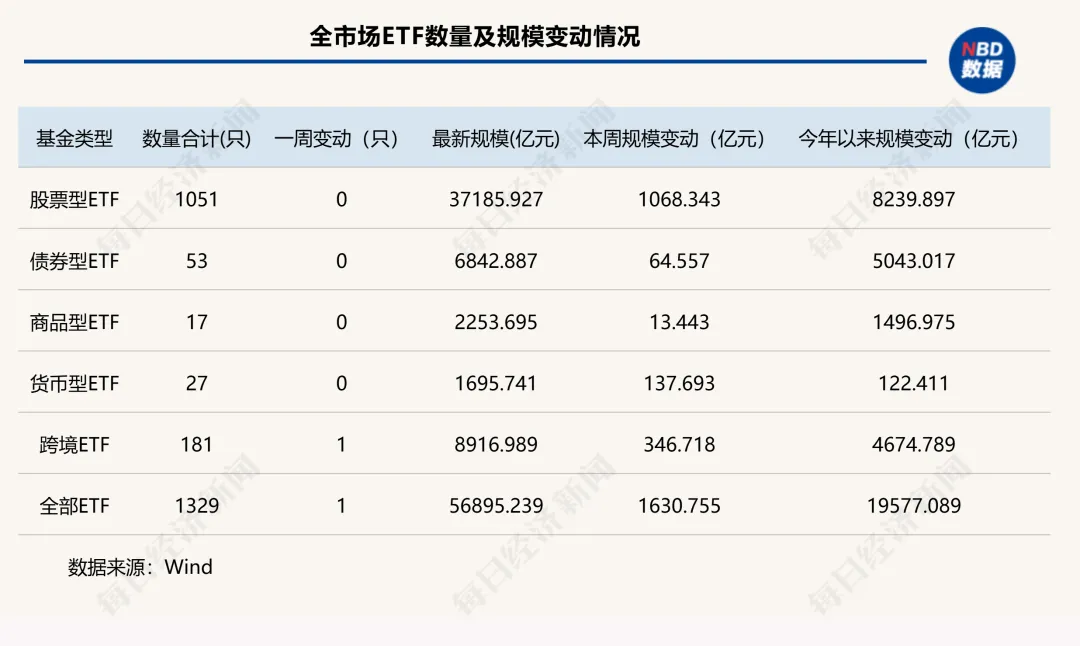
Market Overview - A-shares experienced a significant rebound from October 20 to October 24, with the CSI 300 index rising by 3.24%, and the ChiNext and STAR 50 indices increasing by 8.05% and 7.27% respectively [1][2] - The Hong Kong tech stocks also saw a rebound, with the Hang Seng Tech Index rising by 5.2% during the same period [1] ETF Market Performance - The ETF market saw a strong recovery, with a total increase of 1630.76 billion yuan, marking the highest weekly growth since September [2][3] - Stock ETFs led the growth, increasing by 1068 billion yuan, with broad-based ETFs contributing over 70% of this increase [2][3] - Cross-border ETFs also reversed their recent decline, with money market ETFs recovering from earlier losses [1][2] Key ETF Highlights - The CSI 300 index-linked ETFs were the main focus, with a weekly increase of 343 billion yuan, bringing the total scale to over 1.2 trillion yuan [1][4] - Major fund managers like Huaxia Fund and E Fund saw their ETF scales increase by over 300 billion yuan each, with Huaxia Fund's ETF management scale surpassing 900 billion yuan [1][7] Gold ETFs - Gold ETFs were among the products that saw a decrease in scale, but there was a notable trend of "buying the dip," with over 5 billion yuan net subscriptions for two prominent gold ETFs [1][11] ETF Scale and Growth - As of October 25, the total scale of all ETFs reached 56.9 trillion yuan, with stock ETFs accounting for 37.2 trillion yuan [3][4] - Year-to-date, the total increase in ETF scale has reached 1.96 trillion yuan, with stock ETFs contributing 823.99 billion yuan [3][4] Fund Management Rankings - The top 20 ETF management firms saw significant growth, with Huaxia Fund and E Fund leading the way, each increasing by over 300 billion yuan this week [7][9] - Notably, the performance of traditional fund managers like Huatai-PB and Jiashi Fund was also strong, with each increasing their ETF scales by over 100 billion yuan [7][9] ETF Index Performance - Among the top 20 indices linked to ETFs, only one index, the SGE Gold 9999 index, saw a decrease in scale, while others like the CSI 300 and Hang Seng Tech indices experienced significant recoveries [4][6] - The CSI 300 index-linked ETFs have seen a year-to-date growth of 218.69 billion yuan, while the Hang Seng Tech index-linked ETFs have increased by 96.51 billion yuan [7][6]
公募机构密集提示跨境ETF溢价风险
Zheng Quan Ri Bao· 2025-10-21 16:16
Core Insights - The Nikkei 225 index and the Korean Composite Index both reached historical highs on October 21, with increases of 0.27% and 0.24% respectively, closing at 49,316.06 points and 3,823.84 points [1] Group 1: High Premium Risks in Cross-Border ETFs - Multiple fund companies, including Huaxia Fund, Huaan Fund, and Invesco Great Wall Fund, issued risk warnings regarding high premium rates in their cross-border ETFs, indicating significant deviations from the fund's reference net asset value [2][3] - The Invesco Great Wall Nasdaq Technology ETF (QDII) reported a premium rate as high as 16.89% as of the date of the report [1] Group 2: Market Dynamics and Investor Behavior - The surge in the Japanese and U.S. stock markets has attracted substantial domestic capital into ETFs, while tight quotas for QDII funds have limited primary market subscriptions, pushing secondary market prices higher [3] - Investors' lack of familiarity with cross-border product rules has exacerbated premium fluctuations, leading to irrational trading behaviors [3] Group 3: Industry Response and Recommendations - As of October 21, 16 fund management companies have issued premium risk warnings for 25 products, with 10 of these being cross-border products primarily investing in the U.S. and Japan [4] - Fund managers have indicated that if premium rates do not decrease, they may take measures such as applying for temporary trading halts to warn the market of risks [4] - Experts suggest that high premiums indicate a significant departure from net asset values, posing multiple risks, and recommend that investors maintain rationality and control their positions to avoid potential losses [4]
日经ETF(513520)溢价风险提示
Mei Ri Jing Ji Xin Wen· 2025-10-20 07:03
Core Viewpoint - The Nikkei ETF (513520) experienced significant trading volume and premium pricing above its net asset value, prompting the management to issue a risk alert regarding the potential for premium pricing risks in the secondary market [1] Group 1: Market Activity - On October 20, the Nikkei ETF opened high and saw increased trading volume, with prices significantly exceeding the reference net asset value of the fund [1] - The management indicated that if the premium pricing in the secondary market does not effectively decrease, they may apply for temporary trading suspension from the Shanghai Stock Exchange to warn the market of the risks [1] Group 2: Risk Factors - The management highlighted that factors such as exchange rates, subscription and redemption limits, and supply-demand imbalances can lead to deviations between the secondary market trading prices and the fund's net asset value [1] - Investors are cautioned that buying in during high premium phases may lead to potential losses if the premium is later reduced [1]
盘中“叫停”!炒作资金再度盯上这类基金
证券时报· 2025-03-21 09:34
Core Viewpoint - The article discusses the recent surge in cross-border ETFs, highlighting significant price premiums and the associated risks of market volatility and potential corrections [1][3][7]. Group 1: Market Performance - On March 21, multiple cross-border ETFs experienced substantial gains, with the Guotai S&P 500 ETF seeing a temporary suspension due to a premium rate reaching 28.55% [1][3]. - Other ETFs, such as the Southern Saudi ETF and the Invesco S&P Consumer ETF, also reported significant increases, with trading volumes exceeding 8 billion yuan and 38.73 billion yuan respectively [3][4]. Group 2: Premium Rates and Risks - The premium rates for several ETFs have surged, with the Invesco S&P Consumer ETF exceeding 43% and the Southern Saudi ETF reaching 11.83% [3][4]. - Fund managers have issued multiple risk warnings regarding high premiums, indicating that the trading prices are significantly above the net asset values, which could lead to substantial losses for investors [4][7]. Group 3: Market Dynamics - Since the beginning of the year, cross-border ETFs have been subject to high premiums and volatility, driven by speculative trading behavior [6][7]. - Despite a decline in U.S. stock indices, certain cross-border ETFs have shown resilience, with the Guotai S&P 500 ETF rising 10.24% while the S&P 500 index fell by 7.61% [6][8]. Group 4: U.S. Market Context - The U.S. stock market has been experiencing fluctuations, with major indices like the Dow Jones and Nasdaq down 5.99% and 11.79% respectively since late February [9][10]. - Factors contributing to market uncertainty include policy changes, geopolitical events, and concerns over economic growth, which may affect short-term stock performance [9][10].

盘中"叫停"!炒作资金再度盯上这类基金……
券商中国· 2025-03-21 06:05
Core Viewpoint - The recent surge in cross-border ETFs has led to significant price premiums, resulting in temporary trading halts due to high volatility and risks associated with speculative trading [2][3][4]. Group 1: Market Performance - On March 21, multiple cross-border ETFs experienced substantial gains, with the Guotai S&P 500 ETF rising over 7% before a second trading halt, reflecting a premium rate of 28.55% [2][3]. - Other ETFs, such as the Southern Saudi ETF and the Invesco S&P Consumer ETF, also saw notable increases of 5.26% and 3.17%, respectively, with trading volumes exceeding 8 billion yuan for the Guotai S&P 500 ETF [3][4]. - The premium rates for these ETFs have reached alarming levels, with the Invesco S&P Consumer ETF exceeding 43% and the Southern Saudi ETF at 11.83% [3][4]. Group 2: Risk Factors - Fund managers have issued multiple risk warnings regarding the high premiums of cross-border ETFs, indicating that the market prices are significantly above the net asset values [4][5]. - The phenomenon of high premiums and volatility has been attributed to speculative trading, which poses risks for investors who may be caught in a "hot potato" scenario if the market corrects [5][6]. - The divergence between ETF performance and underlying indices has been stark, with the Guotai S&P 500 ETF rising 10.24% while the S&P 500 index fell by 7.61% since February 19 [5][6]. Group 3: Broader Market Context - The U.S. stock market has been experiencing high volatility, with major indices like the Dow and Nasdaq declining by 5.99% and 11.79%, respectively, since late February [6][7]. - Concerns over economic growth and geopolitical events have contributed to market uncertainty, with expectations of potential interest rate cuts later in the year [6][7]. - Compared to 2022, the current market conditions are less extreme, as the Federal Reserve has more room to maneuver with interest rates, which may stabilize the market [7].