QDII基金

Search documents
渤海证券研究所晨会纪要(2026.03.03)-20260303
BOHAI SECURITIES· 2026-03-03 00:26
Group 1: Market Overview - The equity market indices showed an overall increase, with the largest gain seen in the CSI 500, which rose by 4.32% during the week from February 24 to February 27, 2026 [2] - Among the 31 Shenwan first-level industries, 25 experienced gains, with the top five performing sectors being steel, non-ferrous metals, chemicals, environmental protection, and coal [2] - The public fund market saw a strong performance, particularly in quantitative funds, which averaged a rise of 2.22%, with a positive return ratio of 92.26% [2] Group 2: Fund Performance - The average return for equity market funds was notable, with solid performance across various fund types, including a 0.30% increase for fixed income + funds and a 0.93% increase for pension target FOFs [2] - The average return for pure bond funds was minimal at 0.01%, while QDII funds saw a slight decline of 0.11% [2] Group 3: ETF Market Dynamics - The ETF market experienced a net outflow of 228.28 billion yuan, with stock-type ETFs accounting for a significant portion of this outflow at 362.86 billion yuan [3] - The average daily trading volume in the ETF market reached 4,768.04 billion yuan, with a turnover rate of 7.40% [3] Group 4: Industry Insights - The light industry manufacturing sector outperformed the CSI 300 index by 2.67 percentage points, while the textile and apparel sector lagged behind by 0.13 percentage points during the period from February 2 to February 27, 2026 [9] - The domestic consumption market showed steady growth during the Spring Festival, with a total of 5.96 billion domestic trips made, generating a total expenditure of 8,034.83 billion yuan, an increase of 1,264.81 billion yuan compared to the previous year [9][11] - Shanghai's new real estate policy aims to optimize housing demand, which is expected to positively impact the real estate market and related industries [10][11]
1月份89%QDII基金正收益 华泰柏瑞中韩半导体涨28%
Zhong Guo Jing Ji Wang· 2026-02-03 23:13
Core Viewpoint - In January 2026, 89% of the 694 comparable QDII funds experienced net value increases, with 16 funds rising over 20%, primarily in passive equity categories, indicating a strong performance in the QDII market [1]. Group 1: Fund Performance - 618 out of 694 QDII funds saw net value increases, with 70 funds declining and 6 remaining flat [1]. - The top performer was the Huatai-PB Korea Semiconductor ETF (QDII), which rose by 28.20%, followed closely by its linked funds with increases of 24.60%, 24.59%, and 24.58% [1]. - 16 QDII funds achieved over 20% growth in January, with many being passive equity funds [1][2]. Group 2: Fund Management - The Huatai-PB Korea Semiconductor ETF is managed by Liu Jun and Li Mu Yang, both with extensive experience in fund management [2]. - Four QDII funds under E Fund Management also performed well, with increases ranging from 21.82% to 22.75%, focusing on gold and gold stocks [2]. Group 3: Sector Allocation - The Huatai-PB Korea Semiconductor ETF maintained a low tracking error, achieving its investment goals effectively, with top holdings including Samsung Electronics and SK Hynix [1]. - In the last quarter, the fund increased its holdings in materials, industrials, and consumer staples while reducing exposure to energy and non-consumer goods [3]. Group 4: Underperforming Funds - Only 6 QDII funds fell by more than 4% in January, with the Huabao Overseas New Energy Vehicle Stock Fund (QDII) leading the decline at -5.95% [3]. - The Manulife India Stock Fund also underperformed, with declines of 4.66% and 4.71% [3].

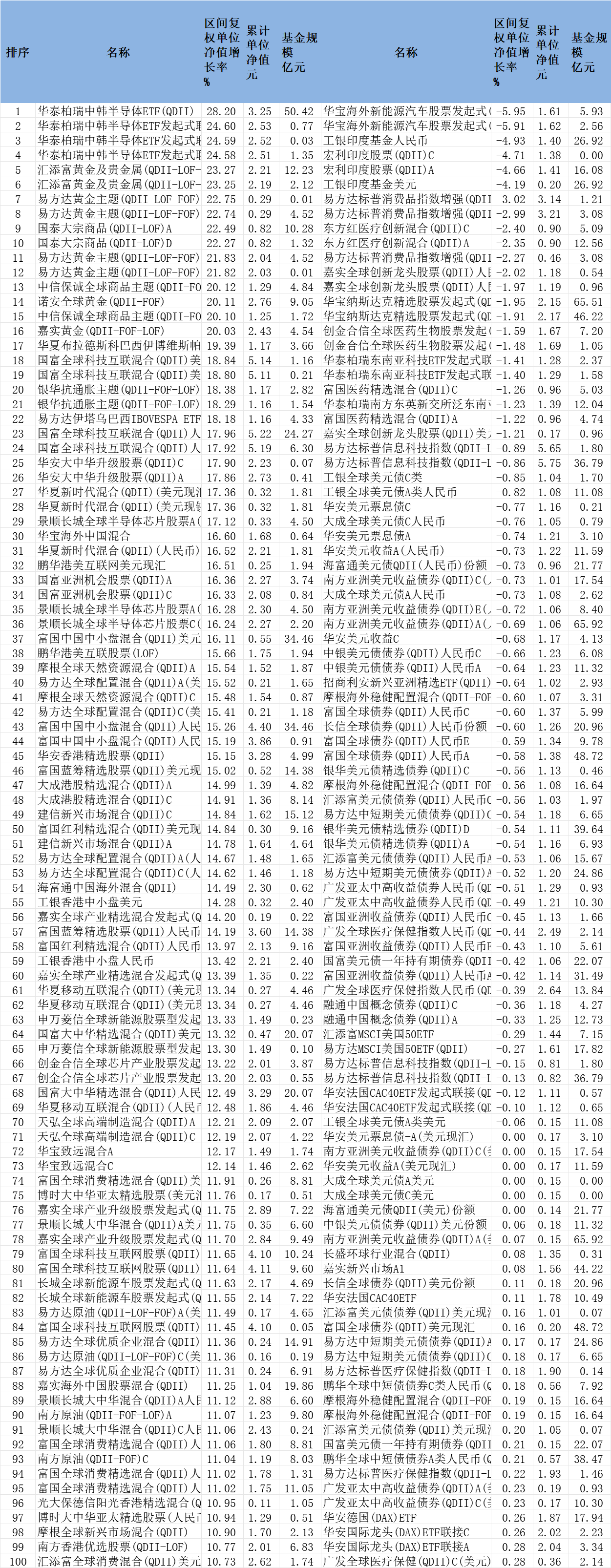
新华财经早报:1月11日
Xin Hua Cai Jing· 2026-01-11 00:44
Group 1 - The National Internet Information Office has drafted the "Regulations on the Collection and Use of Personal Information by Internet Applications" and is seeking public opinion, emphasizing minimal impact on personal rights and the necessity of data collection for services [1] - The revised "Market Supervision Complaint and Reporting Handling Measures" will take effect on April 15, 2026, aiming to enhance the quality of complaint handling and regulate malicious claims [1] - The National Medical Insurance Administration has initiated a pilot program for the "Personal Medical Insurance Cloud," set to explore a new model for smart medical insurance management from February to December this year [1] Group 2 - The Supreme People's Procuratorate reported that from 2024 to November 2025, 191 individuals were prosecuted for financial fraud, with a 21% increase in prosecutions from January to November 2025 compared to the previous year [1] - The China Securities Regulatory Commission has imposed penalties on Jiang Wei for insider trading, resulting in the confiscation of illegal gains amounting to 4,709,741.41 yuan and a fine of 14,629,224.23 yuan [1] - The "China Ice and Snow Tourism Development Report (2026)" forecasts that the number of participants in ice and snow tourism will reach 360 million by the winter of 2025-2026, generating an expected revenue of 450 billion yuan [1] Group 3 - QDII funds are set to receive policy support, with adjustments required in the use of QDII quotas for public and private products, aiming for at least 50% of the adjustments to be completed by the end of 2026 [1] - The Beijing Electric Power Trading Center reported that inter-provincial electricity trading volume in the State Grid's operating area reached 1.67 trillion kilowatt-hours in 2025, a 10% year-on-year increase [1] - China has applied for frequency resources for over 200,000 satellites, indicating a strategic elevation of satellite frequency resource applications [1]

2025年度QDII业绩出炉:最高汇添富香港优势精选涨超112%VS易方达原油跌逾13%(附涨跌榜)
Xin Lang Cai Jing· 2026-01-09 08:36
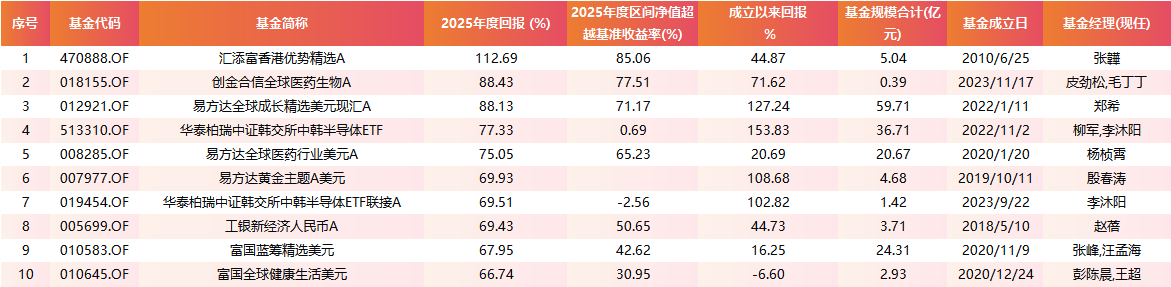
Core Insights - The QDII (Qualified Domestic Institutional Investor) funds have shown significant performance differentiation in 2025, with some funds achieving remarkable returns while others faced substantial losses due to market volatility and sector-specific challenges [1][4][6]. Performance Highlights - The top-performing QDII fund, Huatai-PB Hong Kong Advantage Selection, achieved a return of over 112%, benefiting from the global rise in innovative pharmaceuticals and biotechnology [2][9]. - Other notable funds include China Universal Global Pharmaceutical Biology and E Fund Global Growth Selection, both with returns exceeding 88%, driven by the global pharmaceutical sector's growth [2][9]. - The E Fund Gold Theme QDII also performed well, nearing a 70% return amid global risk aversion and monetary policy adjustments [2][9]. Underperformers - In contrast, several QDII funds focused on oil and real estate faced significant declines, with returns ranging from -10.78% to -13.76% for oil-themed funds like E Fund Oil and Southern Oil [4][11]. - Funds tracking the Saudi Arabian market also struggled, with returns exceeding -12% since their inception in 2024 [4][11]. - Real estate-focused funds, such as Penghua US Real Estate and Nuveen Global Real Estate, reported negative annual returns, reflecting broader market challenges [4][11]. Market Trends - The performance of QDII funds in 2025 highlights the importance of sector-specific trends, with technology and healthcare being key drivers of growth, while traditional cyclical assets like oil and real estate remain sensitive to macroeconomic conditions [6][13]. - The ability to diversify across different asset classes and geographic regions is emphasized as a critical strategy for investors to mitigate risks associated with concentrated investments [6][13].
2025年QDII基金跌幅前7名易方达占4席 最深跌13.6%
Zhong Guo Jing Ji Wang· 2026-01-09 07:06
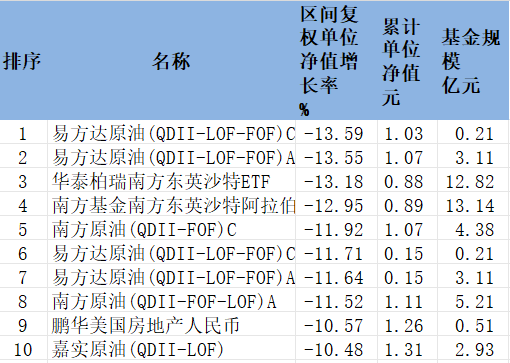
Core Viewpoint - In 2025, out of 650 comparable QDII funds, only 31 funds experienced a decline in net value, indicating a generally positive performance in the market [1] Group 1: Fund Performance - A total of 10 QDII funds saw a decline of over 10%, with four funds from E Fund Management Co., Ltd. leading the losses [1] - The specific funds from E Fund that underperformed include: - E Fund Oil (QDII-LOF-FOF) C (RMB share) with a decline of 13.59% - E Fund Oil (QDII-LOF-FOF) A (RMB share) with a decline of 13.55% - E Fund Oil (QDII-LOF-FOF) C (USD share) with a decline of 11.71% - E Fund Oil (QDII-LOF-FOF) A (USD share) with a decline of 11.64% [1][2] Group 2: Fund Management - The aforementioned four underperforming QDII funds are currently managed by fund manager Yin Chuntao, who has been with E Fund since June 2024 [1] - Yin Chuntao also took on the role of fund manager for E Fund Gold Theme Securities Investment Fund (LOF) and E Fund Global Allocation Mixed Securities Investment Fund (QDII) starting November 13, 2024 [1]
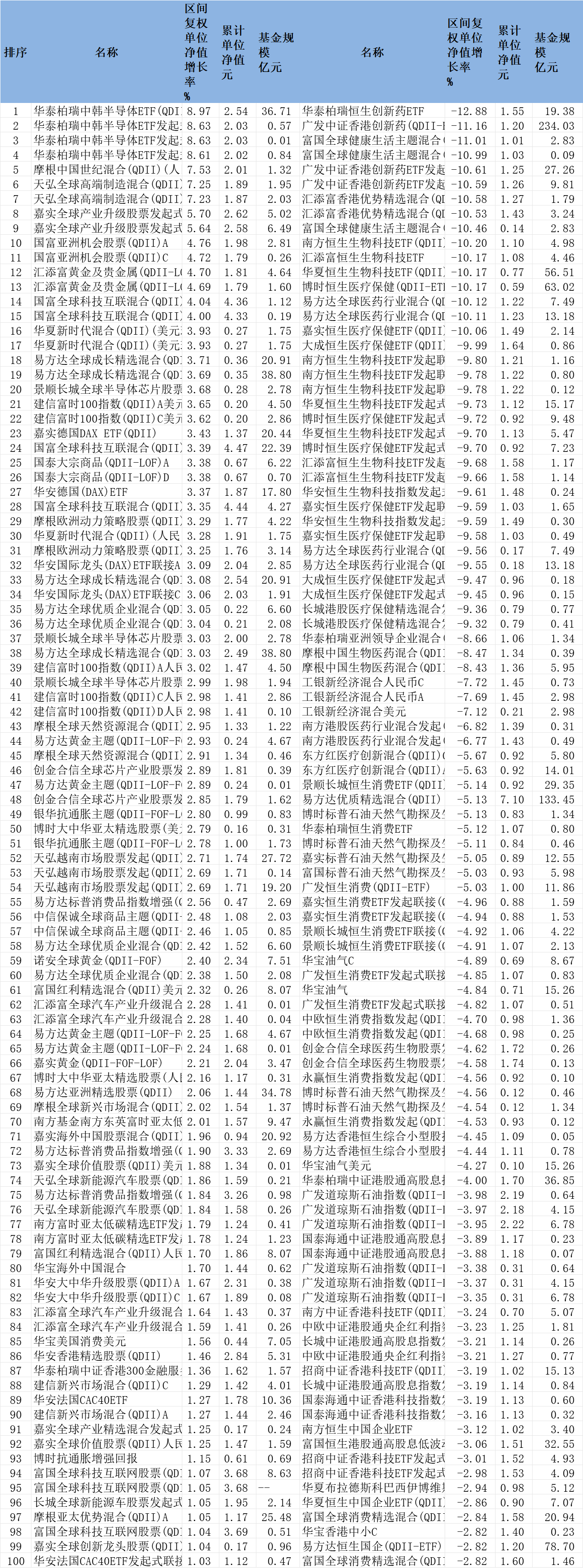
2025年12月34%QDII正收益 华泰柏瑞中韩半导体涨9%
Zhong Guo Jing Ji Wang· 2026-01-06 23:10
Core Viewpoint - In December 2025, 34.5% of the 692 comparable QDII funds experienced a net value increase, while 453 funds saw a decline, indicating a mixed performance in the market [1]. Group 1: Fund Performance - Among the QDII funds, 239 funds had a net value increase, while 453 funds had a decrease, with 8 funds remaining flat [1]. - The top-performing funds included four from Huatai-PB, specifically the Huatai-PB Sino-Korean Semiconductor ETF and its various linked versions, with monthly gains of 8.97%, 8.63%, 8.63%, and 8.61% respectively [1]. - The Huatai-PB Sino-Korean Semiconductor ETF, established on November 2, 2022, achieved a cumulative return of 153.83% by December 31, 2025, with a net value of 2.5383 yuan [1]. Group 2: Fund Holdings and Strategies - The Huatai-PB Sino-Korean Semiconductor ETF employed a passive investment strategy closely tracking its benchmark index, achieving its investment objectives effectively [2]. - As of the end of the third quarter, the top ten holdings of the Huatai-PB Sino-Korean Semiconductor ETF included major companies such as Samsung Electronics and SK Hynix [2]. - Additionally, 35 other QDII funds recorded monthly gains between 3% and 8%, with the E Fund Global Growth Select Mixed Fund (QDII) A and C having a combined scale of 5.971 billion yuan [2]. Group 3: Underperforming Funds - In December 2025, 16 QDII funds experienced declines exceeding 10%, with three from GF Fund leading the losses [3]. - The largest fund, GF CSI Hong Kong Innovative Medicine ETF, had a scale of 24.889 billion yuan and included top holdings such as Innovent Biologics and WuXi AppTec [3]. - The fund manager, Liu Jie, has over ten years of experience managing public funds since 2014 [3].
榜单|易方达垫底 2025年QDII基金业绩倒数榜
Xin Lang Cai Jing· 2025-12-24 14:38
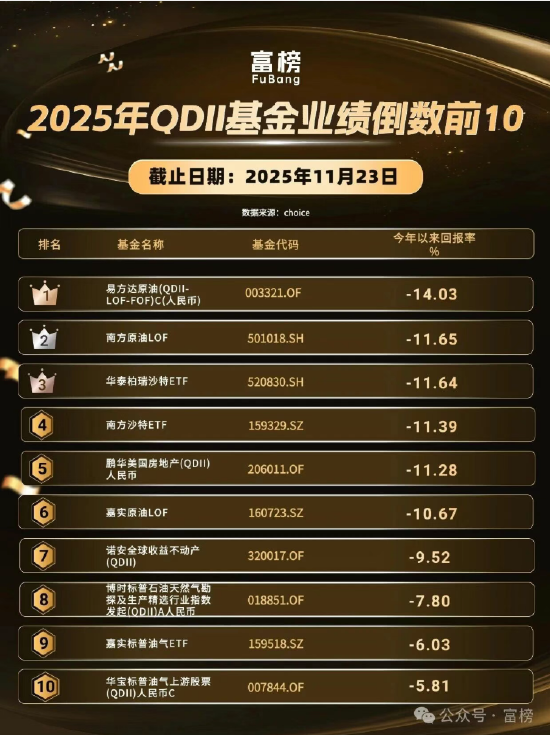
Core Viewpoint - The performance of QDII funds in 2025 has been disappointing, with many funds failing to achieve positive returns, particularly those focused on energy, real estate, and Middle Eastern markets [2][3][4]. Group 1: QDII Fund Performance - A total of 43 QDII funds have underperformed the market this year, with the E Fund Oil (QDII-LOF-FOF) C (RMB) recording the lowest return at -14.03% [2][3]. - Other poorly performing funds include Southern Oil LOF (-11.65%), Huatai-PB Saudi ETF (-11.64%), and Saudi ETF (-11.39%), all reflecting significant declines due to international oil price trends and geopolitical issues in the Middle East [2][3][4]. Group 2: Industry and Market Analysis - The energy sector has faced severe adjustments in 2025, with lower-than-expected oil demand due to sluggish global economic recovery and accelerated energy transition, leading to a downward trend in Brent and WTI oil prices [3][8]. - The Saudi stock market has been negatively impacted by a slowdown in domestic economic transformation and foreign capital outflows, resulting in a weak MSCI Saudi Index and declining net asset values for related ETFs [3][8]. - Real estate-focused QDII funds have also struggled, with Penghua US Real Estate (QDII) RMB at -11.28% and Northern Global Income Real Estate (QDII) at -9.52%, primarily due to high financing costs and valuation pressures from the Federal Reserve's sustained high interest rates [3][8]. Group 3: Investment Strategy Recommendations - Investors are advised to avoid excessive concentration in single countries or industries when allocating QDII funds and to prioritize products with strong management research capabilities and robust risk control mechanisms [4][9]. - Implementing strategies such as dollar-cost averaging is recommended to smooth out volatility rather than making large, one-time investments [4][9].
首尾相差125个百分点 QDII基金近一年业绩显著分化
Shang Hai Zheng Quan Bao· 2025-12-21 18:14
Group 1: QDII Fund Performance - The performance of QDII products has shown significant differentiation over the past year, with the top-ranking fund, Huatai-PineBridge Hong Kong Advantage Selected Mixed A, achieving a net value increase of 111%, leading the bottom-ranking products by 124.6 percentage points [1] - As of December 17, the average net value increase for QDII funds over the past year was 20.9%, with notable performers including Huatai-PineBridge Hong Kong Advantage Selected Mixed A (111%), Chuangjin Hexin Global Pharmaceutical Biotechnology Stock A (86.54%), and GF Zhongzheng Hong Kong Innovation Medicine (74.14%) [1] - The top ten funds in the QDII performance rankings are primarily Hong Kong stock funds, many of which have significant holdings in the Hong Kong pharmaceutical sector [1] Group 2: Market Trends and Analysis - The Hong Kong innovative pharmaceutical sector has recently experienced a significant adjustment, leading to a decline in the net value of related products, attributed to seasonal outflows of southbound funds and a decrease in the holding ratio of leading pharmaceutical stocks in the Hong Kong Stock Connect [2] - Despite the recent downturn, the fundamental outlook for the innovative pharmaceutical industry remains positive, with ongoing trends of innovative drugs going global, benefiting the entire supply chain, including upstream CXO and research services [2] - The performance of Saudi-themed ETFs and oil-related products has been poor, with two Saudi-themed products seeing net value declines of over 10% in the past year, while several oil-focused funds also reported negative returns [2] Group 3: Future Outlook - Looking ahead to global asset allocation for the next year, there is a belief that Hong Kong stocks still possess significant low valuation advantages amidst high valuations in most global markets, with expectations of orderly capital inflows as the external environment stabilizes and the Chinese economic outlook improves [2]
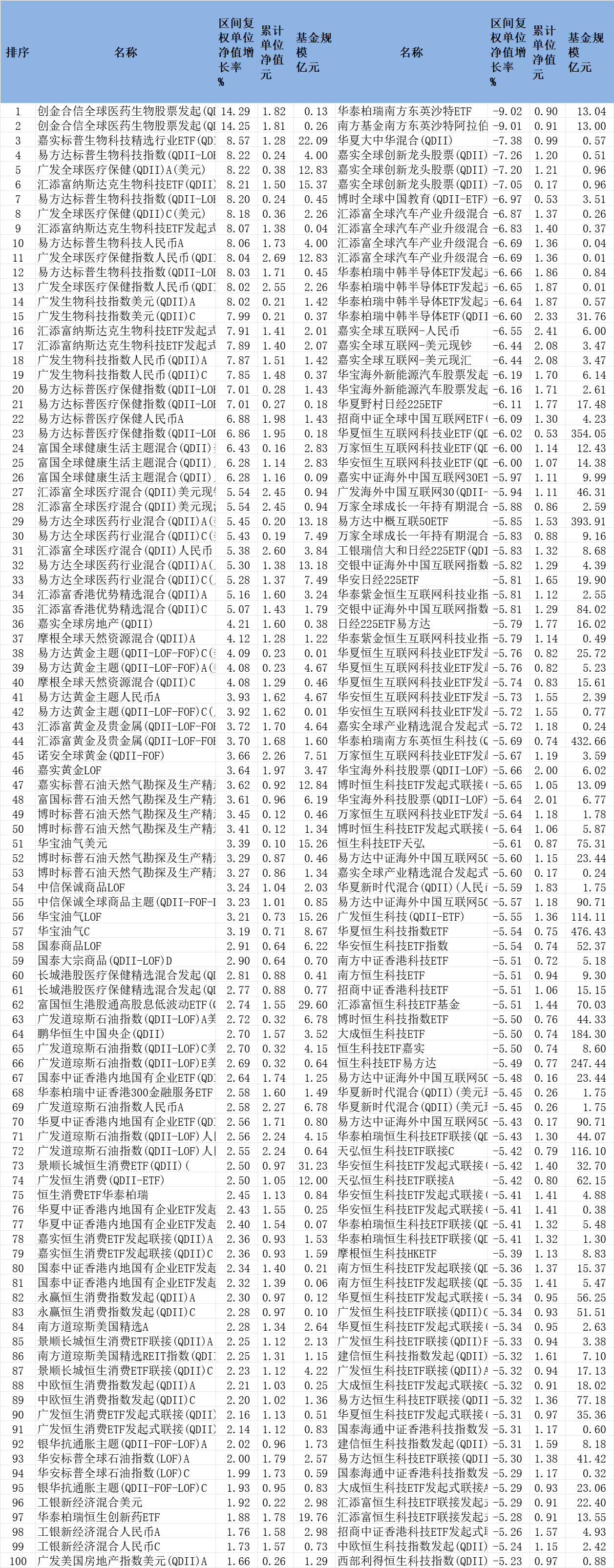
11月31%QDII正收益 创金合信全球医药生物股票涨14%
Zhong Guo Jing Ji Wang· 2025-12-03 23:17
Summary of QDII Fund Performance in November Core Insights - In November, out of 687 comparable QDII funds, 31.1% (214 funds) saw an increase in net value, while 470 funds experienced a decline, and 3 funds remained unchanged [1] - The top-performing QDII fund was the Chuangjin Hexin Global Pharmaceutical Biotechnology Fund, which achieved a return of 14.29% [1] - The overall performance of QDII funds was mixed, with significant variations in returns across different sectors, particularly in biotechnology and healthcare [2][3] Group 1: Fund Performance - 14 QDII funds had returns exceeding 8% in November, with the Chuangjin Hexin Global Pharmaceutical Biotechnology Fund leading at 14.29% [1] - The largest fund by size among those with over 8% returns was the Harvest S&P Biotechnology Select Industry ETF, with a scale of 2.209 billion yuan and a return of 8.57% [2] - Other notable funds included the GF Global Healthcare Fund A (USD) and the Huatai-PB Nasdaq Biotechnology ETF, with returns of 8.22% and 8.21% respectively [2] Group 2: Fund Details - The Chuangjin Hexin Global Pharmaceutical Biotechnology Fund, established on November 17, 2023, reported a year-to-date return of 97.34% and a cumulative net value of 1.7974 yuan [1] - The Harvest S&P Biotechnology Select Industry ETF, established on December 26, 2023, had a year-to-date return of 29.47% and a cumulative net value of 1.2525 yuan [2] - The top ten holdings of the Chuangjin Hexin fund included companies like Cidar, Anapt, and Taysh, focusing on the innovative drug industry [1] Group 3: Sector Performance - Funds tracking the Hang Seng Internet Technology Index and the China Securities Korea Exchange Semiconductor Index performed poorly, contributing to the decline of several QDII funds [3] - The overall trend indicates a strong performance in the biotechnology sector, while technology-focused funds faced challenges [3]
巴西ETF“杀疯了”!超51亿资金抢购,跨境投资为何如此火热?
Sou Hu Cai Jing· 2025-11-05 08:15
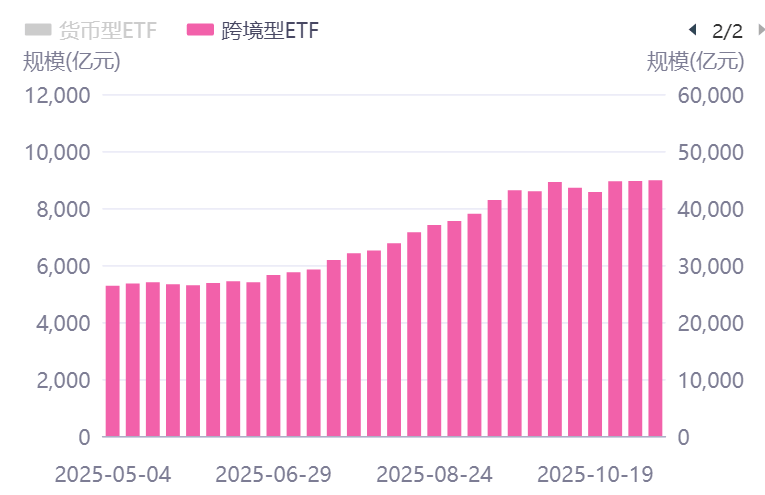
Core Insights - The recent surge in cross-border ETFs, particularly Brazilian ETFs, has attracted significant investor interest, with two ETFs being fully subscribed within a day, raising a total of approximately 5.137 billion yuan [1][3]. Group 1: Market Performance - The Brazilian IBOVESPA index has shown a 10-year annualized return exceeding 12%, comparable to the S&P 500, and has increased by 24.98% year-to-date [5]. - The total scale of cross-border ETFs has approached 900 billion yuan, with a rapid growth from approximately 565.5 billion yuan at the end of Q2 to about 884 billion yuan at the end of Q3 this year [3]. Group 2: Investment Trends - The popularity of Brazilian ETFs is part of a broader trend, with previous ETFs like the Southern Fund's Saudi Arabia ETF also experiencing significant subscription success [3]. - Investors are increasingly looking to global markets for opportunities, as evidenced by the strong performance of the Brazilian stock market compared to the Chinese market over the past decade [7]. Group 3: Economic Factors - Brazil's high interest rates, currently at 15%, are among the highest globally, attracting foreign investment despite potential economic growth constraints [10][12]. - The Brazilian ETF market is projected to see a cumulative net inflow of approximately 6.25 billion reais (about 1.167 billion USD) by 2025, with fixed income ETFs contributing significantly to this inflow [9].