卫星互联网(Starlink)

Search documents
年底回顾与展望:六大前沿赛道的投资密钥与产业跃迁
Sou Hu Cai Jing· 2025-12-11 23:34
Group 1: Commercial Aerospace - SpaceX plans to conduct an IPO in 2026, aiming to raise several billion dollars, marking a new phase of commercialization and capitalization in the commercial aerospace industry [3] - China's recent successful launch of multiple satellites demonstrates its growing capabilities in space exploration, with an increasing frequency of launches expected to drive exponential growth in orders for upstream suppliers [3][4] - Companies like Guanglian Aviation are positioned to benefit significantly from the anticipated increase in commercial rocket launches, with potential revenue growth reaching tens of billions [4] Group 2: AI and Server Technology - The demand for AI computing power is escalating, with power consumption for AI models increasing significantly, leading to a shift from traditional air cooling to liquid cooling solutions [6] - Companies with rare certification for liquid cooling solutions are expected to see a revaluation of their worth due to the high technical barriers and increased average selling prices [6] - The AI server supply chain is evolving, with investments shifting towards companies that possess high technical barriers and rare certifications, which will likely enjoy valuation premiums [6][9] Group 3: Humanoid Robots - Tesla's Optimus has initiated the supplier review process, indicating that humanoid robots are on the verge of mass production, with Chinese companies expected to surpass Tesla in production scale by 2026 [7] - Key components such as lightweight materials and advanced sensors are critical for the development of humanoid robots, with companies like Ningbo Huaxiang collaborating on innovative materials [8][10] - Investment strategies should prioritize core components over complete systems, focusing on companies with high technical barriers and established supply chains [11] Group 4: Semiconductor Industry - The demand for high-bandwidth memory (HBM) is surging due to AI chip requirements, prompting a rapid evolution in HBM technology and a focus on domestic production capabilities [12] - Companies like Huahai Chengke are positioned to capture significant market share in the HBM materials sector, with potential revenues reaching 3 billion yuan [14] - The semiconductor investment landscape is shifting towards companies that can achieve substantial breakthroughs and secure orders in high-demand areas like HBM and advanced packaging [12] Group 5: Energy Sector - The energy market is experiencing a transition, with gas turbines expected to maintain strong demand through 2035, benefiting companies like Yingliu [15] - Nuclear fusion technology is advancing, with Chinese teams making significant progress, positioning companies like China Uranium Industry as future leaders in energy solutions [16] - Investment strategies should focus on both immediate opportunities in gas turbines and long-term potential in nuclear fusion technologies [16] Group 6: Optical Communication - The optical communication sector is transitioning from 800G to 1.6T technology, significantly increasing the demand for core materials like indium phosphide [17] - Companies that have achieved breakthroughs in domestic production of critical components for optical modules are expected to benefit from industry growth and market share increases [17][21] - Investment in optical communication should align with the dual themes of speed upgrades and domestic substitution [17] Group 7: Macro Variables - The Federal Reserve's recent interest rate cut is expected to create a more favorable liquidity environment for growth-oriented technology stocks, particularly those sensitive to interest rates [18][22] - The anticipated improvement in financing conditions will support technology companies in sectors like commercial aerospace, AI, and robotics that require substantial R&D investments [22] - Investors should focus on identifying companies with real technological barriers and clear growth paths in the evolving landscape of hard technology [23]




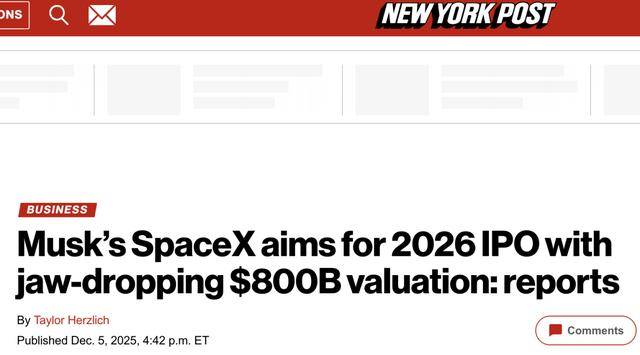
马斯克旗下SpaceX计划于2026年上市,估值高达8000亿美元
Sou Hu Cai Jing· 2025-12-06 06:12
Core Viewpoint - SpaceX is initiating a new round of secondary stock sales, potentially doubling its valuation to $800 billion, driven by strong investor support and performance in key business areas [1][2]. Group 1: Stock Sale and Valuation - SpaceX's valuation is expected to reach $800 billion, up from $400 billion in the previous secondary stock sale [2]. - The company is utilizing a "Tender Offer" model, allowing employees and early investors to liquidate shares while providing entry opportunities for new investors [2]. - The optimistic market sentiment is supported by a group of long-term investors backing SpaceX's high valuation [2]. Group 2: Business Performance - Investors are optimistic about SpaceX's valuation due to its strong performance in satellite internet (Starlink) and government defense collaborations [2]. - SpaceX is a key partner for NASA and the Pentagon, handling numerous launch missions and satellite deployment projects, maintaining industry-leading technology and market share [2]. Group 3: Future Prospects - SpaceX's CFO has communicated the potential for an initial public offering (IPO) in 2026 [2]. - The company anticipates annual revenue of $15.5 billion for the year, as stated by Elon Musk [3]. - Ongoing investments in the development of the Starship heavy-lift rocket are aimed at supporting future crewed lunar missions and enhancing deep space exploration capabilities [3].