
双环路协同演进脑机接口系统

Search documents
2025中关村论坛年会|“北脑一号”临床顺利,脑机接口驶向未来
Bei Jing Shang Bao· 2025-03-31 13:23
Core Insights - Brain-computer interface (BCI) technology is emerging as a transformative force, bridging theoretical exploration and practical application across various industries [1][5] - The "North Brain No. 1" project represents a significant breakthrough in China's BCI field, having successfully completed three human implantations with a 128-channel micro-system [5][6] - The BCI industry is still in its early stages, facing major challenges in core components, signal acquisition, and wireless transmission [5][7] Industry Developments - The BCI Industry Alliance announced the top ten innovative achievements in BCI for 2025, highlighting "North Brain No. 1" and several other advanced systems [6] - The forum emphasized the need for enhanced collaboration among government departments to guide the BCI industry's innovation and development [8] - Recommendations were made to strengthen technological research, optimize the industry ecosystem, and establish a robust patent and standards system for BCI technology [8][9] Clinical Progress - The clinical trials of "North Brain No. 1" have shown a language decoding accuracy exceeding 60% at the Xuanwu Hospital, indicating promising results [5] - Data collection and model calibration are ongoing, with multiple decoding teams actively working on patient data analysis [5] Future Outlook - The ultimate goal of BCI technology is not only to connect the brain with machines but also to link humanity with the future [10]


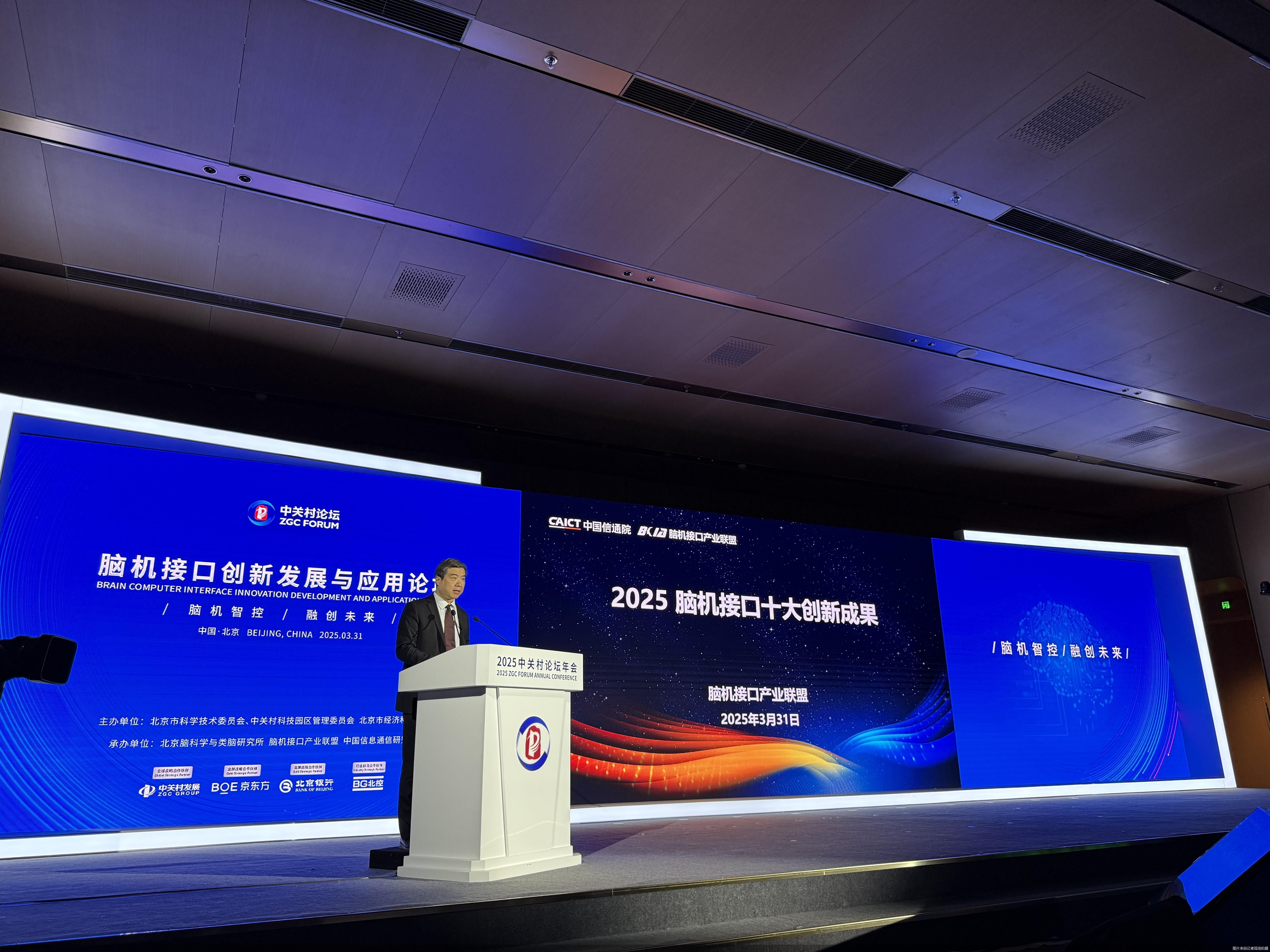
脑电大模型、脑机协同演进……2025脑机接口十大创新成果发布
Xin Jing Bao· 2025-03-31 10:40
Core Insights - The article highlights the release of the "Top Ten Innovations in Brain-Computer Interface (BCI)" by the Brain-Computer Interface Industry Alliance during the Zhongguancun Forum, showcasing significant advancements in BCI technology and applications. Group 1: Innovations in BCI Technology - "Beijing Brain No. 1" completed the first international implantation of a flexible high-throughput semi-invasive wireless brain-computer system, featuring a 128-channel micro, wireless, low-power fully implanted system for clinical validation in motor function decoding and language decoding for conditions like ALS [1] - The "Three-in-One" cranial implantable brain-spinal interface micro-device, developed by Fudan University, utilizes a minimally invasive 4-hour surgery to implant a flexible electrode with a diameter of only 1mm, achieving a 90% reduction in trauma area and a 92.7% accuracy in lower limb muscle control [2] - The dual-loop collaborative evolution brain-computer interface system proposed by Tianjin University introduces the concept of collaborative evolution, enabling information exchange between biological intelligence and machine intelligence, laying a theoretical foundation for practical BCI systems [3] Group 2: Advanced Applications and Models - LaBraM, the world's first large brainwave model developed by Shanghai Lingwei Technology, processes EEG data with superior performance in emotion recognition tasks compared to traditional deep learning models, and has been recognized in ICLR 24 hot papers [4] - A mixed reality-based brain-computer interface system from East China University of Science and Technology integrates virtual and real control frameworks for efficient control of quadruped robots in complex environments [5] - A rechargeable directional Bluetooth perceptive brain pacemaker from Beijing Pinchi Medical Equipment Co., Ltd. is designed for treating Parkinson's disease and other neurological disorders, featuring innovations in directional stimulation and remote control capabilities [6] Group 3: Medical Devices and Treatments - A dual-target implantable deep brain stimulation system for drug addiction treatment developed by Jingyu Medical Technology is the first of its kind, filling a technological gap in addiction therapy and has received FDA breakthrough device designation [7][8] - A non-invasive brain-computer interface rehabilitation training device from Shanghai Shaonao Sensor Technology has been clinically tested in over 10 top-tier hospitals, achieving a 92% doctor approval rate and 85% patient satisfaction [9] - The non-invasive closed-loop temporal interference deep brain stimulation system from Shenzhen Zhongke Huayi Technology integrates multimodal neural imaging data and AI algorithms for precise brain area modulation, improving stimulation focus by over 60% [10] Group 4: Standardization and Future Directions - The Brain-Computer Interface Standardization Roadmap (2025) developed by the China Academy of Information and Communications Technology provides a comprehensive framework for the standardization of BCI technology, promoting its global application and innovation [11]