双足人形机器人Atlas

Search documents
黄仁勋定调,“物理AI”吹响号角
3 6 Ke· 2026-01-07 11:10
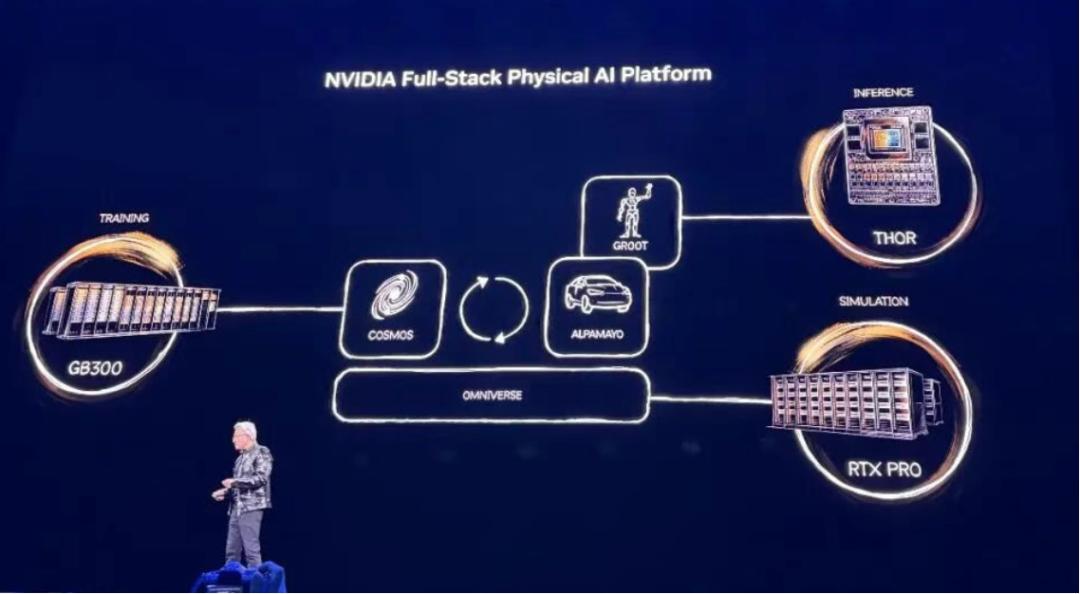
Core Insights - The core viewpoint presented by NVIDIA CEO Jensen Huang is that artificial intelligence (AI) is entering a new phase termed "Physical AI," which signifies a shift from understanding language to comprehending the physical world [2][3]. Group 1: Development of Physical AI - Huang predicts that by 2026, robots with "human-level" capabilities will be achievable, marking a significant transition in AI's ability to interact with the physical environment [2][3]. - The concept of "Physical AI" involves AI systems that can understand natural laws and interact with the physical world, moving beyond mere text and image processing [3][4]. - Huang emphasizes that the development of "Physical AI" requires a comprehensive set of models that can decompose problems and utilize tools, rather than relying on a single model [4]. Group 2: Industrialization of AI - Huang outlines a vision for "AI industrialization," indicating that the entire computing industry must undergo a fundamental transformation to support scalable and deployable AI capabilities [5]. - The latest NVIDIA offerings include a suite of open models, frameworks, and infrastructure aimed at enabling "Physical AI," showcasing collaborations with global partners to create various robotic applications [5][8]. - Huang asserts that the key to advancing AI from virtual to physical realms lies in the ability of robots to understand concepts like gravity, friction, and causality, allowing them to make informed decisions and actions [7][8]. Group 3: Industry Impact and Challenges - The emergence of "Physical AI" is expected to bring robots closer to practical applications, moving them from experimental showcases to commercially viable products [9][11]. - The performance of robots like Boston Dynamics' Atlas demonstrates that humanoid robots are being designed for real-world applications, emphasizing functionality over mere imitation of human movement [11]. - However, challenges remain in the form of data quality, the gap between simulation and real-world application, and the need for technological integration across the industry [12][13].