古兰(Qeran)

Search documents
伊朗走投无路
Sou Hu Cai Jing· 2025-10-15 11:20
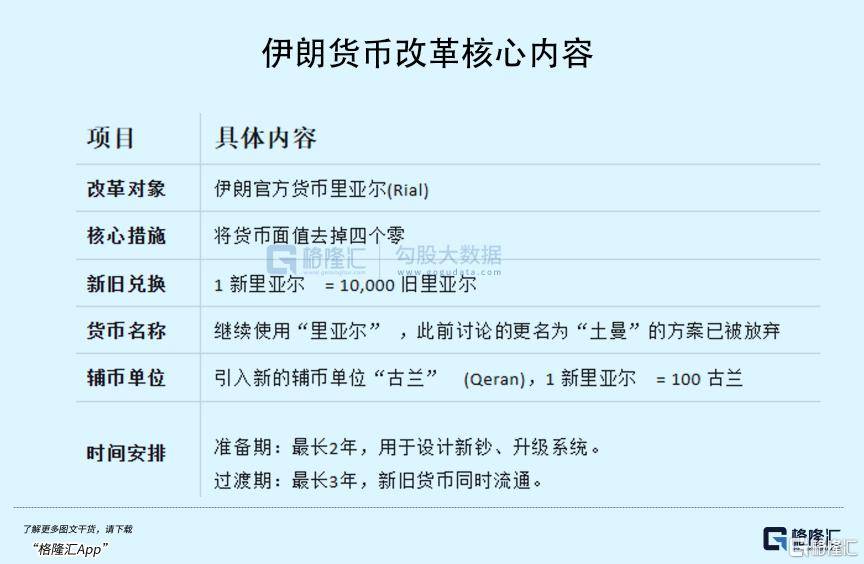
Core Viewpoint - Iran is undergoing a significant currency reform due to hyperinflation, which has led to the devaluation of its currency, the rial, necessitating the removal of four zeros from its face value to simplify transactions and restore some semblance of economic order [4][5][6][8]. Currency Reform - The Iranian parliament has approved a comprehensive reform of the currency system, which includes removing four zeros from the rial [4][5]. - The new exchange rate will be 1 new rial equal to 10,000 old rials, while the currency name will remain "rial" [11]. - A new subunit called "qeran" will be introduced, where 1 new rial equals 100 qeran [11]. - The reform will have a preparation period of up to two years and a transition period of up to three years during which both old and new currencies will circulate [11]. Economic Context - The Iranian economy is facing severe challenges, with a reported economic growth rate of -0.1% in the first quarter of 2025, and significant declines in industrial and agricultural sectors [17]. - Tax revenue for 2025 is projected to be around $12.8 billion, accounting for less than 2.5% of GDP, indicating a near collapse of the tax base [18][19]. - The government has been heavily reliant on borrowing from the central bank, leading to rampant money printing and further devaluation of the rial [52][54]. Structural Issues - The Iranian economy is characterized by a dual structure where religious foundations and the Islamic Revolutionary Guard Corps (IRGC) dominate economic activities, contributing over 50% of GDP but failing to benefit the general populace [48]. - The IRGC has expanded its influence into various sectors, including construction and energy, often without competition due to its privileged status [45][47]. - The economic model has led to a significant wealth gap, with a small elite controlling most resources while the general population suffers from declining purchasing power [40][61]. Historical Perspective - The current situation in Iran contrasts sharply with the historical "Golden Age" of Islam, where leaders were chosen based on merit rather than religious or military power [59]. - The present-day clerical leadership has shifted from moral exemplars to self-serving elites, exacerbating social inequalities and economic mismanagement [60][61].