抵抗型经济

Search documents
希琳:我一直相信“抵抗体制”可以保卫伊朗,直到亲历战火……
Xin Lang Cai Jing· 2026-02-10 06:39
Core Viewpoint - The article discusses the ongoing tensions between Iran and the United States following the "Twelve-Day War," highlighting the psychological and social impacts on the Iranian populace, particularly the youth, and the implications for future protests and political movements. Group 1: Impact of the "Twelve-Day War" - The "Twelve-Day War" has left a lasting trauma on the Iranian people, with its shadow still looming over their lives [1][9] - The war resulted in significant civilian casualties, with thousands of Iranians reportedly killed, leading to a growing sense of insecurity among the populace [5][6] - The conflict has exacerbated existing economic issues, causing the Iranian rial to depreciate sharply, which has been a burden on ordinary citizens [9] Group 2: Social and Political Dynamics - The war has led to increased societal division and protests, with many Iranians questioning the effectiveness of the "resistance economy" and attributing their economic struggles to systemic issues [9][10] - The emergence of political figures like Reza Pahlavi has polarized public opinion, with many young people initially supporting him but later expressing disillusionment due to his perceived alignment with Western interests [11][13] - The political environment has become increasingly hostile, with individuals fearing backlash for expressing dissenting views, leading to a chilling effect on political discourse [14] Group 3: Future Outlook - There is a prevailing sense of pessimism among Iranians regarding the future, particularly in light of potential renewed conflict with the U.S., which many believe would disproportionately affect civilians [16][17] - The ongoing geopolitical tensions and economic sanctions have created a complex landscape where both government supporters and opposition groups suffer from the consequences of external pressures [16]

伊朗走投无路
虎嗅APP· 2025-10-17 09:36
Core Viewpoint - The article discusses the severe economic crisis in Iran, highlighting the rapid devaluation of the Iranian rial and the government's inability to restore economic stability through superficial reforms [5][6][12]. Group 1: Currency Devaluation and Economic Impact - As of September 2025, the exchange rate of the US dollar to the Iranian rial reached 1:1,150,000, a significant increase from 800,000 rial per dollar at the beginning of the year and 10,000 rial per dollar in 2010 [6][7]. - The rapid devaluation has rendered the currency nearly worthless, leading to a drastic decline in economic efficiency and daily consumer difficulties [8][10]. - In response to hyperinflation, the Iranian parliament approved a comprehensive reform to remove four zeros from the rial's face value, which is seen as a technical fix rather than a solution to the underlying economic issues [11][12]. Group 2: Government Revenue and Economic Structure - Since 2022, Iranian government revenues have significantly decreased, with the economy entering a recession again after a brief growth in 2024 [21][22]. - The projected tax revenue for 2025 is approximately $12.8 billion, accounting for less than 2.5% of GDP, indicating a near collapse of the tax base [23][24]. - The article suggests that the Iranian government has lost its ability to regulate society due to financial constraints, exacerbated by external sanctions and internal mismanagement [27][28]. Group 3: Political and Economic System - Iran's political system is characterized by a theocratic structure where religious authority supersedes democratic governance, leading to inefficiencies and corruption [29][30]. - The Bonyad, a network of religious foundations, contributes about 20% of Iran's GDP but operates outside normal regulatory frameworks, enjoying tax exemptions and government subsidies [35][48]. - The Islamic Revolutionary Guard Corps (IRGC) has evolved into a military-industrial complex, controlling significant economic sectors and contributing over 30% of GDP, further entrenching the economic challenges faced by the government [78][79]. Group 4: Socioeconomic Disparities - The wealth distribution in Iran has become increasingly skewed, with a small elite, including high-ranking clerics, accumulating vast fortunes while the majority of the population struggles with low incomes [49][50]. - The article highlights the disparity between the high allowances of clerics and the low average income of citizens, illustrating the deepening economic divide [49][50]. - The current economic situation is viewed as a result of systemic issues within the governance structure, where wealth is concentrated among a few, leading to widespread discontent among the populace [104][106].
伊朗走投无路
Sou Hu Cai Jing· 2025-10-15 11:20
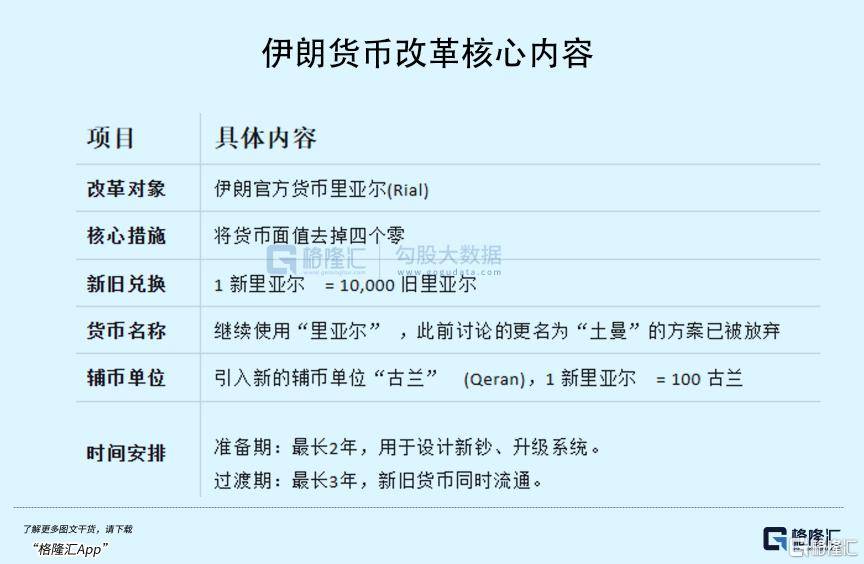
Core Viewpoint - Iran is undergoing a significant currency reform due to hyperinflation, which has led to the devaluation of its currency, the rial, necessitating the removal of four zeros from its face value to simplify transactions and restore some semblance of economic order [4][5][6][8]. Currency Reform - The Iranian parliament has approved a comprehensive reform of the currency system, which includes removing four zeros from the rial [4][5]. - The new exchange rate will be 1 new rial equal to 10,000 old rials, while the currency name will remain "rial" [11]. - A new subunit called "qeran" will be introduced, where 1 new rial equals 100 qeran [11]. - The reform will have a preparation period of up to two years and a transition period of up to three years during which both old and new currencies will circulate [11]. Economic Context - The Iranian economy is facing severe challenges, with a reported economic growth rate of -0.1% in the first quarter of 2025, and significant declines in industrial and agricultural sectors [17]. - Tax revenue for 2025 is projected to be around $12.8 billion, accounting for less than 2.5% of GDP, indicating a near collapse of the tax base [18][19]. - The government has been heavily reliant on borrowing from the central bank, leading to rampant money printing and further devaluation of the rial [52][54]. Structural Issues - The Iranian economy is characterized by a dual structure where religious foundations and the Islamic Revolutionary Guard Corps (IRGC) dominate economic activities, contributing over 50% of GDP but failing to benefit the general populace [48]. - The IRGC has expanded its influence into various sectors, including construction and energy, often without competition due to its privileged status [45][47]. - The economic model has led to a significant wealth gap, with a small elite controlling most resources while the general population suffers from declining purchasing power [40][61]. Historical Perspective - The current situation in Iran contrasts sharply with the historical "Golden Age" of Islam, where leaders were chosen based on merit rather than religious or military power [59]. - The present-day clerical leadership has shifted from moral exemplars to self-serving elites, exacerbating social inequalities and economic mismanagement [60][61].