周易X3 NPU IP

Search documents
安谋科技发布“AI Arm China”战略发展方向,携手产业共创AI未来
半导体行业观察· 2025-11-24 01:34
Core Viewpoint - The article emphasizes the strategic direction of "AI Arm CHINA" announced by Arm Technology, focusing on AI development and integration within the Chinese market, aiming to enhance the AI computing ecosystem in China [3][5][14]. Group 1: AI Strategy and Market Positioning - Arm Technology is committed to investing fully in AI, connecting closely with the global Arm ecosystem, and fostering local innovation in China [3][6]. - The company aims to leverage AI to reshape various industries, including semiconductors, by adopting an AI+ mindset [6][10]. - Arm's computing platform is positioned as the only solution capable of meeting the diverse AI computing needs, from milliwatt to megawatt levels [10][12]. Group 2: Technological Advancements and Collaborations - Arm's architecture offers a performance efficiency improvement of up to 40% compared to other platforms, particularly in cloud services [12]. - The company has established partnerships with major players like Meta, Microsoft, and NVIDIA to expand its data center chip offerings, with expectations that nearly 50% of the computing power for large-scale cloud service providers will be based on Arm architecture by 2025 [12]. - Arm Technology has shipped over 325 billion chips globally and has a developer ecosystem of over 22 million, facilitating the deployment of AI solutions across various sectors [12][14]. Group 3: Product Development and Innovations - The company has launched several self-developed IP product lines, including "Zhouyi" NPU, "Xingchen" CPU, "Shanhai" SPU, and "Linglong" multimedia series, reflecting its commitment to the Chinese market [14]. - Recent product highlights include the Zhouyi X3 NPU IP, designed for large models, and the Xingchen MC3 CPU, which offers enhanced AI capabilities and lower power consumption [16][18]. - The company is also focusing on establishing an international R&D center in Hong Kong and revitalizing its Shanghai office to foster collaboration within the AI industry cluster [19].


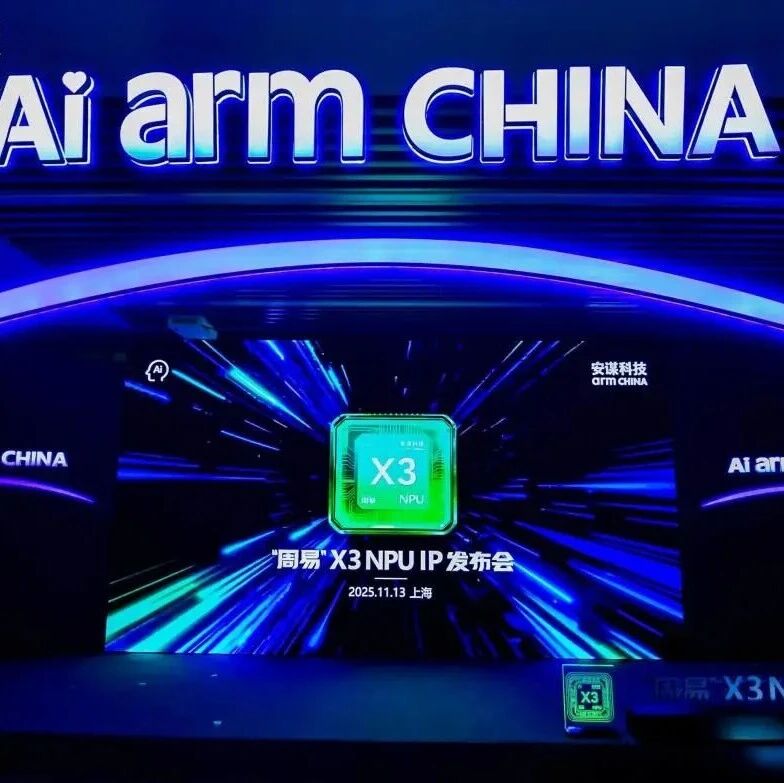
安谋科技Arm China“周易”X3 NPU IP,树立端侧AI新标杆!
半导体行业观察· 2025-11-18 01:40
Core Viewpoint - The article discusses the rapid growth of AI computing demand in edge intelligent devices, highlighting the challenges such as limited computing power, bandwidth bottlenecks, and high development thresholds that hinder the large-scale implementation of edge AI. It emphasizes the role of NPU (Neural Processing Unit) as a key driver for the realization of edge AI applications [2]. Group 1: Product Launch and Strategy - On November 13, 2025, Arm China officially launched the "Zhouyi" X3 NPU IP, marking a significant step in its "All in AI" strategy aimed at setting new benchmarks for edge AI computing efficiency [3]. - The release of the "Zhouyi" X3 NPU IP is a critical practice in Arm China's strategic direction for AI development [5]. - Arm China’s Vice President of Product Development, Liu Hao, stated that the company will continue to invest in integrating top-tier R&D resources and providing comprehensive solutions from hardware to software to empower partners' product innovation and commercialization [8]. Group 2: Technical Innovations - The "Zhouyi" X3 features a new DSP+DSA architecture specifically designed for large models, marking a transition from fixed-point to floating-point calculations, thus creating a hybrid architecture [13]. - The NPU supports a flexible computing power configuration ranging from 8 to 80 FP8 TFLOPS, with a single core bandwidth of up to 256GB/s, which, when combined with proprietary decompression hardware, can achieve an additional 15%-20% equivalent bandwidth improvement [15]. - The introduction of W4A8/W4A16 computation acceleration modes significantly reduces bandwidth consumption, facilitating the efficient migration of cloud-based large models to edge devices [17]. Group 3: Software Ecosystem - The "Zhouyi" X3 is equipped with the upgraded Compass AI software platform, which focuses on openness, ease of use, and efficiency, addressing the challenges of adapting to edge AI development [19]. - The platform supports over 160 operators and more than 270 models, including cutting-edge models like LLM, VLM, and MoE, and has open-sourced core components to enhance development efficiency [19]. - The software ecosystem aims to lower the development threshold and improve the overall user experience for AI developers [19]. Group 4: Performance and Applications - The "Zhouyi" X3 demonstrates a performance improvement of 30%-50% in CNN models compared to its predecessor, the X2, with a linear scalability of multi-core computing power reaching 70%-80% [23]. - The NPU is designed to support various AI applications across four core areas: infrastructure, smart vehicles, mobile terminals, and smart IoT, providing robust computing power for diverse AI devices [28][30]. - The NPU's capabilities enable it to handle complex cognitive tasks, marking a transition from single-function implementations to widespread adoption of edge AI [31]. Group 5: Future Directions - Arm China plans to enhance the general computing capabilities and scalability of its NPU architecture, exploring multi-die and multi-chip collaboration technologies [33]. - The company aims to optimize programming models and develop a more user-friendly software interface to support a wider range of data formats and network structures [33]. - Arm China is committed to fostering an open ecosystem and expanding collaboration models to promote efficient deployment of hardware and software [33].