声呐探测系统

Search documents
“十五五”水下攻防体系前沿技术与未来产业链发展趋势预判报告
Xin Lang Cai Jing· 2026-01-29 12:12
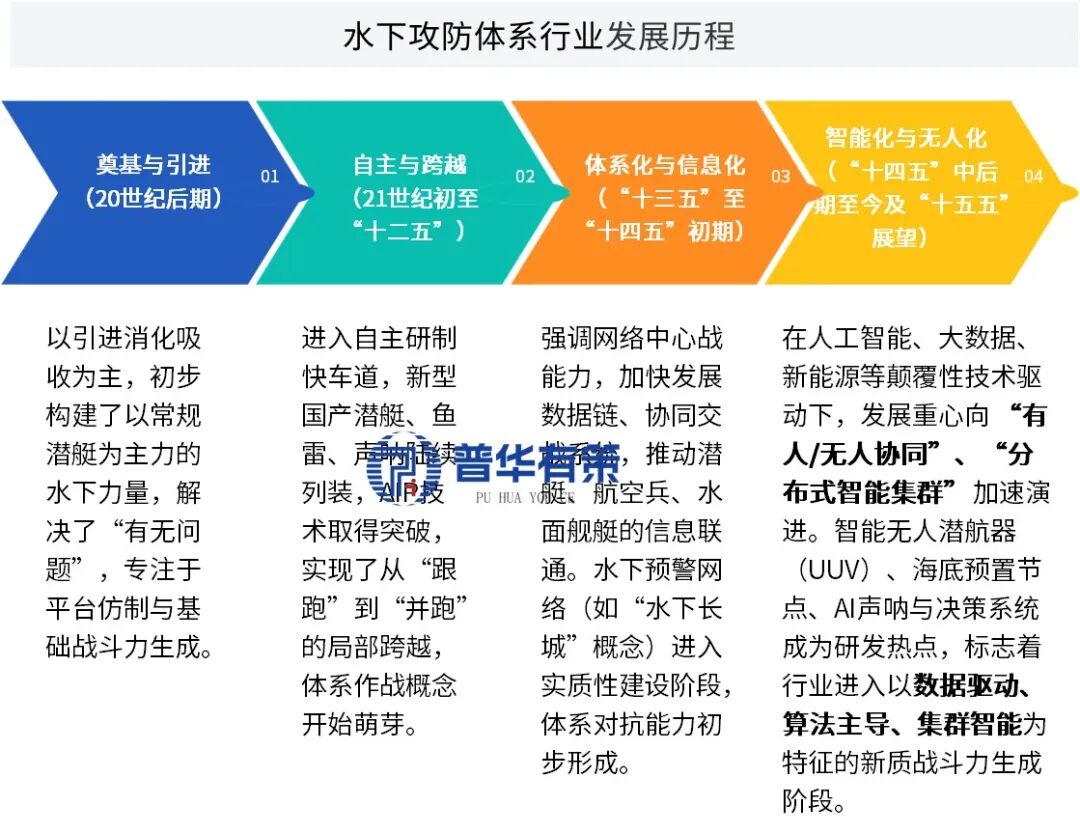
Core Insights - The underwater defense system is a strategic and systematic equipment and capability collection that integrates manned/unmanned platforms, detection networks, communication systems, intelligent weapons, and command control systems to safeguard national maritime sovereignty and security [1][23]. Industry Overview - The underwater defense system industry is a long-term pursuit and innovation history spanning several decades in China [2][24]. - The industry is characterized by a "pyramid" structure, with upstream focusing on special materials and core components, midstream on system integration, and downstream on military and civilian applications [5][28]. Industry Development Factors - The rigid demand for national strategic security and maritime rights drives the construction of the underwater defense system, ensuring the safety of strategic nuclear deterrence and maintaining maritime strategic channels [9][34]. - Breakthroughs in disruptive technologies and continuous advancements in deep-sea frontier technologies are crucial for the industry's capability leap [10][35]. - Strong support from top-level strategic planning and policy resources is essential for the development of the underwater defense system [11][36]. - The large-scale innovation and deepening military-civilian integration act as market accelerators for the industry [12][37]. Industry Trends - The industry is transitioning towards intelligent, unmanned, and distributed networks, reshaping rules and competitive landscapes [1][40]. - The integration of AI, advanced materials, and new energy sources is becoming a core manifestation of new productive forces in the underwater defense field [1][40]. Technological Characteristics - China has reached or is close to world-class levels in conventional submarine technology, certain underwater detection devices, and launch weapons, but still lags in nuclear submarine stealth technology and high-power persistent power systems [7][30]. - AI applications are primarily focused on signal processing and target classification, with a rapid expansion into more complex decision support areas [7][30]. Market Structure and Competitive Landscape - The global underwater defense system market is characterized by oligopolistic competition, with major military groups dominating the market [5][5]. - In China, the market is led by state-owned enterprises, while private companies are rapidly penetrating niche segments [5][5].

科学仪器新风口:“深地经济” 纳入国家战略布局
仪器信息网· 2025-10-24 09:21
Core Viewpoint - The "Deep Earth Economy" has been officially recognized as a strategic emerging industry in China's 14th Five-Year Plan, indicating a significant opportunity for the scientific instrument sector to evolve and innovate in response to technological advancements [1][2]. Summary by Sections Definition of Deep Earth Economy - The "Deep Earth Economy" refers to economic activities that occur underground, including oil and gas resource development, deep coal mining, underground infrastructure construction, geothermal energy utilization, and urban underground space engineering [2]. Instruments and Equipment Involved - A variety of advanced scientific instruments are essential for deep earth exploration, development, and utilization, including: - Geological exploration instruments: sonar detection systems, geological imaging devices, transient electromagnetic equipment, and oil and gas exploration instruments - Rock mechanics and experimental instruments: rock mechanics testing systems, multi-field coupling experimental devices, and nuclear magnetic resonance analyzers - Monitoring and safety instruments: deep earth monitoring systems and geological disaster monitoring equipment - Commonly known oil and mineral analysis instruments: gas chromatographs, petroleum liquefied gas analyzers, density measurement instruments, and viscometers [4]. Market Outlook for Deep Earth Instruments - The market size for instruments related to the "Deep Earth Economy" is expected to reach 3-5 trillion yuan during the 14th Five-Year Plan, with ongoing policy benefits driving explosive growth, particularly in fields such as superhard materials, intelligent drilling, and geological monitoring [5]. Technological Development Needs - There is significant room for technological advancement in the instruments used for oil analysis and exploration. Traditional methods are slow and costly, failing to meet modern production demands. The shift in requirements from slow analysis to rapid precision and from laboratory analysis to in-situ measurements is reshaping the instrument market landscape [6]. Conclusion - The recent signals from the Ministry of Natural Resources indicate a promising future for related companies, such as ShenKai Co., in the stock market. The combination of policy support and market demand is expected to drive the upgrade of instrument equipment, presenting a rare historical opportunity for domestic instruments [7].