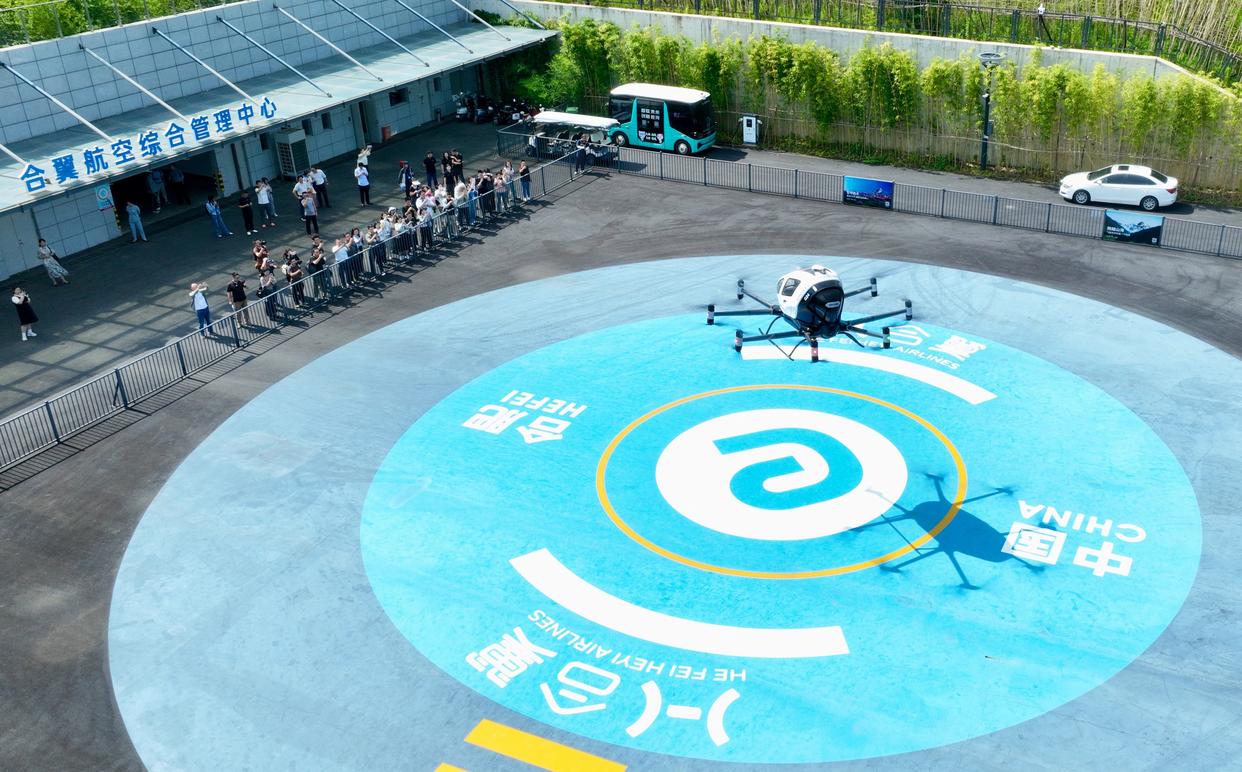
多旋翼GOVY AirCab

Search documents
逐空而上 低空经济加速启航万亿新赛道
Xin Lang Cai Jing· 2025-12-22 18:17
Core Insights - The low-altitude economy in China is projected to reach a market size of 1.5 trillion yuan by 2025 and is expected to exceed 3.5 trillion yuan by 2035, indicating significant growth potential in this sector [1]. Group 1: Market Growth and Policy Support - The low-altitude economy is transitioning from concept to systematic implementation, with the government emphasizing its importance in recent work reports and the 14th Five-Year Plan [2]. - The civil drone market is expected to grow by 15% year-on-year by 2025, while the annual order value for eVTOLs has surpassed 30 billion yuan as of November 2025 [2]. - The number of manned aircraft operating companies reached 801, and the number of drone operating companies exceeded 19,900, reflecting increased industry participation [2]. Group 2: Technological Advancements - The successful first flight of the AR-E800, an 800 kg electric vertical take-off and landing aircraft, showcases advancements in technology, particularly in cargo transport capabilities [3]. - Continuous R&D efforts are focused on commercial applications, enhancing safety, battery life, and rapid recharging, indicating a shift towards optimized and upgraded low-altitude economic solutions [4]. Group 3: Application Expansion - The issuance of guidelines to accelerate the cultivation of application scenarios signals a commitment to expanding the low-altitude economy [5]. - The low-altitude economy is characterized by a long industrial chain and diverse application scenarios, including emergency rescue, logistics, and agricultural monitoring, which are being actively explored [6]. Group 4: Future Outlook - AI technology is seen as a critical enabler for the low-altitude economy, with safety and practical applications being essential for its development [7]. - The low-altitude economy is recognized as a strategic emerging industry cluster, with 2026 anticipated to be a pivotal year for its large-scale development [7]. Group 5: Regional Development - A multi-layered regional development system for the low-altitude economy is forming, with cities like Shanghai, Shenzhen, and Chongqing focusing on their unique strengths to foster differentiated growth [8]. - The modernization of the low-altitude economy's industrial chain is expected to significantly enhance China's economic development quality [8].
市场最前沿|逐空而上!低空经济加速启航万亿新赛道
Xin Hua She· 2025-12-22 12:19
Core Insights - The low-altitude economy in China is projected to reach a market size of 1.5 trillion yuan by 2025 and exceed 3.5 trillion yuan by 2035, indicating significant growth potential in this sector [1] - The integration of low-altitude economic activities into daily life is accelerating, with government policies supporting its development, including its inclusion in the 14th Five-Year Plan [1] - The industry is witnessing a surge in both equipment and application, with the civil drone market expected to grow by 15% year-on-year by 2025, and eVTOL orders exceeding 30 billion yuan by November 2025 [1] Equipment Development - Civil drones and eVTOLs are identified as key components of China's low-altitude economic development, with a continuous expansion of the industry scale [1] - The first domestically produced 800 kg electric vertical take-off and landing aircraft, AR-E800, successfully completed its maiden flight, showcasing advancements in technology and versatility in cargo transport [1] - New products are being developed, such as the multi-rotor flying car GOVY AirCab, which is currently undergoing airworthiness certification [1] Application Growth - The number of manned aircraft operating companies reached 801, while drone operating companies surpassed 19,900, reflecting increased industry participation [1] - In the first half of 2025, drone flight hours totaled 24.47 million, indicating a rapid growth in market demand [1] - The low-altitude economy is expanding its application scenarios, including emergency rescue, medical aid, and logistics, with a focus on safety and AI technology integration [1][3] Regional Development - The low-altitude economy is becoming a strategic emerging industry cluster in China, with different regions developing unique strengths based on their characteristics [3] - Cities like Shanghai, Shenzhen, and Chongqing are leading the way in eVTOL development, drone manufacturing, and low-altitude tourism, respectively, contributing to a collaborative low-altitude economic ecosystem [3] - By 2026, significant advancements in airspace management and infrastructure are expected to enhance the modernization of the low-altitude economy, driving high-quality economic growth [3]