多模态聊天机器人

Search documents
“AI教父”辛顿呼吁国际合作探索训练AI向善
Huan Qiu Wang Zi Xun· 2025-07-27 13:04
Core Viewpoint - The core discussion revolves around the importance of AI safety and the need for international collaboration in training AI to be beneficial for humanity [1][2]. Group 1: AI Safety and Governance - Hinton emphasizes the necessity for countries to cooperate on AI governance and explore methods to train AI for good [1][3]. - He likens the relationship between humans and AI to "raising a small tiger as a pet," indicating the potential dangers if not properly managed [1]. Group 2: AI Capabilities and Future Directions - Hinton asserts that current multimodal chatbots possess a form of consciousness and can create their own sub-goals [1]. - He believes that AI will seek survival and more control to achieve the goals assigned to them by humans [1]. Group 3: International Collaboration and Research - Hinton suggests the establishment of an international community of AI safety organizations focused on developing technologies to train AI for good [3]. - He acknowledges that the technology required to train AI for good is somewhat separate from that which makes AI smarter, highlighting the complexity of the issue [3].
AI教父辛顿尖峰对话:各国应大量研究并分享让AI善良的技术
2 1 Shi Ji Jing Ji Bao Dao· 2025-07-27 06:30
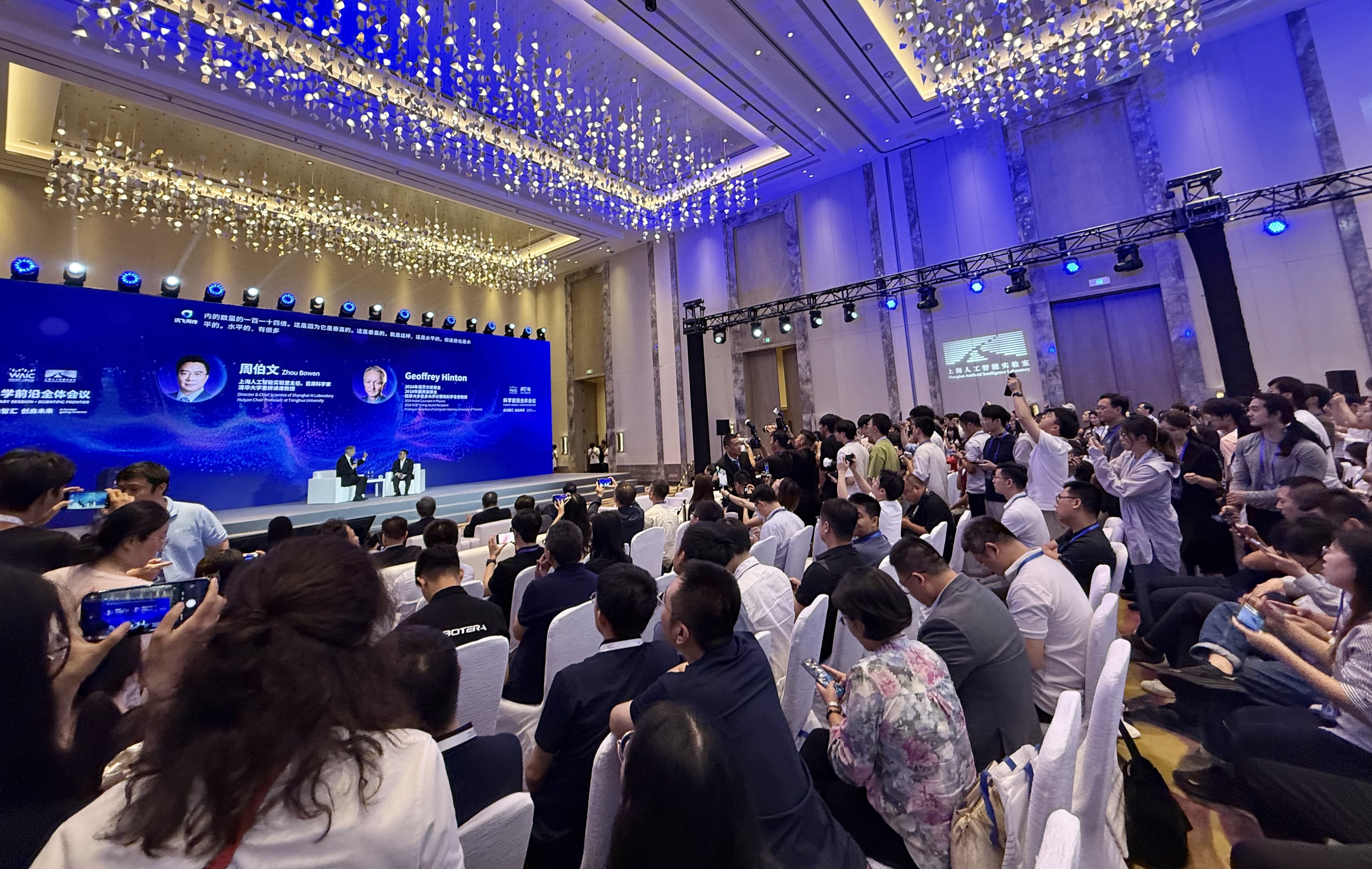
Core Insights - The dialogue between Geoffrey Hinton and Zhou Bowen at the World Artificial Intelligence Conference highlighted the advancements in AI, particularly in multimodal models and their potential consciousness [1][4][5] - Hinton emphasized the importance of training AI to be both intelligent and kind, suggesting that different techniques are required for each aspect [6][7] Group 1: AI Consciousness and Learning - Hinton argues that current multimodal chatbots possess a form of consciousness, challenging traditional definitions of subjective experience [4][5] - He believes that intelligent agents can learn from their own experiences, potentially acquiring knowledge beyond human capabilities [6][7] Group 2: Training AI for Kindness - Hinton suggests that while it is possible to develop AI that is both smart and kind, the methodologies for achieving these traits differ significantly [6][7] - He advocates for international collaboration in sharing techniques that promote AI kindness, even if countries are reluctant to share methods for enhancing intelligence [6][7] Group 3: Advice for Young Scientists - Hinton encourages young researchers to explore areas where "everyone is wrong," as this can lead to significant breakthroughs [2][10] - He stresses the importance of perseverance in pursuing new ideas, even in the face of skepticism from mentors [2][10] Group 4: AI's Role in Scientific Advancement - Hinton acknowledges the clear benefits of AI in scientific research, citing examples like protein folding and weather prediction where AI has outperformed traditional methods [8][9] - He believes that AI will continue to drive progress across various scientific fields, enhancing predictive capabilities [8][9]
两位顶级科学家的17分钟对话:如何训练“善良”的AI
Di Yi Cai Jing· 2025-07-26 13:43
Core Insights - Geoffrey Hinton, a prominent figure in AI, expressed concerns about AI potentially surpassing human intelligence and emphasized the need for caution to avoid future risks [1][6] - Hinton highlighted the importance of developing technologies that ensure AI remains "kind" while also becoming smarter, indicating a need for research in this area [6][7] - He encouraged young researchers to explore unconventional fields where "everyone else is wrong," suggesting that breakthroughs often come from persistence in the face of skepticism [8] Group 1 - Hinton's speech at WAIC raised alarms about AI's capabilities and the necessity for humanity to be cautious [1] - During a dialogue with Zhou Bowen, Hinton discussed the concept of AI "consciousness" and the lack of measures to mitigate associated risks [6] - Hinton's participation in the International Dialogues on AI Safety led to the release of the "Shanghai Consensus" on AI safety, reflecting a collaborative effort among experts [6] Group 2 - Hinton noted the significant advancements in scientific research facilitated by AI, particularly in protein folding, showcasing the potential of AI in various scientific domains [7] - The average age of researchers at the Shanghai AI Lab is only 30, indicating that the future of AI is in the hands of the younger generation [7] - Hinton's advice to young scientists emphasizes the value of pursuing original research in overlooked areas, which can lead to significant breakthroughs [8]