多邻国语言学习课程

Search documents
AI+组合系列报告之四:AI+教育:ToC赛道领跑,突破“不可能三角”
Shenwan Hongyuan Securities· 2025-11-21 13:42
Group 1 - The core driving force behind the rapid growth of "AI + Education" comes from the resonance of policy, technology, and market factors. Policies since 2024 have emphasized the integration of AI technology into all aspects of education [2][5][8] - AI's core value in education lies in breaking the traditional "impossible triangle" of achieving scale, quality, and personalization simultaneously. AI can expand services at low cost while maintaining personalized and interactive teaching content [2][6][8] - Successful overseas examples, such as Duolingo, provide a replicable commercialization model for "AI + Education," demonstrating the dual potential of AI educational products in enhancing learning outcomes and achieving commercial monetization [2][15][16] Group 2 - The domestic "AI + Education" business model is primarily divided into To G, To B, and To C categories, each serving different scenarios and needs. The To G model focuses on educational equity and compliance governance, while To B aims to enhance teaching and management efficiency in schools, and To C directly targets students and parents [2][20][24] - The To G model emphasizes using AI to ensure educational fairness and compliance, with typical applications including "smart examination rooms" and "AI scoring systems." Companies deeply rooted in educational information technology are expected to have advantages in this area [2][24][25] - The To B model aims to improve internal teaching and management efficiency within schools. Traditional educational hardware companies are likely to dominate the "AI classroom" hardware segment, while publishing and media companies with close ties to teaching materials are expected to excel in "AI teaching assistant" software [2][26][27] Group 3 - The To C model focuses on providing highly personalized learning experiences directly to students and parents. Key product forms include "AI learning machines" and "AI tutoring" applications. Leading companies in the To C segment need to possess internet technology development capabilities to support real-time interaction and algorithm iteration [2][29][30] - Several listed companies have actively laid out in the To C "AI + Education" field, forming competitive product portfolios. For example, Visionox provides integrated AI teaching solutions through its "Xihuo" brand, while iFlytek has launched AI learning machines and smart blackboards based on self-developed large models [2][34][35] - Despite being in the early stages of development, "AI + Education" has vast application scenarios and strong future growth momentum. The industry still has room for improvement in technology integration depth and market penetration, but the speed of product adoption is expected to accelerate as costs decrease and user awareness increases [2][37]



硬控5亿人的多邻国沾上AI后,我果断卸载了
Hu Xiu· 2025-05-18 23:19
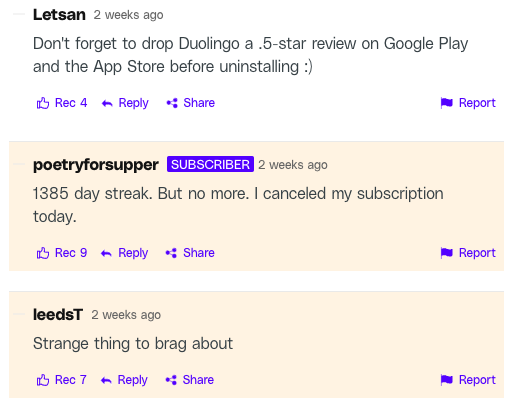
Group 1 - The core strategy of Duolingo is an "AI-first" approach, emphasizing the integration of AI in recruitment and operational processes, with CEO Luis von Ahn stating a preference for action over waiting for perfect technology [1][22][27] - Duolingo has launched 148 new language courses, significantly aided by generative AI in content development and testing, which allows for rapid course creation compared to previous timelines [28][29] - The introduction of features powered by GPT-4, such as "Explain My Answer" and "Roleplay," enhances user engagement and learning experience, showcasing a close partnership with OpenAI [9][13][14] Group 2 - Despite the advancements, user dissatisfaction arises from the perception that the "AI-first" strategy undermines human roles, leading to layoffs and reduced contractor reliance [22][23] - The company aims to not just optimize existing processes but to fundamentally reinvent them, reflecting a radical approach to automation and efficiency [25][27] - While the platform offers a variety of languages and engaging methods, users express concerns about the effectiveness of learning, indicating a gap between initial engagement and actual language mastery [31][32][49]