
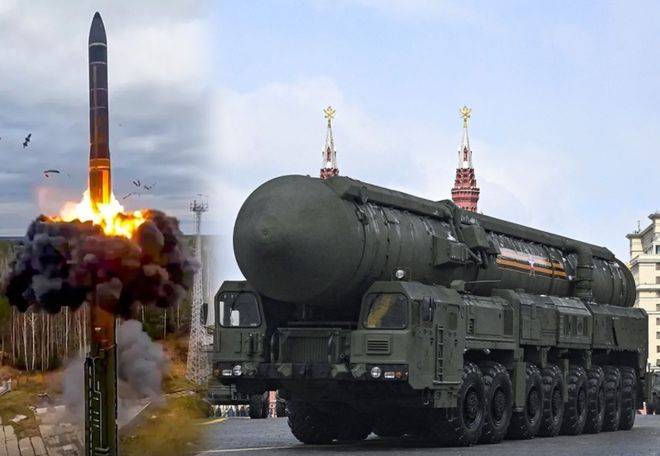
奥列什尼克高超音速导弹

Search documents
“榛树”让欧洲慌了,马克龙呼吁搞对等武器,否则欧洲将不再安全
Sou Hu Cai Jing· 2026-01-17 10:38
Core Insights - The recent launch of the "Oleshnik" hypersonic missile by Russia has raised significant concerns in Europe, particularly highlighted by French President Macron's call for accelerated development of new long-range weapons to counter this unprecedented threat [1][3] Group 1: Missile Capabilities and Impact - The "Oleshnik" missile, capable of reaching speeds of 13,000 km/h, successfully penetrated Ukraine's air defense systems and caused severe damage by melting concrete without conventional explosives [1] - The missile's operational range, which can cover most of Europe, and its speed of 10 to 12 Mach exceed current air defense capabilities, making interception nearly impossible [5] - The missile's combat mode utilizes inert warheads and can deploy multiple submunitions, allowing it to target strategic assets like underground bunkers and energy hubs, directly impacting Europe's energy supply [6] Group 2: European Response and Strategic Initiatives - Macron's "European Long-Range Strike Plan" (ELSA) aims to integrate the industrial and technological strengths of France, Germany, Poland, and other European nations to develop capabilities against hypersonic threats [3][9] - The urgency for this plan has increased due to the perceived threat from the "Oleshnik" missile, prompting European nations to prioritize breakthroughs in hypersonic technology [9][12] - Despite some initial advancements in hypersonic weapons, Europe faces significant challenges in catching up with Russia and China, necessitating a collaborative approach to weapon development [11][14] Group 3: Strategic Implications - The reliance on existing air defense systems is deemed insufficient, and Europe must achieve technological breakthroughs in long-range strike capabilities to maintain strategic credibility [9][16] - The ongoing hypersonic arms race highlights Europe's lagging position compared to Russia, emphasizing the need for immediate action to avoid a passive role in global security dynamics [14][16]

俄分析人士称若公投,大多数俄罗斯人会支持对欧洲和乌克兰核打击
Sou Hu Cai Jing· 2025-12-29 17:54
Group 1 - A Kremlin-loyal political analyst claimed that a majority of Russians would support nuclear strikes against Europe and Ukraine if a referendum were held, intensifying global alertness amid preliminary progress in U.S.-mediated peace talks [1][3] - The analyst, Sergey Mikhayev, described this extreme stance as reflecting the opinion of "most people" and urged efforts to instill fear of "disaster" to undermine the EU [1][3] - Mikhayev's statements align with the Russian state media's pattern of showcasing nuclear capabilities, with recent assessments indicating Moscow's advancement in deploying nuclear-capable hypersonic missiles in Belarus [3] Group 2 - Western and Ukrainian officials quickly condemned these remarks as provocative propaganda aimed at intimidation during a sensitive diplomatic period [5] - European leaders expressed renewed concern over reckless nuclear rhetoric, while security analysts noted that such broadcasts aim to prevent further aid to Kyiv and persuade the West that escalation would lead to global "disaster" [5] - Independent polling results starkly contrast Mikhayev's assertions, with a December survey showing only 25% of Russians supporting continued war, the lowest since 2022, and 66% favoring peace negotiations, the highest recorded [6]

委内瑞拉获强援,俄制武器挑起防空大梁
Zhong Guo Xin Wen Wang· 2025-11-06 16:48
Core Viewpoint - Russia is providing advanced air defense systems to Venezuela, which is seen as a strategic move to counter U.S. military pressure in the Caribbean region [1][2]. Group 1: Military Support and Equipment - Russia has confirmed the delivery of "Pantsir-S1" and "Buk-M2E" air defense systems to Venezuela via an Il-76 transport aircraft [1]. - The Il-76 flight path included stops in Armenia, Algeria, Morocco, Senegal, and Mauritania before arriving in Caracas on October 26 [1]. - The Russian Deputy Chairman of the Defense Committee stated that there are no obstacles to providing advanced weapons, including "Zircon" hypersonic missiles and "Kalibr" cruise missiles, to friendly nations like Venezuela [2]. Group 2: Venezuela's Military Capabilities - Venezuela's air force is significantly supported by Russian-made Su-30MK2 fighter jets and several battalions of S-300VM air defense systems, which protect key facilities [2]. - The Su-30MK2 has been modified for maritime strike capabilities and can carry Kh-31 supersonic missiles, which can target surface vessels over 100 kilometers away [2]. - Venezuela is reported to have around 20 Su-30MK2 aircraft and an unspecified number of Kh-31 missiles, which were recently showcased in military exercises [2]. Group 3: Defense Strategy - Venezuela has established a multi-layered air defense system around its capital, air bases, and industrial corridors, primarily using Russian-made air defense weapons [3]. - The core of Venezuela's air defense includes several S-300VM, "Buk-M2E", and "Pantsir-S1" systems, along with approximately 5,000 "Stinger-S" portable air defense missiles [3]. - The S-300VM can intercept aerial targets up to 250 kilometers away, while the "Buk-M2E" poses a threat to cruise missiles and aircraft within 45 kilometers [3].