武器装备制造

Search documents
瑞士强烈不满美国挪用军购资金
第一财经· 2026-03-27 05:37
Core Viewpoint - The article discusses the controversy surrounding the U.S. reallocating funds from Switzerland's purchase of F-35 fighter jets to other military procurement projects, leading to significant dissatisfaction within the Swiss Federal Assembly [3][5]. Group 1: U.S. Military Procurement Actions - The U.S. has redirected funds intended for Switzerland's F-35 fighter jet purchase to other military projects, causing a funding shortfall for the F-35 program [3]. - This action was prompted by Switzerland's decision to suspend payments for the "Patriot" air defense missile system, which was initially ordered in 2022 [5]. Group 2: Reactions from Swiss Officials - Swiss military procurement chief Urs Lörch expressed that the U.S. action has placed immense pressure on the Swiss Defense Ministry due to the funding gap for the F-35 project [3]. - Swiss People's Party Federal Assembly member Werner Salzmann criticized the U.S. move as "outrageous," suggesting that Switzerland should reconsider its military sales contracts with the U.S. [3]. - Swiss Social Democratic Party Federal Assembly member Priska Seiler Graf indicated a desire for Switzerland to avoid future arms purchases from the U.S. [4]. Group 3: Financial Details - Switzerland had previously paid 650 million Swiss francs (approximately 822 million USD) for five "Patriot" missile systems, with plans for delivery by 2028 [5]. - In the same year, Switzerland committed 60 billion Swiss francs (approximately 76 billion USD) for 36 F-35 fighter jets [5].


警惕!日本借反无人机发展激光武器
Xin Lang Cai Jing· 2026-02-23 22:47
Core Viewpoint - The Japanese government plans to revise three security-related documents within the year, focusing on strengthening air defense measures against drone attacks, influenced by the tactics observed in the Russia-Ukraine conflict [1]. Group 1: Air Defense Strategy - Japan's Self-Defense Forces currently rely on the domestically produced "Type 03 Medium-Range Surface-to-Air Missile" to intercept drones, but this system is limited in the number of targets it can engage simultaneously and is cost-inefficient when using expensive missiles against cheaper drones [3]. - The Self-Defense Forces are requesting the introduction of new air defense missiles and high-power laser weapons to adjust their strategy for intercepting drones [3]. Group 2: Development of Laser Weapons - The Japanese Ministry of Defense is developing high-power laser systems capable of shooting down small drones, with dedicated funding for research and testing included in recent defense budgets [3]. - In the fiscal year 2026 budget proposal, Japan allocated 1.3 billion yen (approximately 58 million RMB) for the development of high-power microwave weapons that can intercept multiple drones simultaneously [3]. Group 3: Testing and Implementation - A vehicle-mounted high-power laser demonstration system was showcased at the 2025 Japan Defense Exhibition, successfully shooting down small drones during tests conducted in February and March of the same year [3]. - A larger power laser weapon system, intended for installation on Japan's Maritime Self-Defense Force vessels, is currently in prototype testing, designed to combine multiple 10-kilowatt fiber lasers into a 100-kilowatt system capable of penetrating metal surfaces [4]. Group 4: Strategic Implications - The Ministry of Defense believes that high-power laser weapons could be a "game changer" on the battlefield due to their low operational costs, immediate response capabilities, and virtually unlimited ammunition capacity under sufficient power supply [5]. - Integrating such laser weapon systems into the Self-Defense Forces' operational framework indicates a shift towards more diversified and adaptable defense capabilities [5].
日本政府已开始讨论修订“防卫装备转移三原则”
Xin Lang Cai Jing· 2026-02-15 03:16
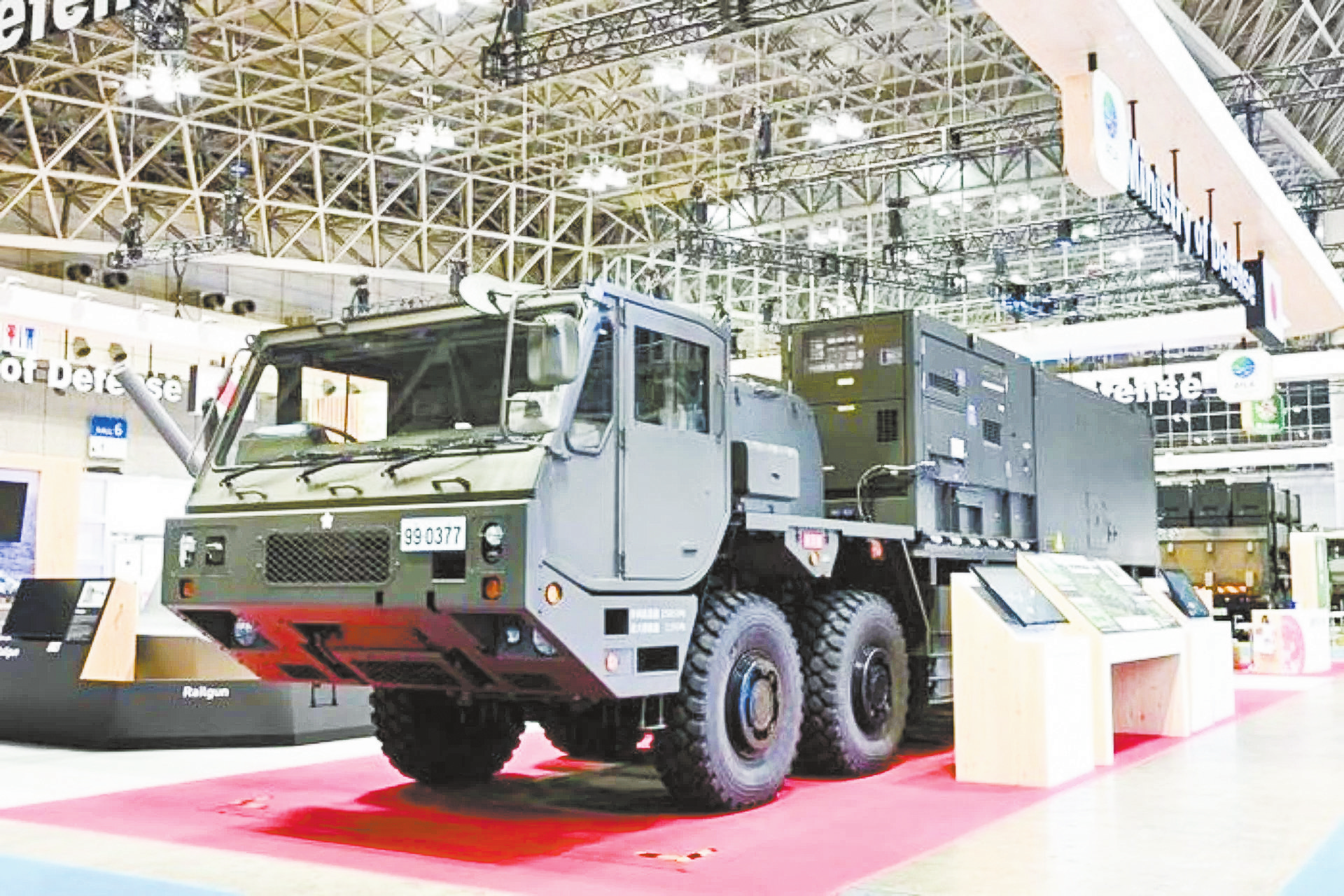
Core Viewpoint - The Japanese government and the Liberal Democratic Party (LDP) are discussing revisions to the "Three Principles on Transfer of Defense Equipment," aiming to expand the range of exportable defense equipment, which currently includes only five categories: rescue, transport, surveillance, and mine clearance [1] Group 1 - The current export categories are seen as a limitation to expanding defense equipment exports, prompting plans for a revision by spring 2026 [1] - The LDP's proposal includes the potential lifting of restrictions on the export of "weapons" as defined in the Self-Defense Forces Law, which encompasses high-lethality equipment such as tanks, frigates, and missiles [1] - If the five-category classification is abolished, lethal weapons will also become eligible for export [1]
从战火硝烟中走来,俄罗斯新一代武器亮相防务展
Xin Lang Cai Jing· 2026-02-10 11:50
Core Insights - Russia is showcasing a wide range of advanced military equipment at the 2026 Riyadh World Defense Exhibition, including new-generation weapons that are not even deployed in its own military [1] - The showcased Russian equipment features enhanced intelligence and information capabilities, drawing from valuable combat experience [2] Group 1: New Weaponry - The "Salma" guided rocket launcher has improved accuracy and mobility, with a weight reduction of over 20% and a speed increase of 40% compared to existing Russian rocket launchers [5] - The "Salma" can strike targets up to 120 kilometers away with a maximum precision of 7 meters, offering a cost-effective alternative to short-range tactical missiles [5] - The BTR-22 armored vehicle is designed to withstand 12.7mm armor-piercing rounds and 6 kg TNT blasts, featuring blast-absorbing seats for crew protection [6] Group 2: Advanced Defense Features - The BTR-22 can be equipped with a remote-controlled weapon station featuring a 30mm cannon and anti-tank missiles, allowing crew members to engage targets from within the vehicle [6] - The vehicle also includes additional protective measures against modern threats, such as drones, through enhanced armor and protective nets [6] Group 3: Autonomous Systems - Russia has introduced several new drones and loitering munitions capable of autonomous target detection and engagement [7] - The Rus-PE loitering munition can be operated by a single soldier, flying for 30 minutes and striking targets within a 70-kilometer range [8] - When deployed in swarms from containerized launchers, these munitions can execute saturation attacks, enhancing operational mobility [8]

2030亿美元打了水漂?中国软件算出的B-21“缺陷”到底是真是假?
Xin Lang Cai Jing· 2026-02-03 04:38
Core Viewpoint - The article discusses the potential flaws identified in the B-21 aircraft by a Chinese software analysis, questioning the validity of these claims and the implications for the $203 billion investment in the program [1] Group 1: Investment Implications - The B-21 program represents a significant financial commitment of $203 billion, raising concerns about the return on investment if the identified flaws are accurate [1] - The analysis suggests that if the defects are substantiated, it could lead to substantial financial losses and impact future defense spending [1] Group 2: Technical Analysis - The Chinese software reportedly identified specific defects in the B-21 design, prompting debates over the reliability and effectiveness of the aircraft [1] - The validity of the software's findings is under scrutiny, with experts divided on whether the identified issues are genuine or exaggerated [1] Group 3: Industry Impact - The discussion around the B-21's potential flaws could influence perceptions of U.S. military technology and its competitiveness in the global defense market [1] - If the defects are confirmed, it may lead to increased scrutiny of other defense projects and a reevaluation of military procurement strategies [1]


美军“秘密武器”其实不“神奇”
Xin Lang Cai Jing· 2026-02-01 17:15
Group 1 - The core of the article discusses the use of a "secret weapon" by the U.S. military during the operation to capture Venezuelan President Maduro and his wife, which reportedly incapacitated Venezuelan security forces and rendered their equipment ineffective [2][3]. - The weapon, referred to as a "disruptor," is claimed to be a unique technology that the U.S. possesses, which can cause physiological effects on enemies, such as bleeding and loss of mobility [3][4]. - Reports indicate that the U.S. military has been developing directed energy weapons, including microwave and sound wave technologies, which can incapacitate targets without causing permanent harm [5][6]. Group 2 - The U.S. Department of Defense has invested significantly in directed energy weapons, allocating approximately $1 billion annually for research and development in this area [6]. - Historical context shows that the research and application of sound wave weapons date back to World War II, with various countries exploring their potential for military use [8][9]. - Recent advancements in sound wave technology have led to the development of systems capable of causing temporary incapacitation, with various military powers, including the U.S., actively pursuing these technologies [10].
解放军报文章:日本全面解禁武器出口必将玩火自焚
Xin Lang Cai Jing· 2026-01-04 23:11
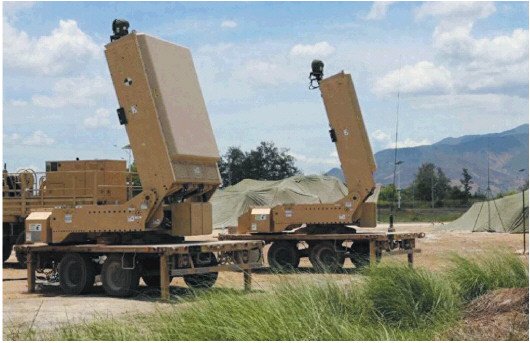
Core Viewpoint - Japan's Prime Minister Suga Yoshihide is pushing to lift restrictions on arms exports, which could lead to a significant increase in Japan's military exports and raise concerns about regional security [1][2]. Group 1: Policy Changes - The Japanese government plans to submit a motion in February 2026 to abolish the current five categories of arms export restrictions, effectively allowing for a comprehensive opening of arms exports, including potentially lethal equipment [1]. - Since 2014, Japan has gradually relaxed its arms export policies, transitioning from a strict "three principles" of arms exports to a more permissive "three principles of defense equipment transfer," which allows for various types of arms exports under certain conditions [1][2]. Group 2: Military Cooperation and Strategy - The current security policy emphasizes that the transfer of defense equipment is crucial for maintaining peace and stability in the Indo-Pacific region, and it aims to deter adversaries from altering the status quo through military means [2]. - Japan has signed defense equipment and technology transfer agreements with countries such as the U.S., U.K., Italy, Australia, and the Philippines, expanding its military cooperation network and enhancing its overseas military presence [2]. Group 3: Domestic and International Reactions - There is a growing concern among the Japanese public regarding the government's arms export policies, with protests emerging against Japan becoming a "merchant of weapons" [3]. - The government's strategy to expand arms exports is seen as a means to bolster domestic military-related industries and strengthen alliances, but it raises alarms about potential militarization and regional instability [3].
Iconic Cold War Weapons the U.S. Military Still Relies On Today
247Wallst· 2026-01-04 16:30
Core Viewpoint - The article discusses the continued reliance of the U.S. military on weapons developed during the Cold War, highlighting their adaptability to modern warfare despite the end of the Cold War over three decades ago [1] Group 1: Historical Context - The Cold War ended more than thirty years ago, yet many weapons designed for that era remain in active service within the U.S. military [1] - These weapons were originally intended for a superpower conflict that ultimately did not occur, leading to their adaptation for new forms of warfare [1] Group 2: Military Strategy - The ongoing use of these Cold War-era weapons underscores a fundamental principle of military power: effective weapons are retained regardless of their original purpose [1] - The article emphasizes that the adaptability of these systems reflects the evolving nature of military engagements and strategies [1]
金融时报:伊朗拟接受加密货币出售武器系统
Xin Lang Cai Jing· 2026-01-02 00:55
Core Viewpoint - Iran's Defense Export Center (Mindex) has proposed allowing cryptocurrency as a payment method for selling advanced weapon systems to foreign governments, including ballistic missiles, drones, and warships [1] Group 1: Company Overview - Mindex is a state-owned entity responsible for overseas military sales in Iran [1] - The organization claims to have customer relationships with 35 countries [1] Group 2: Payment Methods - Mindex is open to accepting barter and payments in Iranian rials in addition to cryptocurrency [1] - The official website of Mindex lists various types of weaponry and supports multiple languages [1] Group 3: Verification - The authenticity of Mindex's website has been verified through archived versions, registration information, and technical infrastructure reviews [1]
视频丨日本计划加速向他国供武 专家:欲隐蔽推动军事扩张
Yang Shi Xin Wen Ke Hu Duan· 2025-12-25 02:48
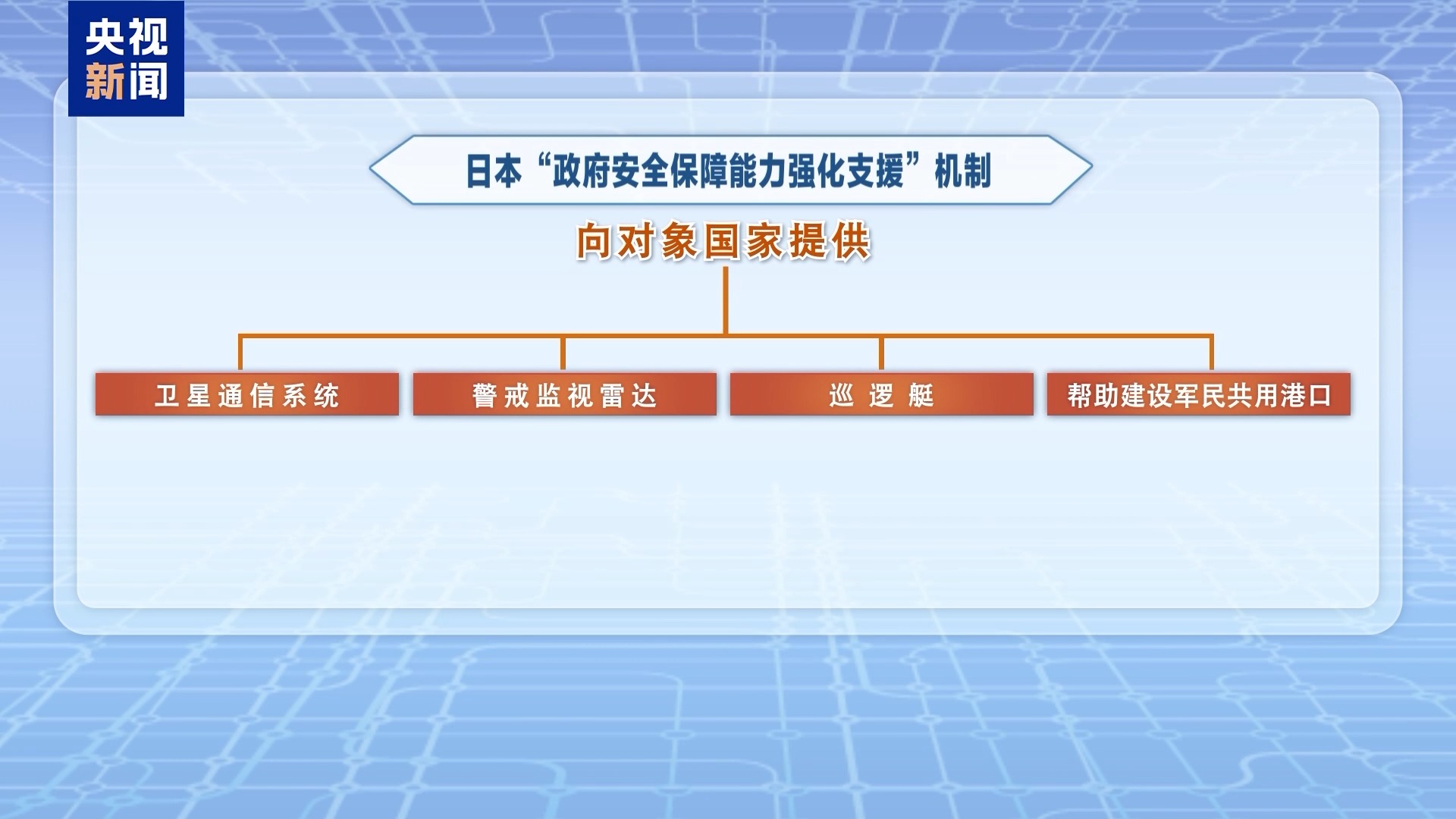
Core Viewpoint - Japan is significantly expanding its "Government Security Capability Enhancement Support" mechanism, with a budget increase to 18.1 billion yen (approximately 815 million RMB) for the fiscal year 2025, up from 8.1 billion yen in the previous year [2]. Group 1: Budget and Mechanism Expansion - The budget for the "Government Security Capability Enhancement Support" mechanism will reach 18.1 billion yen in fiscal year 2025, a substantial increase from 8.1 billion yen in fiscal year 2024 [2]. - The mechanism was established in April 2023 to support developing countries by providing non-lethal military equipment such as satellite communication systems, surveillance radars, and patrol boats [4]. - By the end of 2023, Japan has already provided significant support, including five coastal surveillance radars to the Philippines and four patrol boats to Bangladesh, totaling approximately 2 billion yen [6]. Group 2: Policy and Strategic Implications - Japan's government is pushing to relax restrictions on arms exports, which were previously limited to non-lethal equipment, indicating a shift towards broader military capabilities [11]. - The expansion of the support mechanism is seen as a strategic move to create a security cooperation network led by Japan, while also preparing the groundwork for potential future arms exports [13]. - This strategy allows Japan to enhance its military presence without directly violating its pacifist constitution, thereby increasing its intervention capabilities in potential conflicts [17].