宜品长高高儿童成长奶粉

Search documents
【民生调查局】“增高奶粉”市场乱象调查:多家品牌涉嫌虚假宣传
Zhong Guo Xin Wen Wang· 2025-11-22 09:37
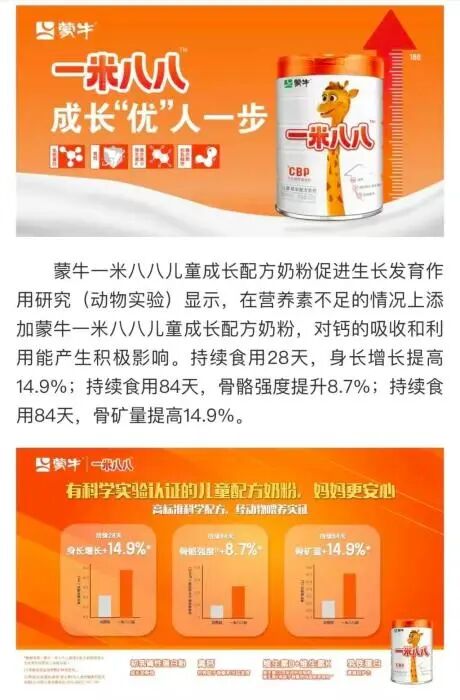
Core Viewpoint - The article highlights the marketing practices of various children's milk powder brands that exploit parents' height anxiety by making exaggerated claims about their products' ability to promote growth, raising concerns about misleading advertising and potential regulatory violations [1][2][6]. Group 1: Marketing Practices - Several brands, including Mengniu and Yipin, are promoting children's milk powder with claims such as "monthly growth of 2 cm" and "helping children grow taller" [1][6][14]. - Mengniu's "1.88m children's milk powder" has been criticized for suggesting that it can enhance children's height based on questionable research data [2][5]. - Other brands like Qigao and Beiyinmei also use similar marketing tactics, with slogans that imply height enhancement [12][14]. Group 2: Controversial Claims and Data - Mengniu's promotional claims were found to misquote a research report from the China Student Nutrition and Health Promotion Association, which denied the existence of the cited data [2][3]. - The article mentions that some claims, such as "14.9% growth in height over 28 days," are based on unpublished animal studies, raising questions about their validity [5][15]. - The use of "initial colostrum alkaline protein" (CBP) as a key ingredient is highlighted, but its effectiveness in promoting height is not scientifically substantiated [15][16]. Group 3: Regulatory Concerns - The marketing strategies of these brands may violate multiple laws, including the Food Safety Law and Advertising Law, as they imply health benefits that are not approved for regular food products [17][18]. - Previous cases, such as Abbott's penalties for similar misleading claims, indicate a pattern of regulatory scrutiny in this sector [17][18]. - Experts suggest that the industry should establish clearer standards for children's milk powder and enforce stricter regulations to prevent misleading marketing [19]. Group 4: Industry Dynamics - The high profit margins associated with children's milk powder, often priced significantly higher than regular milk powder, drive companies to adopt these aggressive marketing strategies [18][19]. - The children's milk powder market is seen as a new growth area, with expectations of reaching a scale of 50 billion yuan, prompting many brands to enter this competitive space [18][19]. - Analysts emphasize the need for scientific rigor in product claims to build long-term brand credibility and consumer trust [19].


人均1米9?“增高”奶粉收割家长
Zhong Guo Xin Wen Wang· 2025-11-22 09:12
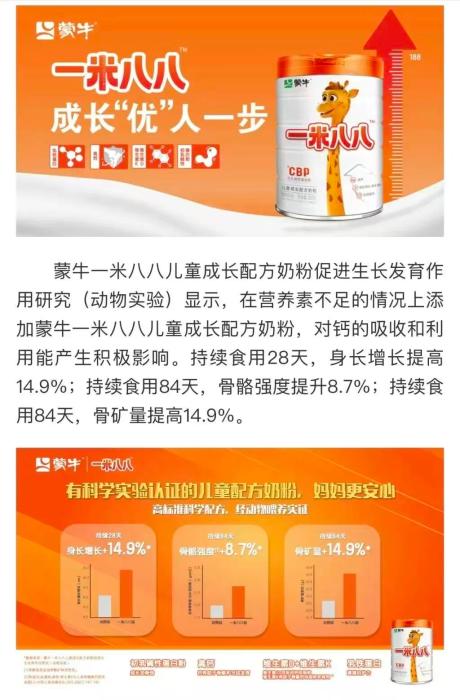
Core Viewpoint - The article highlights the controversial marketing practices of children's milk powder brands in China, particularly focusing on claims related to height growth, which are often misleading and lack scientific backing [1][2][17]. Group 1: Marketing Practices - Several brands, including Mengniu and Yipin, are promoting children's milk powder with claims such as "monthly height increase of 2 cm" and "support for tall growth," which are seen as exploiting parental height anxiety [1][7][13]. - Mengniu's "1.88m" children's milk powder has been accused of misrepresenting research data in its promotional materials, leading to public scrutiny [2][3]. - Other brands like Qigao and Original Gold also use similar height-related marketing strategies, with claims of significant height increases based on questionable research [10][11][13]. Group 2: Scientific Backing and Regulatory Concerns - The research cited by Mengniu regarding height growth was found to be misquoted, with the original report denying the claims made in the marketing [2][3][15]. - The marketing claims often reference ingredients like colostrum alkaline protein (CBP), but the scientific basis for these claims is weak, with many studies being based on animal experiments rather than human trials [15][18]. - Legal experts suggest that these marketing practices may violate multiple laws, including the Food Safety Law and Advertising Law, as they imply health benefits that are not substantiated [16][18]. Group 3: Industry Dynamics - The children's milk powder market is experiencing a surge, with brands capitalizing on the high-profit margins associated with height-related claims, often pricing products significantly higher than regular milk powder [17][18]. - The market for children's milk powder is projected to reach 50 billion yuan, prompting many brands to enter this segment and compete on height-related marketing [17][18]. - Analysts emphasize the need for stricter regulations and standards for children's milk powder to ensure that marketing claims are scientifically validated and not misleading [18].