
宝马 7 系

Search documents
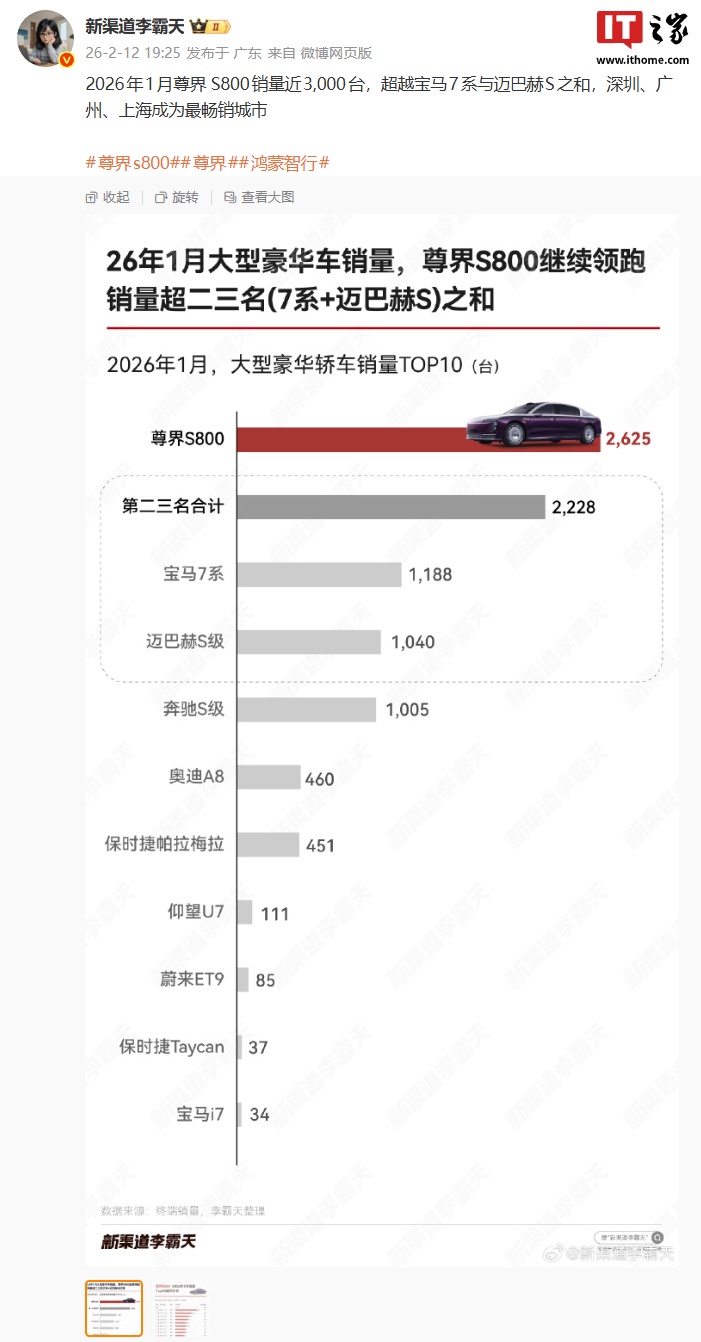
鸿蒙智行尊界 S800 轿车 1 月销量曝近 3000 台,消息称已超越宝马 7 系与迈巴赫 S 之和
Xin Lang Cai Jing· 2026-02-16 00:22
Core Insights - The Hongmeng Zhixing Zun Jie S800 luxury sedan achieved sales of nearly 3,000 units in January 2026, surpassing the combined sales of BMW 7 Series and Maybach S-Class, making it the top-selling large luxury sedan [1][3] - The vehicle is positioned as a "flagship of the era" with a price range of 708,000 to 1,018,000 yuan, and its sales in December reached 4,376 units, marking a month-on-month increase of approximately 104% [1][3] - Major cities for sales include Shenzhen, Guangzhou, and Shanghai, with Shenzhen leading at 213 units sold [3] Sales Performance - Total sales for January amounted to 2,625 units, with a significant increase in sales performance compared to previous months [3] - The Zun Jie S800's sales volume is reported to be nearly four times that of the Maybach S-Class, indicating strong market demand [1][3] Future Plans - Jiangqi Group's chairman, Xiang Xingchu, indicated plans to promote high-end versions of the Zun Jie S800 and to focus on high-quality mass production of subsequent models, including luxury MPVs and SUVs [4][5]

江淮汽车20260211
2026-02-11 15:40
Summary of the Conference Call for Jianghuai Automobile Company Overview - **Company**: Jianghuai Automobile - **Key Product**: ZunJie S800, a luxury sedan priced between 708,000 to 1,018,000 RMB, launched in May 2026 with significant market performance [2][3] Industry Insights - **Market Performance**: The ZunJie S800 has successfully captured market share from competitors such as BMW 7 Series, Audi A8, and Mercedes-Benz S-Class, leading to an increase in overall sales in the 700,000 to 1,000,000 RMB segment from approximately 3,000-4,000 units to over 8,000 units [2][3] - **Luxury MPV Market**: There is a notable lack of quality supply in the luxury MPV market, particularly for extended-range models. The penetration rate of new energy vehicles in the market above 600,000 RMB is only 21%, all of which are fully electric [6][7] Key Points and Arguments - **Customer Demographics**: The primary customers for the ZunJie S800 are high-net-worth males aged 40-50, with 80% being repeat buyers. These customers are less sensitive to price and prioritize comprehensive driving experiences [5] - **Sales Projections**: The company conservatively estimates monthly sales of 2,000 units for sedans and 5,000 units for the new hybrid luxury MPV, contributing an annual profit of between 2.3 billion to 5.18 billion RMB [2][9] - **Profitability Outlook**: Jianghuai Automobile expects to turn a profit by 2026, driven by reduced losses from Anhui Volkswagen and contributions from the ZunJie brand. Projected net profit for 2026 is 1.86 billion RMB, increasing to 7.51 billion RMB in 2027 [10][13] Future Product Launches - **Product Launch Timeline**: The ZunJie sedan series is currently at a peak delivery phase, with the MPV expected to launch in mid-2026 and achieve mass delivery by late summer [4][12] - **Sales Forecast**: The company anticipates selling 25,000 units each of sedans and MPVs in 2026, with total sales projected to reach 50,000 units. By 2027, total sales could approach 140,000 to 150,000 units [12] International Expansion - **Global Market Strategy**: Domestic high-end brands are increasingly expanding overseas, leveraging Jianghuai's established sales networks in over 132 markets and 1,200 service points to enhance profitability abroad [11] Financial Projections and Valuation - **Earnings Forecast**: The company is expected to achieve profitability in 2026, with a projected net profit of 1.86 billion RMB, and further growth to 7.51 billion RMB in 2027. The company is rated favorably based on comparable company PE ratios [13] - **R&D Impact**: R&D expenditures are expected to enhance per-vehicle profitability, with projected net profit per vehicle reaching approximately 50,000 RMB under stable conditions [14] Conclusion - Jianghuai Automobile is positioned for significant growth in the luxury vehicle market, with strong product offerings and a strategic focus on international expansion. The anticipated profitability turnaround and robust sales forecasts indicate a positive outlook for the company in the coming years.

豪车税收政策调整,国产新能源品牌如何“弯道超车”?
Haitong Securities International· 2025-07-20 12:28
Investment Rating - The report does not explicitly provide an investment rating for the automotive industry or specific companies within it. Core Insights - The adjustment of the ultra-luxury vehicle consumption tax aims to promote rational consumption and optimize the tax structure, with the threshold lowered from Rmb1.3 million to Rmb900,000, affecting both new energy vehicles (NEVs) and traditional luxury vehicles [1][9]. - The new tax policy is expected to significantly increase the purchase cost of ultra-luxury vehicles, dampening demand in the Rmb900,000–1.3 million price range, which accounted for only about 20,000 units sold in the first half of 2025 [2][10]. - Domestic NEV brands are presented with a historical opportunity to capture market share in the high-end segment, while imported brands like Porsche face significant challenges due to their reliance on models priced within the affected range [3][12]. Summary by Sections Tax Policy Changes - The consumption tax for ultra-luxury vehicles has been adjusted to include a 10% tax at the retail stage, while NEVs remain exempt from production-stage taxes, leading to a lower overall tax burden for NEVs compared to traditional fuel vehicles [2][11]. - Second-hand ultra-luxury vehicles are exempt from the consumption tax, which may stimulate the used car market and encourage consumers to opt for these vehicles to avoid new tax burdens [2][11]. Market Impact - The new tax policy is expected to further squeeze the market share of high-end imported brands, particularly Porsche, which saw a 49% year-on-year decline in sales in the first half of 2025 [3][12]. - Traditional luxury brands such as Mercedes-Benz and BMW are also anticipated to face pressure, with the pricing center for high-end NEVs expected to shift towards the Rmb500,000–600,000 range [3][12]. Strategic Adjustments - Imported brands must quickly adapt their strategies, either by reducing prices below Rmb900,000 or enhancing vehicle configurations to maintain competitiveness [4][13]. - Domestic brands, benefiting from tax exemptions, have more flexibility in pricing strategies, allowing them to mitigate the impact of the new tax policy through adjustments in vehicle configurations [4][14]. Fiscal Implications - The expansion of the tax base is projected to increase consumption tax revenue, helping to offset declines in ultra-luxury vehicle sales, with consumption tax revenue in the first five months of 2025 totaling Rmb772.9 billion, up 1.6% year-on-year [5][16]. - The policy encourages automakers to focus on the mid- to low-end NEV market, aligning with the trend of rising NEV price ceilings and discouraging blind expansion into the ultra-premium segment [5][16].