宠物芯片

Search documents
重磅!2025年中国及31省市宠物芯片行业政策汇总及解读(全) 宠物芯片从“试点”走向“规模化推广”
Qian Zhan Wang· 2026-02-24 02:09
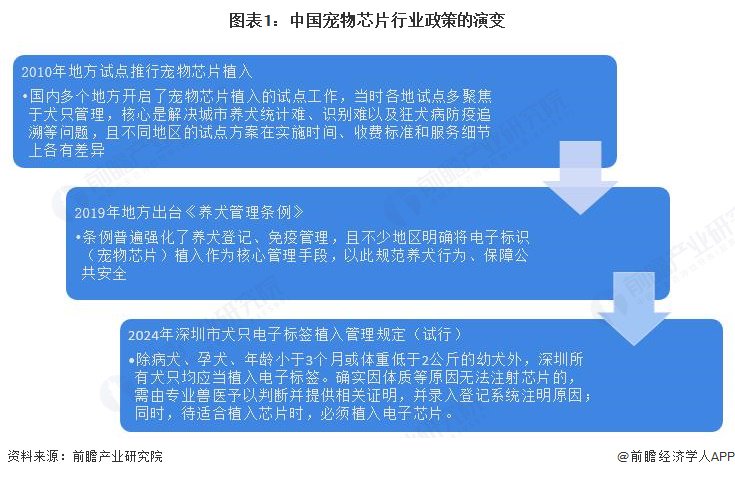
Core Viewpoint - The article discusses the development and regulatory landscape of the pet chip industry in China, highlighting the importance of pet chips for pet management and public safety, as well as the evolving policies at both national and local levels [1][5][7]. Policy Development Timeline - The pet chip industry in China began pilot programs in 2010, focusing on dog management to address issues like urban dog population statistics and rabies prevention. By 2019, many regions implemented dog management regulations that emphasized the use of electronic identification (pet chips) [3]. - In 2024, Shenzhen's regulations mandate that all dogs, except for certain exceptions, must be implanted with electronic tags, reinforcing the importance of pet chips in public safety and management [3][9]. National Policy Summary - Currently, there are no direct national policies specifically targeting the pet chip industry; it falls under the broader pet economy sector. However, relevant regulations include customs announcements that require pets to be microchipped for identification when entering the country [5][6]. - Key national policies include the "Pet Feed Labeling Regulations" and "Pet Feed Hygiene Regulations," which aim to standardize pet food labeling and hygiene standards [6]. Local Policy Summary - Several provinces, including Shandong, Guangdong, Chongqing, Fujian, and Guizhou, have implemented mandatory pet chip implantation policies. For instance, Shandong's regulations require all registered dogs to have electronic chips as identification [7][9]. - Guangdong's regulations specify that all dogs must be microchipped and registered, with detailed management protocols established for pet ownership [9][10]. Development Goals - The regulations aim to standardize dog management, ensure public health and safety, and maintain social order. Local governments are actively promoting the pet chip industry to enhance pet management practices [12][13].



2025年全球宠物芯片行业现状分析:至2030年市场规模超105亿元【组图】
Qian Zhan Wang· 2026-02-09 04:09
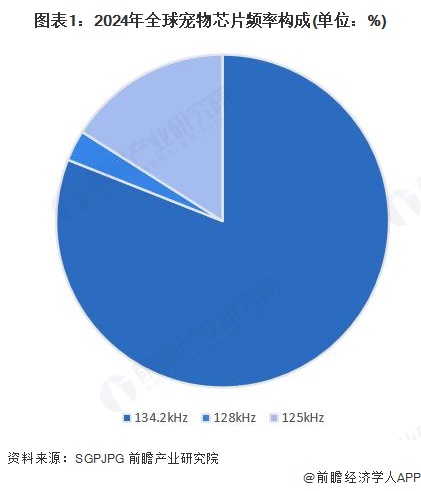
Core Insights - The global pet chip market is experiencing significant growth, driven by increasing demand for pet identification and recovery solutions, with a projected market size of approximately 4.6 billion yuan in 2024 and expected to exceed 10.5 billion yuan by 2030 [7][10]. Group 1: Global Pet Chip Frequency Composition - The frequency composition of global pet chips is highly concentrated, with 134.2 kHz being the dominant frequency, accounting for 81% of the market, followed by 125 kHz at 16%, and 128 kHz at only 3% [1]. Group 2: Global Pet Chip Implantation Rate - North America leads in pet chip implantation rates at 80%, attributed to a mature pet management system and legislative requirements for chip implantation, while China has a low rate of less than 5% due to the absence of national mandates and awareness issues among pet owners [3]. Group 3: Proportion of Implanted Chips in Dogs vs. Cats - Globally, the proportion of implanted chips in dogs is generally higher than in cats, with dogs making up 90% of implanted pets in China, compared to only 10% for cats. This disparity is influenced by pet management regulations and the activity levels of different pet types [6]. Group 4: Global Pet Chip Market Size - The global pet chip market is projected to reach approximately 4.6 billion yuan by 2024, driven by regulatory changes and increased awareness among pet owners regarding the benefits of chip implantation [7]. Group 5: Future Market Size Forecast - The global pet chip market is expected to grow rapidly from 2025 to 2030, with a compound annual growth rate (CAGR) of 15%, leading to a market size exceeding 10.5 billion yuan by 2030 [10].
【干货】宠物芯片产业链全景梳理及区域热力地图
Qian Zhan Wang· 2026-01-29 03:08
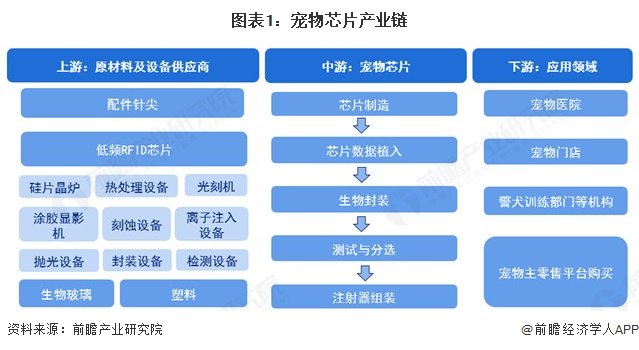
Core Insights - The pet chip industry is experiencing significant growth, driven by advancements in technology and increasing demand for pet identification and health management solutions [2][3][6]. Industry Overview - The pet chip industry chain consists of three main segments: upstream (core materials and high-end equipment suppliers), midstream (chip manufacturing and packaging), and downstream (application and sales terminals) [2][3]. - Upstream suppliers include companies providing low-frequency RFID chips, bioglass, and essential manufacturing equipment [3]. - Midstream focuses on chip manufacturing, data implantation, biological packaging, testing, and assembly, ensuring compliance with medical standards [2][3]. - Downstream applications are primarily through pet hospitals, pet stores, and online platforms, completing the product usage cycle [2][3]. Regional Distribution - The majority of pet chip industry enterprises are concentrated in Guangdong Province, followed by Jiangsu and Shandong [6][8]. - Guangdong is recognized as a pioneer in pet chip promotion, having implemented mandatory chip implantation regulations since 2021 [6]. Key Companies and Developments - Notable companies in the industry include CAINA, CANNA MEDICAL, and 威高股份, which provide essential materials and components [3][8]. - Recent developments include advancements in RFID technology for livestock management, which can be adapted for pet chip applications [13]. - Companies like 瑞值创物联科技 are innovating with implantable animal electronic chips and management systems that integrate RFID technology for comprehensive lifecycle management [13].